Asking the Chef a Question
Eine Frage an die Köchin stellen
Emma asks Grace how to make the sauce less salty. Grace suggests adding a little water and tasting it again.
Emma fragt Grace, wie sie die Soße weniger salzig machen kann. Grace schlägt vor, etwas Wasser hinzuzugeben und die Soße noch einmal zu probieren.
Dialog8
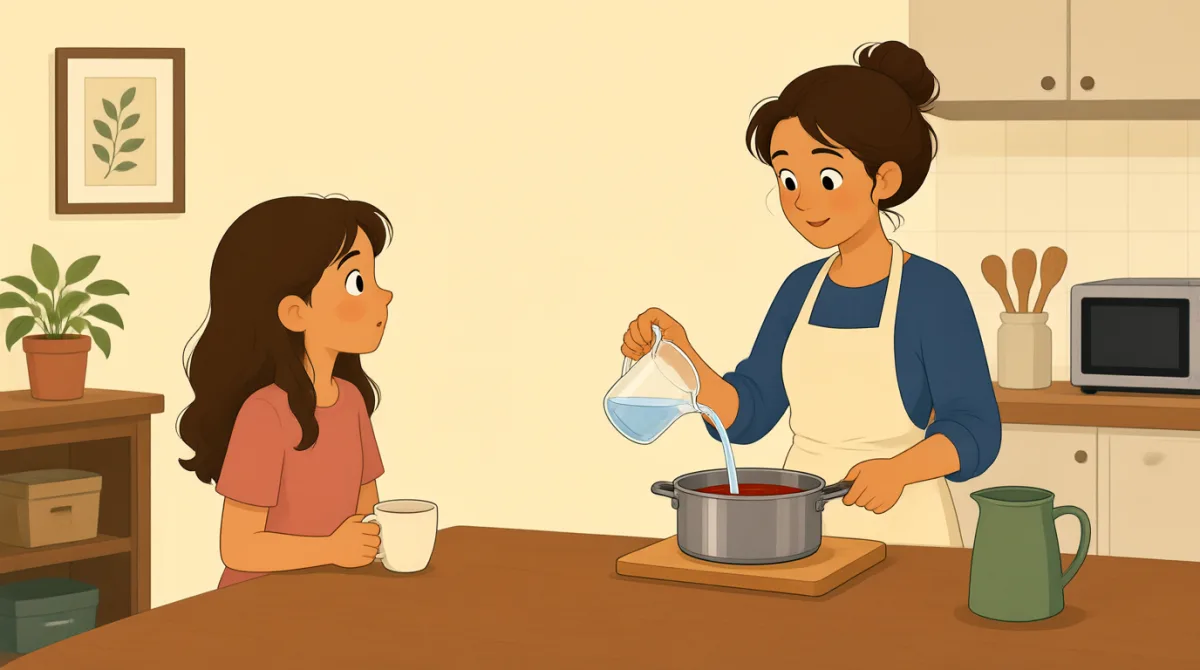

Grace, I think the sauce is too salty. Can I fix it?
Grace, ich finde, die Soße ist zu salzig. Kann ich das noch retten?

Yes. Add a little water, and then stir it well.
Ja. Gib etwas Wasser dazu und rühr die Soße dann gut um.
Should I add the water now, while it’s still hot?
Soll ich das Wasser jetzt dazugeben, solange die Soße noch heiß ist?
Yes, that’s fine. Add just a little at first.
Ja, das ist in Ordnung. Gib erst mal nur ein bisschen dazu.
Okay, I added some. Should I taste it again?
Okay, ich habe etwas dazugegeben. Soll ich sie noch mal probieren?
Yes, use a clean spoon and taste it carefully.
Ja, nimm einen sauberen Löffel und probier sie vorsichtig.
It tastes much better now. Should I add more water?
Jetzt schmeckt sie viel besser. Soll ich noch mehr Wasser dazugeben?
No, it’s good now. A little water made a big difference.
Nein, jetzt ist sie gut. Ein bisschen Wasser hat einen großen Unterschied gemacht.
Wortschatz7
- too saltyzu salzig
This means the sauce has more salt than you want. You can use “too” before an adjective to say something is more than you like.
Das bedeutet, dass mehr Salz in der Soße ist, als du möchtest. Mit „too“ vor einem Adjektiv sagst du, dass etwas mehr ist, als dir lieb ist.
- fix itdas noch retten
Here, this means to make the sauce taste better. You can use “fix it” when you want to correct a problem.
Hier bedeutet das, den Geschmack der Soße zu verbessern. „Fix it“ kannst du sagen, wenn du ein Problem beheben möchtest.
- stir it wellgut umrühren
This means to mix the sauce thoroughly with a spoon. You can say “stir it well” when giving someone a cooking instruction.
Das bedeutet, die Soße gründlich mit einem Löffel zu verrühren. „Stir it well“ kannst du sagen, wenn du jemandem eine Anweisung beim Kochen gibst.
- at firsterst mal
This means at the beginning. Here, Grace says to add only a small amount of water at the beginning.
Das bedeutet „am Anfang“. Hier sagt Grace, dass Emma zu Beginn nur eine kleine Menge Wasser hinzugeben soll.
- taste it againnoch einmal probieren
This means to try the sauce once more to check its flavor. You can use this phrase after changing or adding something to food.
Das bedeutet, die Soße noch einmal zu probieren, um zu prüfen, wie sie schmeckt. Diesen Ausdruck kannst du verwenden, nachdem du etwas am Essen verändert oder etwas hinzugegeben hast.
- a clean spoonein sauberer Löffel
This means a spoon that has been washed and is ready to use. It is useful advice when tasting food while cooking.
Das ist ein gewaschener Löffel, den du benutzen kannst. Dieser Tipp ist praktisch, wenn du beim Kochen etwas probierst.
- made a big differencehat einen großen Unterschied gemacht
This means caused a noticeable change. You can use it to describe how a small action improved a situation.
Das bedeutet, dass etwas eine deutliche Veränderung bewirkt hat. Damit kannst du beschreiben, wie eine kleine Handlung eine Situation verbessert hat.
Wichtige Sätze7
- 1
I think the sauce is too salty.
Ich finde, die Soße ist zu salzig.
Use this sentence to describe a problem with food. You can replace “the sauce” and “too salty” to talk about other dishes or problems.
Mit diesem Satz kannst du ein Problem mit dem Essen beschreiben. Du kannst „the sauce“ und „too salty“ ersetzen, um über andere Gerichte oder Probleme zu sprechen.
- 2
Can I fix it?
Kann ich das noch retten?
This is a simple way to ask if you can correct a problem. You can use “Can I fix it?” in many everyday situations.
So kannst du einfach fragen, ob du ein Problem beheben kannst. „Can I fix it?“ kannst du in vielen Alltagssituationen verwenden.
- 3
Add a little water, and then stir it well.
Gib etwas Wasser dazu und rühr die Soße dann gut um.
This gives two clear cooking instructions in order. You can use “Add a little [ingredient], and then stir it well” for other recipes.
Dieser Satz enthält zwei klare Anweisungen fürs Kochen, und zwar in der richtigen Reihenfolge. Für andere Rezepte kannst du „Add a little [ingredient], and then stir it well“ verwenden.
- 4
Should I add the water now, while it’s still hot?
Soll ich das Wasser jetzt dazugeben, solange die Soße noch heiß ist?
Use this question to ask if it is the right time to do something. You can replace “add the water” with another action.
Mit dieser Frage kannst du dich erkundigen, ob gerade der richtige Zeitpunkt für etwas ist. Du kannst „add the water“ durch eine andere Handlung ersetzen.
- 5
Should I taste it again?
Soll ich sie noch mal probieren?
This is a useful way to check what to do next while cooking. You can use “Should I [action] again?” to ask for advice.
Mit dieser nützlichen Frage kannst du beim Kochen herausfinden, was du als Nächstes tun sollst. Mit „Should I [action] again?“ kannst du um Rat bitten.
- 6
Yes, use a clean spoon and taste it carefully.
Ja, nimm einen sauberen Löffel und probier sie vorsichtig.
This sentence gives practical advice for tasting food safely. You can use “Use a clean [item] and [action] carefully” to give similar instructions.
Dieser Satz gibt einen praktischen Tipp, wie du Essen sicher probieren kannst. Mit „Use a clean [item] and [action] carefully“ kannst du ähnliche Anweisungen geben.
- 7
A little water made a big difference.
Ein bisschen Wasser hat einen großen Unterschied gemacht.
Use this sentence to say that a small change had a noticeable effect. You can replace “water” with another thing that helped.
Mit diesem Satz sagst du, dass eine kleine Veränderung eine deutliche Wirkung hatte. Du kannst „water“ durch etwas anderes ersetzen, das geholfen hat.