Choosing a Trail
Einen Wanderweg auswählen
Emma and Jack look at the trail map and choose a route that fits their time and experience. They pack water and a few snacks before setting off.
Emma und Jack schauen sich die Wanderkarte an und wählen eine Route, die zu ihrer verfügbaren Zeit und ihrer Erfahrung passt. Bevor sie losgehen, packen sie Wasser und ein paar Snacks ein.
Dialog8
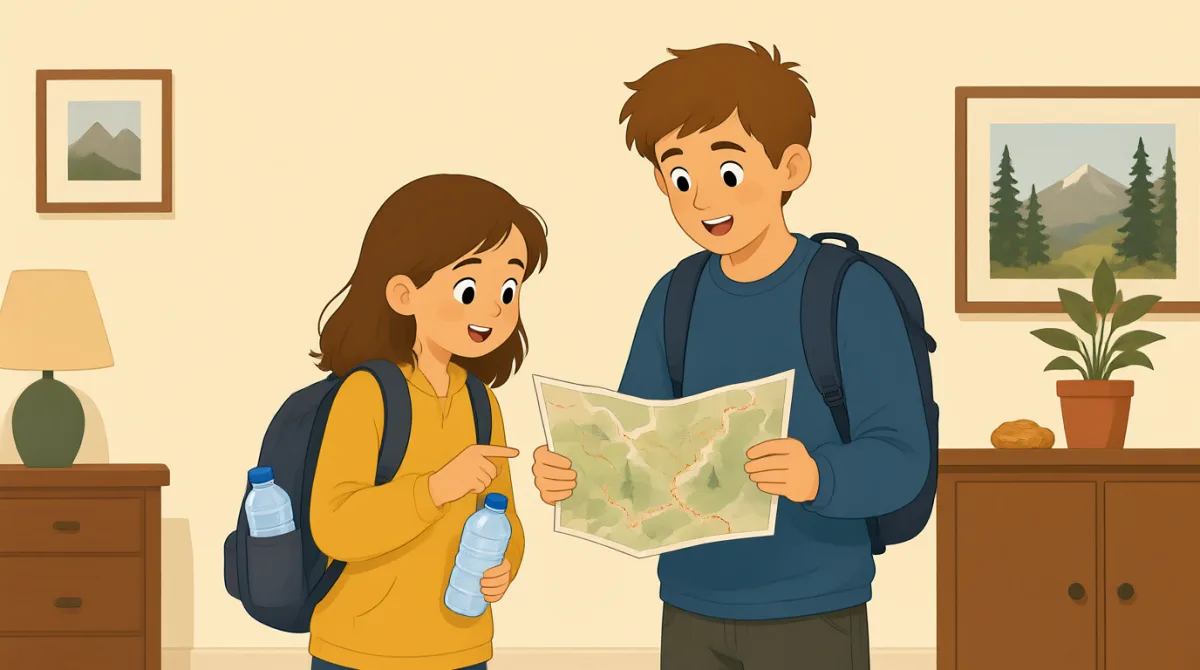

Jack, how much time do we have for the hike?
Jack, wie viel Zeit haben wir für die Wanderung?

About two hours. Let's check the trail map before we choose.
Ungefähr zwei Stunden. Lass uns erst die Wanderkarte anschauen, bevor wir uns entscheiden.
This loop is four miles. Is that too far for us?
Diese Rundtour ist vier Meilen lang. Ist das zu weit für uns?
It looks a little hard, and it may take three hours.
Sie sieht ein bisschen schwierig aus und könnte drei Stunden dauern.
What about the shorter trail? It says one and a half miles.
Wie wäre es mit dem kürzeren Wanderweg? Hier steht, dass er anderthalb Meilen lang ist.
That sounds good. It should take about an hour, and the view looks nice.
Das klingt gut. Er sollte ungefähr eine Stunde dauern, und die Aussicht sieht schön aus.
Great! I'll pack water and some snacks. Do you have the map?
Super! Ich packe Wasser und ein paar Snacks ein. Hast du die Karte?
Yes. I've got the map. Let's pack up and set off.
Ja, ich hab die Karte. Lass uns unsere Sachen packen und losgehen.
Wortschatz6
- trail mapWanderkarte
A map that shows paths in a natural area. You can check it to choose a route.
Eine Karte, auf der Wege in einem Naturgebiet eingezeichnet sind. Du kannst sie dir anschauen, um eine Route auszuwählen.
- loopRundweg
A route that goes around and returns to where it started. You can use “loop” when talking about a walking or hiking path.
Eine Route, die im Kreis verläuft und wieder zum Ausgangspunkt zurückführt. „loop“ kannst du für einen Spazier- oder Wanderweg verwenden.
- a little hardein bisschen schwierig
Somewhat difficult. Use “a little” before an adjective to describe something as slightly difficult or different.
Das bedeutet, dass etwas etwas schwierig ist. Mit „a little“ vor einem Adjektiv beschreibst du, dass etwas leicht schwierig ist oder sich ein wenig unterscheidet.
- shorter trailkürzerer Wanderweg
A trail that is not as long as another one. Use “shorter” to compare the lengths of two routes.
Ein Wanderweg, der nicht so lang ist wie ein anderer. Mit „shorter“ vergleichst du die Länge von zwei Routen.
- pack waterWasser einpacken
To put water in your bag to take with you. You can use “pack” with other things you need for a trip, like snacks or clothes.
Wasser in die Tasche packen, damit du es mitnehmen kannst. „pack“ kannst du auch mit anderen Dingen verwenden, die du für einen Ausflug brauchst, zum Beispiel Snacks oder Kleidung.
- set offlosgehen
To begin a journey or trip. You can say “set off” when you start walking, driving, or traveling.
Eine Reise oder einen Ausflug beginnen. „set off“ kannst du sagen, wenn du zu Fuß, mit dem Auto oder auf andere Weise losfährst.
Wichtige Sätze7
- 1
How much time do we have for the hike?
Wie viel Zeit haben wir für die Wanderung?
This is a useful way to ask how much time is available for an activity. You can replace “the hike” with another event or task.
So kannst du fragen, wie viel Zeit für eine Aktivität zur Verfügung steht. Du kannst „the hike“ durch eine andere Veranstaltung oder Aufgabe ersetzen.
- 2
Let's check the trail map before we choose.
Lass uns erst die Wanderkarte anschauen, bevor wir uns entscheiden.
Use “Let’s” to suggest doing something together. You can replace “check the trail map” with another action and “choose” with a decision.
Mit „Let’s“ schlägst du vor, gemeinsam etwas zu tun. Du kannst „check the trail map“ durch eine andere Handlung und „choose“ durch eine Entscheidung ersetzen.
- 3
Is that too far for us?
Ist das zu weit für uns?
This is a simple way to ask whether something is beyond your group’s ability or comfort. You can replace “far” with an adjective like “hard” or “expensive.”
So kannst du einfach fragen, ob etwas für eure Gruppe zu anstrengend ist oder sich nicht gut anfühlt. Statt „far“ kannst du auch ein Adjektiv wie „hard“ oder „expensive“ verwenden.
- 4
It may take three hours.
Es könnte drei Stunden dauern.
Use “may” to say that something is possible but not certain. You can change the activity or the amount of time.
Mit „may“ sagst du, dass etwas möglich, aber nicht sicher ist. Du kannst die Aktivität oder die Zeitangabe ändern.
- 5
That sounds good.
Das klingt gut.
This is a friendly way to agree with an idea or plan. You can use it in everyday conversations when someone makes a suggestion.
So stimmst du auf freundliche Weise einer Idee oder einem Plan zu. Du kannst den Satz im Alltag verwenden, wenn jemand einen Vorschlag macht.
- 6
I'll pack water and some snacks.
Ich packe Wasser und ein paar Snacks ein.
Use “I’ll” to talk about a decision or plan you are making now. You can replace “water and some snacks” with other things you will bring.
Mit „I’ll“ sprichst du über eine Entscheidung oder einen Plan, den du gerade fasst. Du kannst „water and some snacks“ durch andere Dinge ersetzen, die du mitnehmen wirst.
- 7
Let's pack up and set off.
Lass uns unsere Sachen packen und losgehen.
This suggests getting your things ready and then starting a journey. You can use “Let’s” to invite someone to do both actions with you.
Damit schlägst du vor, eure Sachen fertig zu machen und anschließend aufzubrechen. Mit „Let’s“ kannst du jemanden einladen, beides gemeinsam mit dir zu tun.