Choosing a Trail
등산로 고르기
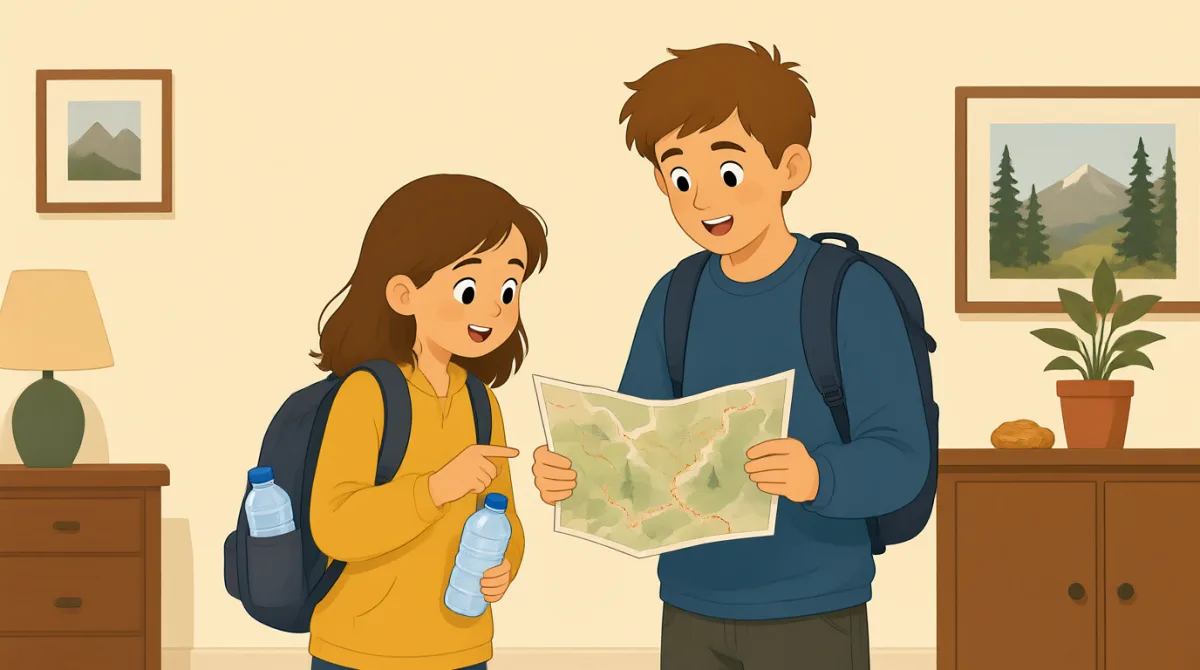
Emma and Jack look at the trail map and choose a route that fits their time and experience. They pack water and a few snacks before setting off.
에마와 잭은 등산로 지도를 살펴보고, 시간과 경험에 맞는 코스를 고른다. 출발하기 전에 물과 간식을 조금 챙긴다.
대화8

Jack, how much time do we have for the hike?
잭, 우리 등산할 시간 얼마나 있어?

About two hours. Let's check the trail map before we choose.
두 시간 정도. 고르기 전에 등산로 지도부터 확인하자.
This loop is four miles. Is that too far for us?
이 순환 코스는 4마일이네. 우리한테 너무 먼 거리일까?
It looks a little hard, and it may take three hours.
조금 힘들어 보이고, 세 시간쯤 걸릴 수도 있어.
What about the shorter trail? It says one and a half miles.
더 짧은 등산로는 어때? 1.5마일이라고 나와 있어.
That sounds good. It should take about an hour, and the view looks nice.
좋은데. 한 시간 정도 걸릴 것 같고, 경치도 좋아 보여.
Great! I'll pack water and some snacks. Do you have the map?
좋아! 내가 물이랑 간식을 좀 챙길게. 지도는 네가 갖고 있어?
Yes. I've got the map. Let's pack up and set off.
응, 지도는 내가 챙겼어. 짐 챙겨서 출발하자.
어휘6
- trail map등산로 지도
A map that shows paths in a natural area. You can check it to choose a route.
자연 지역의 길이 표시된 지도예요. 지도를 보고 어떤 코스로 갈지 정할 수 있어요.
- loop순환 코스
A route that goes around and returns to where it started. You can use “loop” when talking about a walking or hiking path.
한 바퀴 돌아 출발한 곳으로 다시 돌아오는 길이에요. 걷거나 등산하는 코스를 말할 때 “loop”라고 할 수 있어요.
- a little hard조금 힘든
Somewhat difficult. Use “a little” before an adjective to describe something as slightly difficult or different.
다소 어렵다는 뜻이에요. 형용사 앞에 “a little”을 붙이면 조금 어렵거나 다르다고 표현할 수 있어요.
- shorter trail더 짧은 등산로
A trail that is not as long as another one. Use “shorter” to compare the lengths of two routes.
다른 등산로보다 길이가 짧은 길이에요. 두 코스의 길이를 비교할 때 “shorter”를 사용해요.
- pack water물을 챙기다
To put water in your bag to take with you. You can use “pack” with other things you need for a trip, like snacks or clothes.
가져갈 물을 가방에 넣는다는 뜻이에요. 간식이나 옷처럼 여행에 필요한 다른 물건에도 “pack”을 쓸 수 있어요.
- set off출발하다
To begin a journey or trip. You can say “set off” when you start walking, driving, or traveling.
여행이나 이동을 시작한다는 뜻이에요. 걷거나 운전하거나 여행을 떠나기 시작할 때 “set off”라고 할 수 있어요.
핵심 문장7
- 1
How much time do we have for the hike?
우리 등산할 시간 얼마나 있어?
This is a useful way to ask how much time is available for an activity. You can replace “the hike” with another event or task.
어떤 활동에 쓸 수 있는 시간이 얼마나 되는지 물을 때 유용한 표현이에요. “the hike” 대신 다른 행사나 할 일을 넣어도 돼요.
- 2
Let's check the trail map before we choose.
고르기 전에 등산로 지도부터 확인하자.
Use “Let’s” to suggest doing something together. You can replace “check the trail map” with another action and “choose” with a decision.
“Let’s”는 함께 무엇을 하자고 제안할 때 써요. “check the trail map” 대신 다른 행동을, “choose” 대신 다른 결정을 넣어 말할 수 있어요.
- 3
Is that too far for us?
우리한테 너무 먼 거리일까?
This is a simple way to ask whether something is beyond your group’s ability or comfort. You can replace “far” with an adjective like “hard” or “expensive.”
무언가가 우리 일행의 능력이나 편안함에 비해 지나치지 않은지 물을 때 쓰는 간단한 표현이에요. “far” 대신 “hard”나 “expensive” 같은 형용사를 넣을 수도 있어요.
- 4
It may take three hours.
세 시간 걸릴 수도 있어.
Use “may” to say that something is possible but not certain. You can change the activity or the amount of time.
확실하지는 않지만 그럴 가능성이 있다고 말할 때 “may”를 써요. 활동이나 걸리는 시간을 바꿔서 응용할 수 있어요.
- 5
That sounds good.
좋은데.
This is a friendly way to agree with an idea or plan. You can use it in everyday conversations when someone makes a suggestion.
아이디어나 계획에 친근하게 동의할 때 쓰는 표현이에요. 누군가 제안했을 때 일상 대화에서 사용할 수 있어요.
- 6
I'll pack water and some snacks.
내가 물이랑 간식을 좀 챙길게.
Use “I’ll” to talk about a decision or plan you are making now. You can replace “water and some snacks” with other things you will bring.
“I’ll”은 지금 내리는 결정이나 계획을 말할 때 써요. “water and some snacks” 대신 가져갈 다른 물건을 넣을 수 있어요.
- 7
Let's pack up and set off.
짐 챙겨서 출발하자.
This suggests getting your things ready and then starting a journey. You can use “Let’s” to invite someone to do both actions with you.
물건을 챙긴 다음 길을 떠나자고 제안하는 표현이에요. “Let’s”를 써서 두 가지 행동을 함께 하자고 권할 수 있어요.