Getting the Flu Shot
Die Grippeimpfung bekommen
Grace gives Emma the flu shot and tells her what to do while she waits. Emma asks if it will hurt.
Grace impft Emma gegen Grippe und sagt ihr, was sie während der Wartezeit tun soll. Emma fragt, ob es wehtun wird.
Dialog9
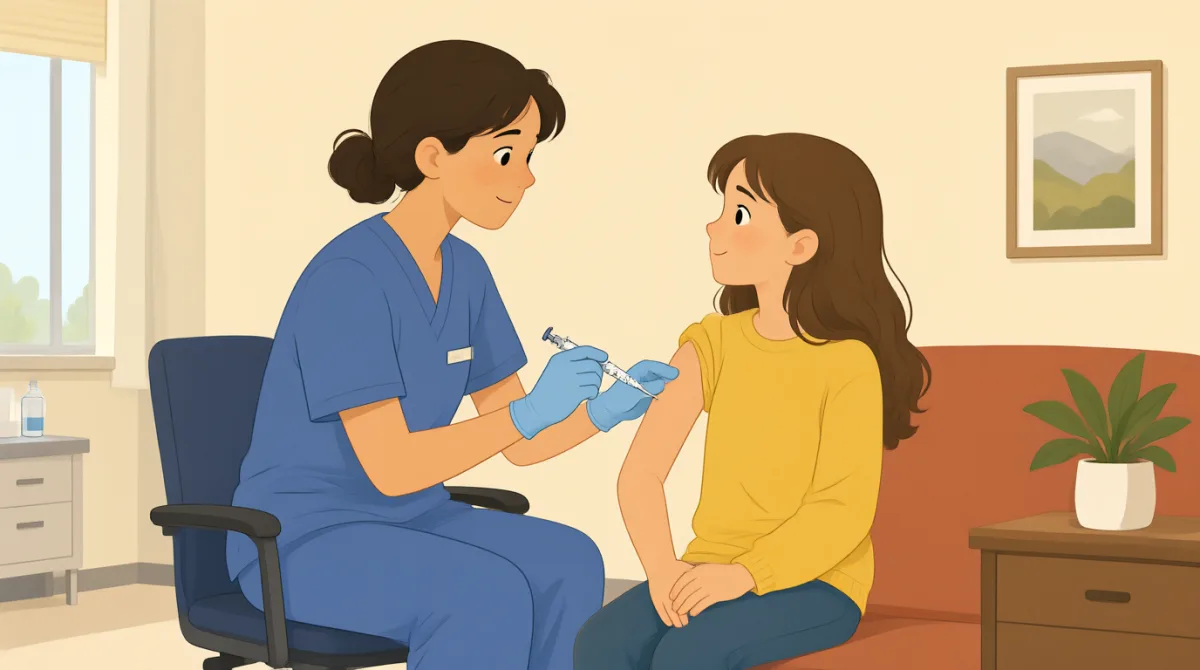

All right, Emma. Please sit here and roll up your sleeve.
Gut, Emma. Setzen Sie sich bitte hierhin und krempeln Sie den Ärmel hoch.

Okay. Will the shot hurt a lot?
Okay. Wird die Spritze sehr wehtun?
You may feel a quick pinch, but it will be over fast.
Vielleicht spüren Sie einen kurzen Pieks, aber es ist schnell vorbei.
All right. I'm ready. Should I keep my arm still?
Gut. Ich bin bereit. Soll ich meinen Arm ruhig halten?
Yes, just relax your arm. Take a slow breath in.
Ja, entspannen Sie einfach Ihren Arm. Atmen Sie langsam ein.
Okay... Is it done already?
Okay ... Sind wir schon fertig?
Yes, all done. Press this cotton on your arm for a moment.
Ja, schon fertig. Drücken Sie die Watte einen Moment lang auf Ihren Arm.
Thanks. What should I do while I wait?
Danke. Was soll ich tun, während ich warte?
Please wait here for fifteen minutes. Tell me if you feel unwell.
Warten Sie bitte fünfzehn Minuten hier. Sagen Sie mir Bescheid, wenn Sie sich unwohl fühlen.
Wortschatz8
- roll up your sleeveden Ärmel hochkrempeln
Pull your sleeve up so your arm is uncovered. You might hear this at a clinic or pharmacy before a shot.
Zieh deinen Ärmel hoch, damit dein Arm frei liegt. Das hörst du vielleicht in einer Arztpraxis oder Apotheke vor einer Spritze.
- hurt a lotsehr wehtun
This asks if something will cause a lot of pain. You can use “Will it hurt a lot?” when you are worried about an activity or treatment.
Damit fragst du, ob etwas starke Schmerzen verursacht. Wenn du dir wegen einer Behandlung oder Aktivität Sorgen machst, kannst du fragen: “Will it hurt a lot?” (Wird es sehr wehtun?)
- a quick pinchein kurzer Pieks
A quick pinch is a short, small feeling of pain, like the feeling of a shot.
Ein kurzer Pieks ist ein kurzer, leichter Schmerz, wie bei einer Spritze.
- keep my arm stillmeinen Arm ruhig halten
This means not moving your arm. You can use “keep [body part] still” when someone asks you to hold still.
Das bedeutet, den Arm nicht zu bewegen. Du kannst “keep [body part] still” sagen, wenn jemand einen Körperteil ruhig halten soll.
- take a slow breath inlangsam einatmen
This means to breathe in slowly. It is a useful instruction when someone wants you to relax.
Das bedeutet, langsam einzuatmen. Diese Anweisung ist hilfreich, wenn jemand sich entspannen soll.
- press this cotton on your armdiese Watte auf den Arm drücken
This means to hold the cotton against your arm. You may hear this after a shot to help with the small injection site.
Das bedeutet, die Watte auf den Arm zu drücken. Nach einer Spritze hörst du das vielleicht, damit du auf die kleine Einstichstelle drückst.
- while I waitwährend ich warte
This means during the time before something happens. You can use “while I wait” to ask what to do during a short wait.
Das bedeutet: in der Zeit, bevor etwas passiert. Mit “while I wait” kannst du fragen, was du während einer kurzen Wartezeit tun sollst.
- feel unwellsich unwohl fühlen
This means to feel sick or not feel well. You can use it to tell someone how you feel.
Das bedeutet, sich krank oder nicht gut zu fühlen. Du kannst damit jemandem sagen, wie es dir geht.
Wichtige Sätze8
- 1
Please sit here and roll up your sleeve.
Setzen Sie sich bitte hierhin und krempeln Sie den Ärmel hoch.
This is a polite way to give someone two simple instructions. You can use “Please sit here and…” in a clinic, office, or other place where someone needs to follow directions.
Das ist eine höfliche Art, jemandem zwei einfache Anweisungen zu geben. “Please sit here and…” kannst du in einer Arztpraxis, im Büro oder an einem anderen Ort verwenden, an dem jemand Anweisungen befolgen soll.
- 2
Will the shot hurt a lot?
Wird die Spritze sehr wehtun?
This is a useful question when you want to know if something will be painful. Replace “the shot” with another treatment or activity to ask about it.
Diese Frage ist nützlich, wenn du wissen möchtest, ob etwas schmerzhaft sein wird. Ersetze “the shot” durch eine andere Behandlung oder Aktivität, nach der du fragen möchtest.
- 3
You may feel a quick pinch, but it will be over fast.
Vielleicht spüren Sie einen kurzen Pieks, aber es ist schnell vorbei.
This sentence explains that there may be a little pain, but it will not last long. You can use “You may feel…, but…” to reassure someone about an experience.
Dieser Satz erklärt, dass etwas wehtun könnte, der Schmerz aber nicht lange anhält. Mit “You may feel…, but…” kannst du jemanden beruhigen und erklären, was ihn erwartet.
- 4
Should I keep my arm still?
Soll ich meinen Arm ruhig halten?
Use this question to check if you should avoid moving your arm. Replace “my arm” with another body part or object to ask what to keep still.
Mit dieser Frage kannst du nachfragen, ob du deinen Arm nicht bewegen sollst. Ersetze “my arm” durch einen anderen Körperteil oder Gegenstand, um zu fragen, was ruhig gehalten werden soll.
- 5
Take a slow breath in.
Atmen Sie langsam ein.
This is a simple instruction that can help someone relax. You can use it when someone feels nervous or needs to calm down.
Diese einfache Anweisung kann jemandem helfen, sich zu entspannen. Du kannst sie verwenden, wenn jemand nervös ist oder sich beruhigen muss.
- 6
Press this cotton on your arm for a moment.
Drücken Sie die Watte einen Moment lang auf Ihren Arm.
This tells someone what to do and how long to do it. Use “Press this [item] on…” to give a simple instruction.
Hier erfährt jemand, was er tun und wie lange er es tun soll. Mit “Press this [item] on…” kannst du eine einfache Anweisung geben.
- 7
Please wait here for fifteen minutes.
Warten Sie bitte fünfzehn Minuten hier.
This is a polite way to tell someone to stay in a place for a specific amount of time. Change “fifteen minutes” to give a different waiting time.
Das ist eine höfliche Art, jemandem zu sagen, dass er eine bestimmte Zeit an einem Ort bleiben soll. Ändere “fifteen minutes”, um eine andere Wartezeit anzugeben.
- 8
Tell me if you feel unwell.
Sagen Sie mir Bescheid, wenn Sie sich unwohl fühlen.
Use this sentence to ask someone to let you know if they start feeling sick. You can replace “unwell” with another feeling, such as “dizzy” or “tired.”
Mit diesem Satz bittest du jemanden, dir Bescheid zu sagen, falls er sich krank zu fühlen beginnt. Du kannst “unwell” durch ein anderes Gefühl ersetzen, zum Beispiel “dizzy” (schwindelig) oder “tired” (müde).