Bringing a Doctor's Note
Ein ärztliches Attest mitbringen
Emma returns to the office and gives Grace a doctor's note. Grace asks how Emma is feeling and welcomes her back.
Emma kommt zurück ins Büro und gibt Grace ein ärztliches Attest. Grace fragt, wie es Emma geht, und heißt sie willkommen zurück.
Dialog8
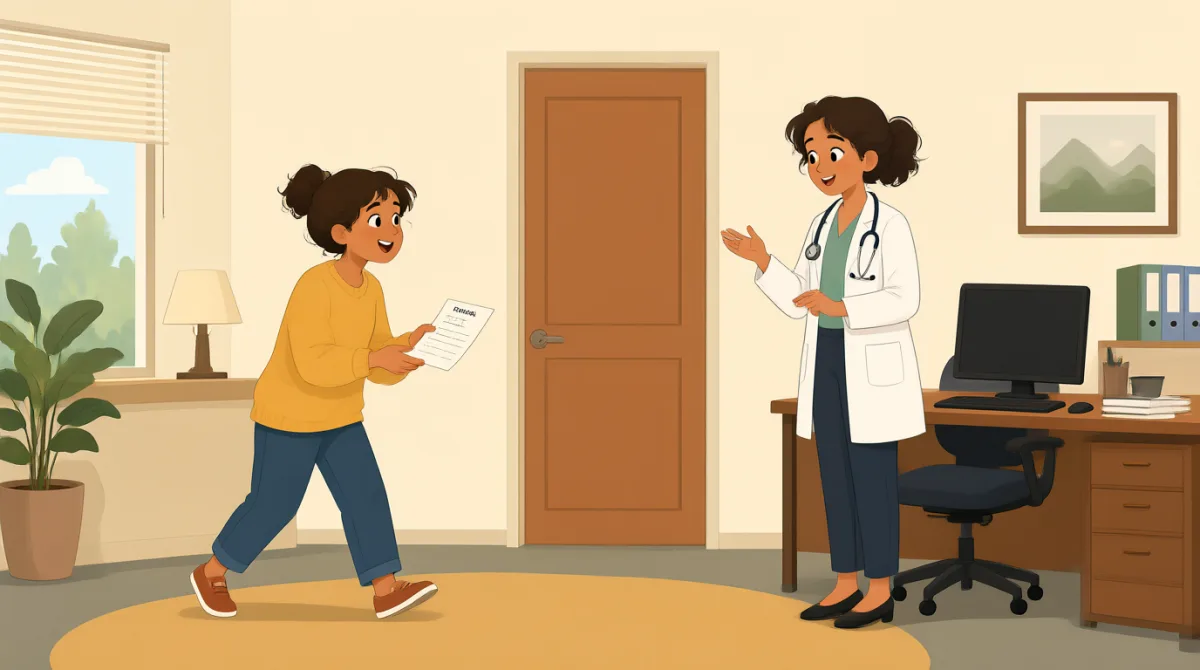

Hi, Grace. I’m back today, and I brought a note from my doctor.
Hallo, Grace. Ich bin heute wieder da und habe ein Attest von meinem Arzt mitgebracht.

Welcome back, Emma. How are you feeling now?
Willkommen zurück, Emma. Wie geht es dir jetzt?
Much better, thanks. I still feel a little tired, but I’m ready to work.
Viel besser, danke. Ich bin noch ein bisschen müde, aber bereit zu arbeiten.
I’m glad to hear that. Did your doctor say you could come back today?
Das freut mich. Hat dein Arzt gesagt, dass du heute wiederkommen kannst?
Yes, my doctor said I could return today. Here’s the note.
Ja, mein Arzt hat gesagt, dass ich heute wiederkommen kann. Hier ist das Attest.
Thanks. I’ll put it with your work papers. Take it easy today.
Danke. Ich lege es zu deinen Arbeitsunterlagen. Mach heute langsam.
I will. I’ll start with the important tasks and catch up slowly.
Mach ich. Ich fange mit den wichtigen Aufgaben an und hole nach und nach auf.
That sounds good. Let me know if you need a short break.
Das klingt gut. Sag Bescheid, wenn du eine kurze Pause brauchst.
Wortschatz8
- I’m back todayI’m back today
This means you have returned to work today after being away. You can also say, “I’m back” when you return to a place or activity.
Das bedeutet, dass du heute nach einer Abwesenheit wieder zur Arbeit gekommen bist. Du kannst auch „I’m back“ sagen, wenn du an einen Ort oder zu einer Aktivität zurückkehrst.
- a note from my doctora note from my doctor
This is a short document from a doctor, often explaining that someone was sick or can return to work. You can use “a note from my teacher” for a similar document from a teacher.
Das ist ein kurzes Dokument vom Arzt, in dem oft steht, dass jemand krank war oder wieder arbeiten kann. Für ein ähnliches Dokument von einer Lehrkraft kannst du „a note from my teacher“ sagen.
- How are you feeling now?How are you feeling now?
This is a kind way to ask about someone’s health. You can use it after someone has been sick or hurt.
Das ist eine nette Frage nach dem Gesundheitszustand einer Person. Du kannst sie stellen, nachdem jemand krank oder verletzt war.
- Much betterMuch better
This means you feel a lot better than before. You can use it to answer a question about how you feel.
Das bedeutet, dass du dich viel besser fühlst als vorher. Du kannst damit auf die Frage antworten, wie es dir geht.
- come back todaycome back today
Here, this means return to work today. You can use “come back” when someone returns to a place or activity.
Hier bedeutet das, heute wieder zur Arbeit zu kommen. „Come back“ kannst du verwenden, wenn jemand an einen Ort oder zu einer Aktivität zurückkehrt.
- put it with your work papersput it with your work papers
This means place the note together with the other work documents. “Put it with” is useful when telling someone where to place something.
Das bedeutet, das Attest zu den anderen Arbeitsunterlagen zu legen. „Put it with“ ist nützlich, wenn du jemandem sagst, wohin er etwas legen soll.
- Take it easy todayTake it easy today
This means do not work too hard or too quickly today. It is a friendly way to suggest that someone rest or work gently.
Das bedeutet, heute nicht zu hart oder zu schnell zu arbeiten. Es ist eine freundliche Empfehlung, sich auszuruhen oder es ruhig angehen zu lassen.
- catch up slowlycatch up slowly
This means do the work you missed little by little. You can use “catch up” when you need to finish work after being away.
Das bedeutet, die Arbeit, die du verpasst hast, nach und nach zu erledigen. „Catch up“ kannst du verwenden, wenn du nach einer Abwesenheit Arbeit nachholen musst.
Wichtige Sätze8
- 1
I’m back today, and I brought a note from my doctor.
Ich bin heute wieder da und habe ein Attest von meinem Arzt mitgebracht.
Use this sentence to tell someone you have returned and brought a doctor’s note. You can replace “a note from my doctor” with another item you brought.
Mit diesem Satz sagst du jemandem, dass du zurück bist und ein ärztliches Attest mitgebracht hast. Du kannst „a note from my doctor“ durch etwas anderes ersetzen, das du mitgebracht hast.
- 2
How are you feeling now?
Wie geht es dir jetzt?
This is a useful, caring question to ask about someone’s health. You can change “now” to “today” to ask how someone feels today.
Das ist eine hilfreiche und fürsorgliche Frage nach dem Gesundheitszustand einer Person. Du kannst „now“ durch „today“ ersetzen, um zu fragen, wie es jemandem heute geht.
- 3
I still feel a little tired, but I’m ready to work.
Ich bin noch ein bisschen müde, aber bereit zu arbeiten.
Use this to explain how you feel while saying you can work. You can replace “tired” with another feeling, such as “weak” or “better.”
Mit diesem Satz beschreibst du, wie du dich fühlst, und sagst gleichzeitig, dass du arbeiten kannst. Du kannst „tired“ durch ein anderes Gefühl ersetzen, zum Beispiel „weak“ oder „better“.
- 4
Did your doctor say you could come back today?
Hat dein Arzt gesagt, dass du heute wiederkommen kannst?
Use this question to check whether a doctor said someone could return to work. You can change “today” to another time, such as “tomorrow.”
Mit dieser Frage kannst du dich erkundigen, ob ein Arzt gesagt hat, dass jemand wieder arbeiten kann. Du kannst „today“ durch einen anderen Zeitpunkt ersetzen, zum Beispiel „tomorrow“.
- 5
Here’s the note.
Hier ist das Attest.
This is a simple way to hand someone a note or document. You can replace “the note” with another item, such as “the form” or “the receipt.”
So kannst du jemandem einfach ein Attest oder Dokument überreichen. Du kannst „the note“ durch etwas anderes ersetzen, zum Beispiel „the form“ oder „the receipt“.
- 6
Take it easy today.
Mach heute langsam.
Use this friendly phrase to tell someone not to work too hard. You can say it to someone who is sick, tired, or recovering.
Mit dieser freundlichen Wendung sagst du jemandem, dass er nicht zu hart arbeiten soll. Du kannst sie zu jemandem sagen, der krank oder müde ist oder sich gerade erholt.
- 7
I’ll start with the important tasks and catch up slowly.
Ich fange mit den wichtigen Aufgaben an und hole nach und nach auf.
Use this to explain how you will return to work after being away. You can replace “the important tasks” with the first things you need to do.
Mit diesem Satz erklärst du, wie du nach deiner Abwesenheit wieder in die Arbeit einsteigst. Du kannst „the important tasks“ durch die ersten Dinge ersetzen, die du erledigen musst.
- 8
Let me know if you need a short break.
Sag mir Bescheid, wenn du eine kurze Pause brauchst.
This is a kind way to offer help at work. You can replace “a short break” with something else the person might need.
So bietest du bei der Arbeit freundlich deine Hilfe an. Du kannst „a short break“ durch etwas anderes ersetzen, das die Person vielleicht braucht.