Asking Where You Are
Nach dem eigenen Standort fragen
Emma asks a station worker where they are. Jack listens and checks the station sign.
Emma fragt eine Mitarbeiterin am Bahnhof, wo sie sind. Jack hört zu und prüft das Stationsschild.
Dialog7
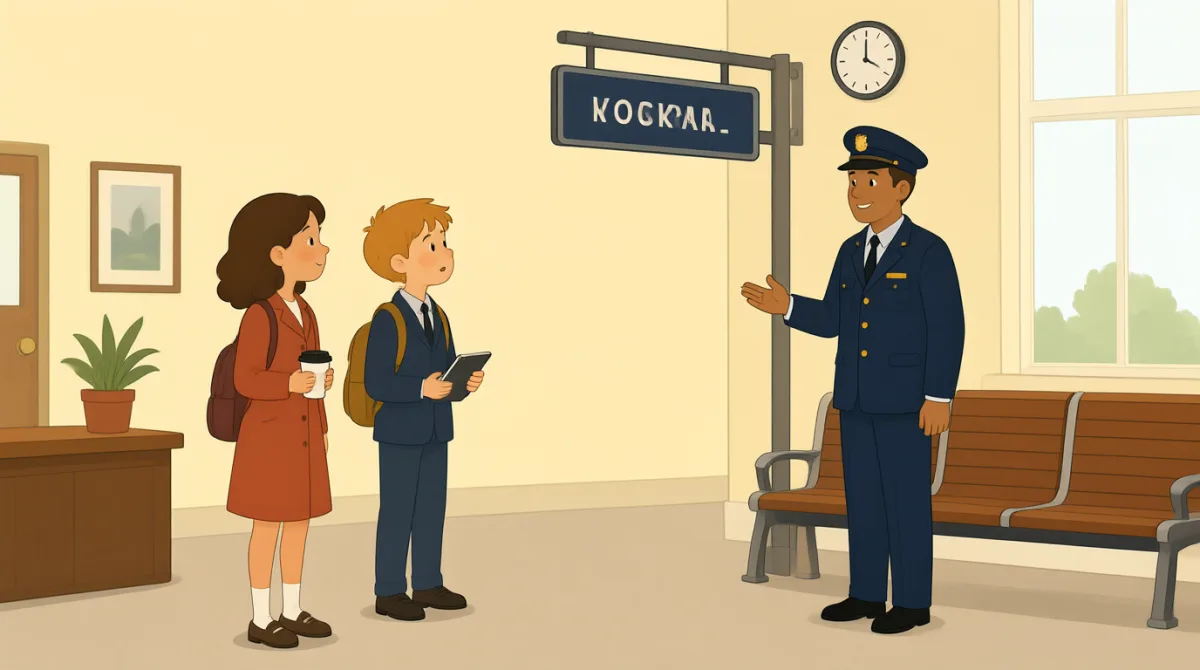

Excuse me, where are we?
Entschuldigen Sie, wo sind wir?

This is Pine Street Station.
Das ist der Bahnhof Pine Street.
Is this Central Station?
Ist das der Hauptbahnhof?
No, this is Pine Street Station.
Nein, das ist der Bahnhof Pine Street.

The sign says Pine Street.
Auf dem Schild steht Pine Street.
Oh, we are at the wrong stop.
Oh, wir sind an der falschen Haltestelle ausgestiegen.
Yes, you are one stop past Central.
Ja, Sie sind eine Haltestelle hinter dem Hauptbahnhof.
Wortschatz6
- Excuse meEntschuldigen Sie
A polite way to get someone’s attention. Use it before asking a stranger for help.
Eine höfliche Art, die Aufmerksamkeit einer Person zu bekommen. Verwende die Wendung, bevor du einen Fremden um Hilfe bittest.
- where are we?Wo sind wir?
A question asking what place you are in. Use it when you are unsure of your location.
Eine Frage danach, an welchem Ort du dich befindest. Verwende sie, wenn du nicht genau weißt, wo du bist.
- stationBahnhof
A place where trains stop. You can use it with a name, like “Pine Street Station.”
Ein Ort, an dem Züge halten. Du kannst das Wort mit einem Namen verwenden, zum Beispiel „Bahnhof Pine Street“.
- The sign says Pine Street.Auf dem Schild steht Pine Street.
This means the sign has the words “Pine Street” on it. Use “The sign says…” to share information you read on a sign.
Das bedeutet, dass auf dem Schild die Worte „Pine Street“ stehen. Mit „The sign says…“ (Auf dem Schild steht …) kannst du Informationen weitergeben, die du auf einem Schild gelesen hast.
- wrong stopfalsche Haltestelle
A stop that is not the one you wanted. Use it when you get off at the wrong place.
Eine Haltestelle, an der du nicht aussteigen wolltest. Verwende die Wendung, wenn du am falschen Ort ausgestiegen bist.
- one stop past Centraleine Haltestelle hinter dem Hauptbahnhof
This means the train went one stop farther than Central. Use “one stop past” to explain where you are compared with another stop.
Das bedeutet, dass der Zug eine Haltestelle weiter als der Hauptbahnhof gefahren ist. Mit „one stop past“ (eine Haltestelle hinter …) kannst du erklären, wo du dich im Vergleich zu einer anderen Haltestelle befindest.
Wichtige Sätze7
- 1
Excuse me, where are we?
Entschuldigen Sie, wo sind wir?
Use this polite question when you do not know where you are. You can replace “where” with another question, such as “Excuse me, where is the station?”
Verwende diese höfliche Frage, wenn du nicht weißt, wo du bist. Du kannst „where“ durch eine andere Frage ersetzen, zum Beispiel „Excuse me, where is the station?“ (Entschuldigen Sie, wo ist der Bahnhof?).
- 2
This is Pine Street Station.
Das ist der Bahnhof Pine Street.
Use “This is…” to say the name of a place. Replace “Pine Street Station” with the name of another station or location.
Mit „This is…“ kannst du den Namen eines Ortes nennen. Ersetze „Pine Street Station“ durch den Namen eines anderen Bahnhofs oder Ortes.
- 3
Is this Central Station?
Ist das der Hauptbahnhof?
Use this yes-or-no question to check if you are at a particular place. Replace “Central Station” with the place you are looking for.
Verwende diese Ja-oder-Nein-Frage, um zu überprüfen, ob du an einem bestimmten Ort bist. Ersetze „Central Station“ durch den Ort, den du suchst.
- 4
No, this is Pine Street Station.
Nein, das ist der Bahnhof Pine Street.
Use this sentence to correct someone and give the right place name. You can replace “Pine Street Station” with another location.
Mit diesem Satz kannst du jemanden korrigieren und den richtigen Ortsnamen nennen. Du kannst „Pine Street Station“ durch einen anderen Ort ersetzen.
- 5
The sign says Pine Street.
Auf dem Schild steht Pine Street.
Use “The sign says…” to tell someone what you read on a sign. Replace “Pine Street” with the words you see.
Mit „The sign says…“ kannst du jemandem sagen, was du auf einem Schild gelesen hast. Ersetze „Pine Street“ durch die Worte, die du siehst.
- 6
Oh, we are at the wrong stop.
Oh, wir sind an der falschen Haltestelle ausgestiegen.
Use this sentence when you realize you got off at a stop you did not want. You can replace “stop” with another place, such as “station.”
Verwende diesen Satz, wenn dir klar wird, dass du an einer Haltestelle ausgestiegen bist, an der du nicht aussteigen wolltest. Du kannst „stop“ durch einen anderen Ort ersetzen, zum Beispiel durch „station“.
- 7
Yes, you are one stop past Central.
Ja, Sie sind eine Haltestelle hinter dem Hauptbahnhof.
Use “one stop past” to explain that someone has gone one stop farther than a place. Replace “Central” with the name of another stop.
Mit „one stop past“ kannst du erklären, dass jemand eine Haltestelle weiter als ein bestimmter Ort gefahren ist. Ersetze „Central“ durch den Namen einer anderen Haltestelle.