Realizing It Is the Wrong Stop
Feststellen, dass es die falsche Haltestelle ist
Emma gets off the train and sees that this is not her stop. She asks Jack if they are in the wrong place.
Emma steigt aus dem Zug und merkt, dass sie nicht an ihrer Haltestelle ist. Sie fragt Jack, ob sie am falschen Ort sind.
Dialog6
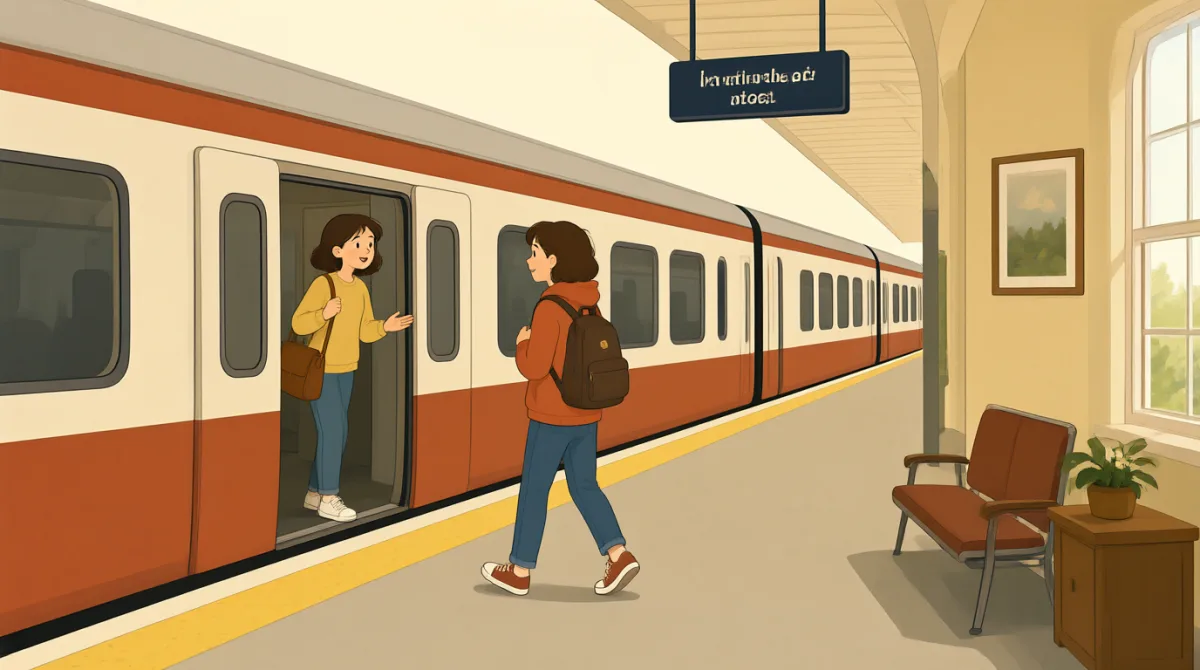

Jack, is this our stop?
Jack, ist das unsere Haltestelle?

I don't think so. This looks wrong.
Ich glaube nicht. Das sieht falsch aus.
Oh no. We got off at the wrong stop.
Oh nein. Wir sind an der falschen Haltestelle ausgestiegen.
Let's check the station sign.
Lass uns auf den Stationsplan schauen.
I don't see our stop on it.
Ich sehe unsere Haltestelle darauf nicht.
You're right. This isn't our stop.
Du hast recht. Das ist nicht unsere Haltestelle.
Wortschatz7
- our stopunsere Haltestelle
This means the train station where we want to get off. Use it to check whether you are at the right station.
Damit ist der Bahnhof oder die Haltestelle gemeint, an der wir aussteigen möchten. So kannst du überprüfen, ob du am richtigen Ort bist.
- I don't think so.Ich glaube nicht.
Use this phrase to say that you think something is not true. It is a polite way to disagree or answer no.
Mit diesem Ausdruck sagst du, dass du etwas für unwahr hältst. Er ist eine höfliche Art, jemandem zu widersprechen oder mit Nein zu antworten.
- looks wrongsieht falsch aus
This means something does not seem right. Use it when a place or thing seems different from what you expect.
Das bedeutet, dass etwas nicht richtig zu sein scheint. Verwende den Ausdruck, wenn ein Ort oder eine Sache anders aussieht, als du erwartet hast.
- got offausgestiegen
This means left a train or bus. Use it to say that you left public transport.
Das bedeutet, einen Zug oder Bus verlassen zu haben. Verwende es, wenn du sagen möchtest, dass du aus einem öffentlichen Verkehrsmittel ausgestiegen bist.
- wrong stopfalsche Haltestelle
This means a train or bus stop that is not the one you want. You can say this when you leave at the wrong place.
Damit ist eine Haltestelle gemeint, an der du nicht aussteigen möchtest. Das kannst du sagen, wenn du am falschen Ort ausgestiegen bist.
- Let's check the station sign.Lass uns auf den Stationsplan schauen.
Use this sentence to suggest looking at the sign for information. You can also say, “Let's check the map.”
Mit diesem Satz schlägst du vor, gemeinsam auf einen Plan oder ein Schild zu schauen. Du kannst auch sagen: “Let's check the map.”
- You're right.Du hast recht.
Use this phrase to agree with someone. It means that what they said is correct.
Mit diesem Ausdruck stimmst du jemandem zu. Er bedeutet, dass das Gesagte stimmt.
Wichtige Sätze8
- 1
Jack, is this our stop?
Jack, ist das unsere Haltestelle?
Use this question to check if you should get off here. Replace “our stop” with a place or station name when needed.
Mit dieser Frage prüfst du, ob ihr hier aussteigen solltet. Ersetze “our stop” durch den Namen eines Ortes oder einer Haltestelle, wenn nötig.
- 2
I don't think so.
Ich glaube nicht.
This is a simple way to say you do not think something is true. You can use it to answer questions or politely disagree.
Das ist eine einfache Möglichkeit zu sagen, dass du etwas nicht für wahr hältst. Du kannst den Satz als Antwort auf eine Frage oder verwenden, um höflich zu widersprechen.
- 3
This looks wrong.
Das sieht falsch aus.
Use this sentence when something does not seem correct. Replace “this” with a place or thing, such as “That sign looks wrong.”
Verwende diesen Satz, wenn etwas nicht richtig zu sein scheint. Ersetze “this” durch einen Ort oder eine Sache, zum Beispiel in “That sign looks wrong.”
- 4
We got off at the wrong stop.
Wir sind an der falschen Haltestelle ausgestiegen.
Use this sentence to explain that you left the train or bus at the wrong place. You can replace “stop” with “station” or “bus stop.”
Mit diesem Satz erklärst du, dass du an der falschen Stelle aus dem Zug oder Bus ausgestiegen bist. Du kannst “stop” durch “station” oder “bus stop” ersetzen.
- 5
Let's check the station sign.
Lass uns auf den Stationsplan schauen.
Use this sentence to suggest looking at a sign together. Replace “station sign” with another source of information, such as “the map.”
Mit diesem Satz schlägst du vor, gemeinsam auf ein Schild zu schauen. Ersetze “station sign” durch eine andere Informationsquelle, zum Beispiel “the map.”
- 6
I don't see our stop on it.
Ich sehe unsere Haltestelle darauf nicht.
Use this sentence when you cannot find a place or name on a sign or map. Replace “our stop” with the information you are looking for.
Verwende diesen Satz, wenn du einen Ort oder Namen auf einem Schild oder einer Karte nicht finden kannst. Ersetze “our stop” durch die Information, nach der du suchst.
- 7
You're right.
Du hast recht.
Use this short phrase to agree with someone. You can follow it with more information, such as “You're right. This is the wrong station.”
Mit diesem kurzen Ausdruck stimmst du jemandem zu. Du kannst noch etwas hinzufügen, zum Beispiel: “You're right. This is the wrong station.”
- 8
This isn't our stop.
Das ist nicht unsere Haltestelle.
Use this sentence to say that you are not at the place where you need to get off. Replace “our stop” with another place, such as “our station.”
Mit diesem Satz sagst du, dass ihr nicht an dem Ort seid, an dem ihr aussteigen müsst. Ersetze “our stop” durch einen anderen Ort, zum Beispiel “our station.”