Asking About a Partially Occupied Table
詢問部分佔用桌子的空位
The person approaches a table where some seats are taken, but others are empty, and asks if an empty seat at that table is free.
這個人走近一張桌子,桌子旁邊的座位有些被佔了,但有些是空的,他會詢問這張桌旁的一個空位是否有人。
對話5
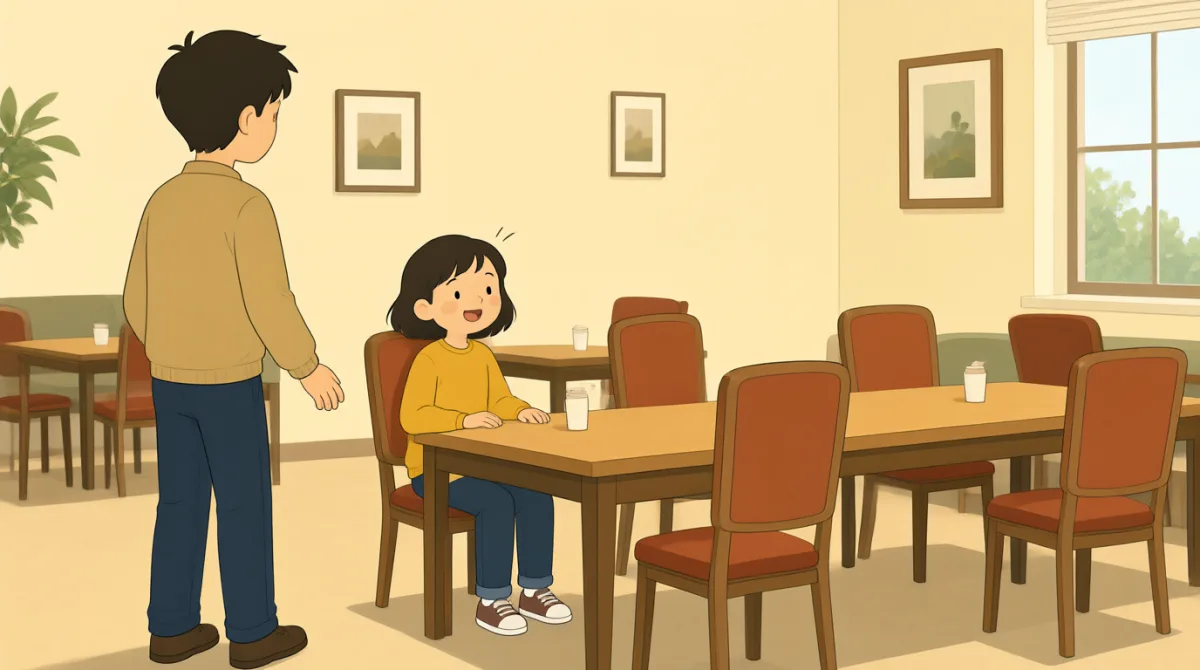

Excuse me, is this seat taken?
不好意思,這個位子有人嗎?

No, it's not. Please, go ahead.
沒有,沒人坐。請坐吧。
Thanks! Do you mind if I sit here?
謝謝!我坐這裡你介意嗎?
Not at all. There's plenty of room.
一點也不介意。位子很多。
Great. Appreciate it.
太好了。謝謝你。
詞彙6
- Excuse me打擾一下
A polite phrase used to get someone's attention before asking a question, especially in public places like restaurants or buses.
在提問前用來禮貌地引起別人注意的短語,尤其適用於餐廳或公交車等公共場所。
- seat座位
A place where you can sit, like a chair at a table or on a bus; in this context, it refers to an available spot at a shared table.
可以坐下的地方,比如桌邊的椅子或公交車上的座位;在這裡指共用一張桌子時可坐的空位。
- taken有人坐的
Means already occupied or in use by someone else; often used with 'seat' to ask if it's free.
意思是已經有人佔著或正在使用;常和 'seat' 一起用來詢問座位是否空著。
- go ahead請便
An informal way to give permission, meaning 'please proceed' or 'feel free to do it'; useful for encouraging someone to sit or start something.
一種非正式的許可表達,意思是“請繼續”或“儘管做”;可以用來邀請別人坐下或開始做某事。
- mind介意
In this context, 'do you mind' means 'do you object' or 'is it okay with you'; it's a polite way to ask for permission.
在這裡,'do you mind' 的意思是“你會反對嗎”或“你覺得可以嗎”;這是禮貌徵求許可的說法。
- appreciate感激
To feel grateful for something someone does for you; often used to say thank you in a more formal or sincere way.
因別人為你做了某事而心懷感謝;常用於以更正式或真誠的方式表達謝意。
關鍵句5
- 1
Excuse me, is this seat taken?
不好意思,這個位子有人嗎?
This is a polite question to check if a seat is available before sitting; 'is this seat taken?' uses present simple tense for current status and is very common in social situations like cafes.
這是一種禮貌的問法,坐下前先確認座位是否空著;'is this seat taken?' 用一般現在時詢問當前情況,在咖啡館等社交場合很常見。
- 2
No, it's not. Please, go ahead.
沒有,請坐吧。
A friendly response giving permission; 'it's not' is a contraction of 'it is not,' and 'go ahead' means proceed, making it useful for inviting someone to join you at a table.
這是友好地表示許可;'it's not' 是 'it is not' 的縮寫,'go ahead' 意思是“請便”,可以用來邀請別人一起坐在桌邊。
- 3
Do you mind if I sit here?
我坐這裡你介意嗎?
A polite way to ask for permission; the structure 'do you mind if + present simple' is a common pattern for requesting approval without being too direct.
這是一種禮貌的徵求許可方式;'do you mind if + present simple' 是常見句型,可以在不顯得太直接的情況下徵求對方同意。
- 4
Not at all. There's plenty of room.
一點也不介意,地方很寬敞。
Means 'I don't mind at all'; 'not at all' is an idiomatic response to show no objection, and 'plenty of room' explains there's enough space, useful for reassuring someone.
意思是“我完全不介意”;'not at all' 是表示毫無異議的習慣說法,'plenty of room' 則說明地方很寬敞,能讓對方放心。
- 5
Great. Appreciate it.
太好了,謝謝你。
A casual expression of thanks; 'appreciate it' is a shortened form of 'I appreciate it,' showing gratitude in everyday conversations after receiving help or permission.
一種輕鬆的感謝表達;'appreciate it' 是 'I appreciate it' 的簡略說法,在日常對話中接受幫助或許可後可以用來表達謝意。