Discussing Chores with a Family Member
Ev İşlerini Bir Aile Üyesiyle Konuşmak
Two family members are talking about who will do which household chores, like dishes, laundry, or tidying up common areas.
İki aile üyesi bulaşık, çamaşır veya ortak alanları toplamak gibi ev işlerini kimin yapacağını konuşuyor.
Diyalog8
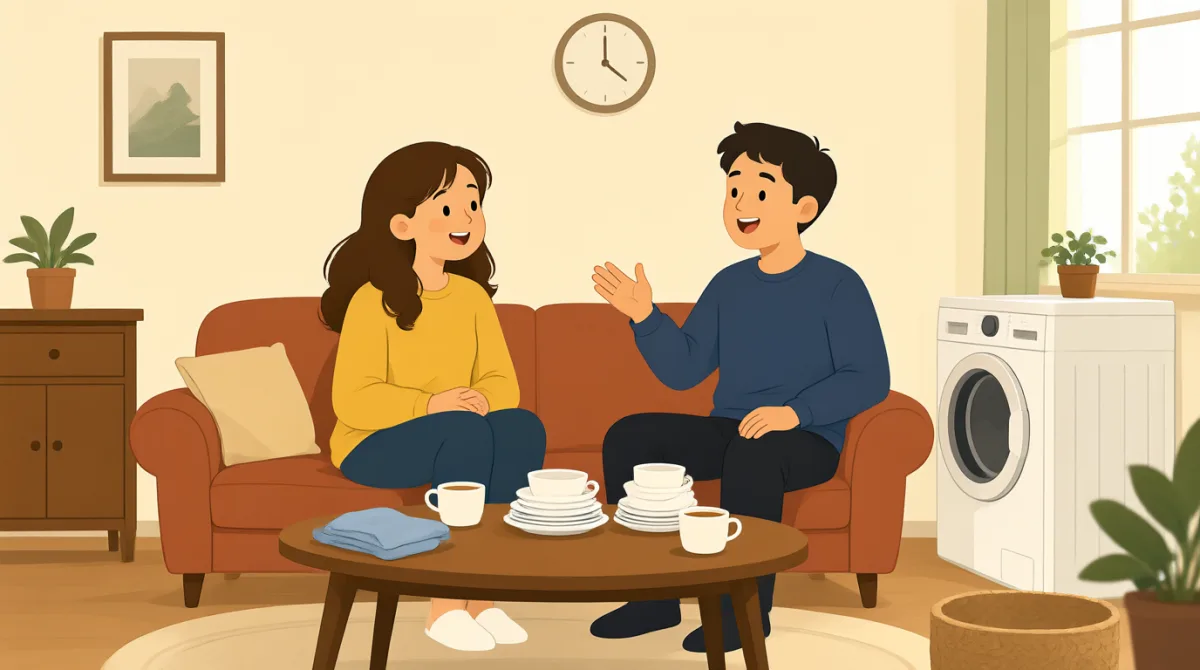

Hey Jack, the kitchen is a bit of a mess. Who's on dishes tonight?
Hey Jack, mutfak biraz dağılmış. Bu akşam bulaşıkları kim yıkıyor?

Hmm, I did them last night, so I think it's your turn. I can take out the trash though.
Hımm, dün gece ben yıkamıştım, o yüzden sıra sende sanırım. Ama çöpü ben çıkarabilirim.
Right, I forgot. Okay, I'll do the dishes then. What about the living room? It needs tidying up too.
Doğru ya, unutmuşum. Tamam, bulaşıkları ben yıkarım o zaman. Peki ya oturma odası? Orayı da toplamak lazım.
I can tackle the living room after I take out the trash. Just need to put the remote back and fold those blankets.
Çöpü çıkardıktan sonra oturma odasını ben hallederim. Kumandayı yerine koyup şu battaniyeleri katlamam yeter.
Perfect! And the laundry? Did you put that load in, or should I start one?
Harika! Peki çamaşırlar? Makineye attın mı, yoksa ben mi çalıştırayım?
Oh, I completely forgot about the laundry. It's still in the hamper. If you could start it, that would be a huge help.
Ah, çamaşırları tamamen unutmuşum. Hâlâ sepette duruyorlar. Makineyi sen çalıştırabilirsen çok iyi olur.
No worries. I'll get that going after the dishes are done. So, dishes and laundry for me, and trash and living room for you. Sound good?
Sorun değil. Bulaşıklar bitince çamaşırları da hallederim. Yani bulaşıklar ve çamaşırlar bende, çöp ve oturma odası sende. Uygun mu?
Sounds like a plan! Thanks, Emma.
Anlaştık! Sağ ol Emma.
Kelime Bilgisi7
- messdağınıklık
A 'mess' means a dirty or untidy state, like when things are scattered around. Use it to describe a room that's not clean, e.g., 'The room is a mess.'
'Mess', etrafa saçılmış eşyalar gibi kirli veya düzensiz bir durumu anlatır. Toplu ya da temiz olmayan bir odayı tarif etmek için kullanılır; örneğin, 'The room is a mess.' (Oda darmadağın.)
- dishesbulaşıklar
'Dishes' refers to plates, bowls, and utensils used for eating. In chores, it means washing them after meals, e.g., 'I need to do the dishes.'
'Dishes', yemek yerken kullanılan tabak, kâse ve çatal bıçak takımlarını ifade eder. Ev işleri bağlamında yemeklerden sonra bunları yıkamak anlamına gelir; örneğin, 'I need to do the dishes.' (Bulaşıkları yıkamam gerekiyor.)
- trashçöp
'Trash' means garbage or waste that needs to be thrown away. Common in home tasks like 'take out the trash' to empty the bin.
'Trash', atılması gereken çöpleri veya atıkları ifade eder. Ev işlerinde, çöp kutusunu boşaltmak anlamındaki 'take out the trash' ifadesinde sıkça kullanılır.
- tidying uptoparlamak
'Tidying up' means making a space neat by putting things in order. It's a polite way to say cleaning lightly, e.g., 'Let's tidy up the room.'
'Tidying up', eşyaları düzenleyerek bir alanı derli toplu hâle getirmek demektir. Hafifçe temizlik yapmayı anlatan nazik bir ifadedir; örneğin, 'Let's tidy up the room.' (Haydi odayı toparlayalım.)
- tackleele almak, halletmek
In this context, 'tackle' means to deal with or start a task, especially a challenging one. Use it for chores like 'I'll tackle the garden.'
Bu bağlamda 'tackle', özellikle zorlayıcı bir işi ele almak veya işe koyulmak demektir. 'I'll tackle the garden.' (Bahçeyle ben ilgileneceğim.) gibi ev işleri için kullanabilirsin.
- laundryçamaşır
'Laundry' means dirty clothes that need washing. It's often used for the whole process, e.g., 'I have to do the laundry today.'
'Laundry', yıkanması gereken kirli giysiler demektir. Çamaşır yıkama işinin tamamı için de kullanılır; örneğin, 'I have to do the laundry today.' (Bugün çamaşır yıkamam gerekiyor.)
- hamperkirli çamaşır sepeti
A 'hamper' is a basket for holding dirty clothes before washing. Say 'The laundry is in the hamper' to mean it's waiting to be washed.
'Hamper', yıkanmayı bekleyen kirli çamaşırları koymak için kullanılan sepettir. 'The laundry is in the hamper' (Kirli çamaşırlar sepette) dediğinde, çamaşırların yıkanmayı beklediğini anlatırsın.
Önemli Cümleler8
- 1
Hey Jack, the kitchen is a bit of a mess. Who's on dishes tonight?
Hey Jack, mutfak biraz dağılmış. Bu akşam bulaşıkları kim yıkıyor?
This sentence starts a casual conversation about chores. 'A bit of a mess' softens the complaint, and 'Who's on dishes?' uses 'on' to mean whose turn it is. Useful for asking about responsibilities in family talks.
Bu cümle, ev işleri hakkında gündelik bir konuşma başlatıyor. 'A bit of a mess' (biraz dağınık) şikâyeti yumuşatıyor; 'Who's on dishes?' ifadesindeki 'on' ise kimin sırası olduğunu anlatıyor. Aile içinde sorumlulukları sormak için kullanışlıdır.
- 2
Hmm, I did them last night, so I think it's your turn.
Hımm, dün gece ben yıkamıştım, o yüzden sıra sende sanırım.
Here, 'Hmm' shows thinking, and 'so' connects reasons to conclusions. 'It's your turn' is a common phrase for sharing tasks fairly. Great for negotiating chores politely.
Burada 'Hmm' düşünme belirtir; 'so' ise nedeni sonuca bağlar. 'It's your turn' (sıra sende), işleri adil biçimde paylaşırken kullanılan yaygın bir ifadedir. Ev işlerini nazikçe paylaştırırken işe yarar.
- 3
I can take out the trash though.
Ama çöpü ben çıkarabilirim.
'Though' adds a positive offer after a refusal. 'Take out the trash' is a fixed expression for emptying garbage. Use this to compromise in discussions.
'Though', bir işi üstlenmeyi reddettikten sonra olumlu bir öneri ekler. 'Take out the trash', çöpü dışarı çıkarmak için kullanılan kalıplaşmış bir ifadedir. İş bölümü konusunda uzlaşmaya varırken kullanabilirsin.
- 4
What about the living room? It needs tidying up too.
Peki ya oturma odası? Orayı da toplamak lazım.
This asks about another task using 'What about...?' to suggest more. 'Needs tidying up' uses 'needs' for something requiring action. Helpful for expanding on household duties.
Bu cümle, başka bir iş önermek için 'What about...?' kalıbını kullanır. 'Needs tidying up' ifadesindeki 'needs', bir şeyin yapılması gerektiğini anlatır. Ev işlerine başka görevler eklerken kullanışlıdır.
- 5
If you could start it, that would be a huge help.
Makineyi sen çalıştırabilirsen çok iyi olur.
This is a polite request with 'if you could' for hypothetical help, and 'that would be a huge help' expresses gratitude in advance. Ideal for asking family for assistance without demanding.
'If you could' kalıbı, yardım istemenin nazik bir yoludur; 'that would be a huge help' ise şimdiden teşekkür etmeyi ifade eder. Aileden bir şey isterken buyurgan olmamak için bu kalıbı kullanabilirsin.
- 6
No worries. I'll get that going after the dishes are done.
Sorun değil. Bulaşıklar bitince çamaşırları da hallederim.
'No worries' means 'don't worry' casually. 'Get that going' is an idiom for starting a task. Use this to agree and sequence actions in chore planning.
'No worries', gündelik bir şekilde 'endişelenme' demektir. 'Get that going', bir işe başlamak anlamında kullanılan bir deyimdir. Ev işlerini planlarken hem kabul etmek hem de işlerin sırasını belirtmek için kullanabilirsin.
- 7
So, dishes and laundry for me, and trash and living room for you. Sound good?
Yani bulaşıklar ve çamaşırlar bende, çöp ve oturma odası sende. Uygun mu?
This summarizes the agreement with 'So' for conclusion, lists tasks clearly, and ends with 'Sound good?' for confirmation. Perfect for wrapping up discussions on dividing work.
Bu cümle, sonucu belirtmek için 'So' ile anlaşmayı özetler, işleri açıkça sıralar ve onay almak için 'Sound good?' diye sorar. İş bölümü konuşmasını tamamlamak için çok uygundur.
- 8
Sounds like a plan!
Anlaştık!
This idiom means 'that's a good idea' or 'agreed.' It's a positive way to end a conversation. Use it in casual settings to show approval of arrangements.
Bu deyim, 'iyi fikir' ya da 'kabul' anlamına gelir. Konuşmayı olumlu biçimde bitirmenin bir yoludur. Bir düzenlemeyi onayladığını göstermek için gündelik konuşmalarda kullanabilirsin.