Taking Photos of the Parking Sign
Fotografando a placa de estacionamento
Leo and Mia return to the parking spot to photograph the sign and the nearby meter. They notice that part of the sign is hard to read.
Leo e Mia voltam à vaga para fotografar a placa e o parquímetro próximo. Eles percebem que é difícil ler uma parte da placa.
Diálogo9
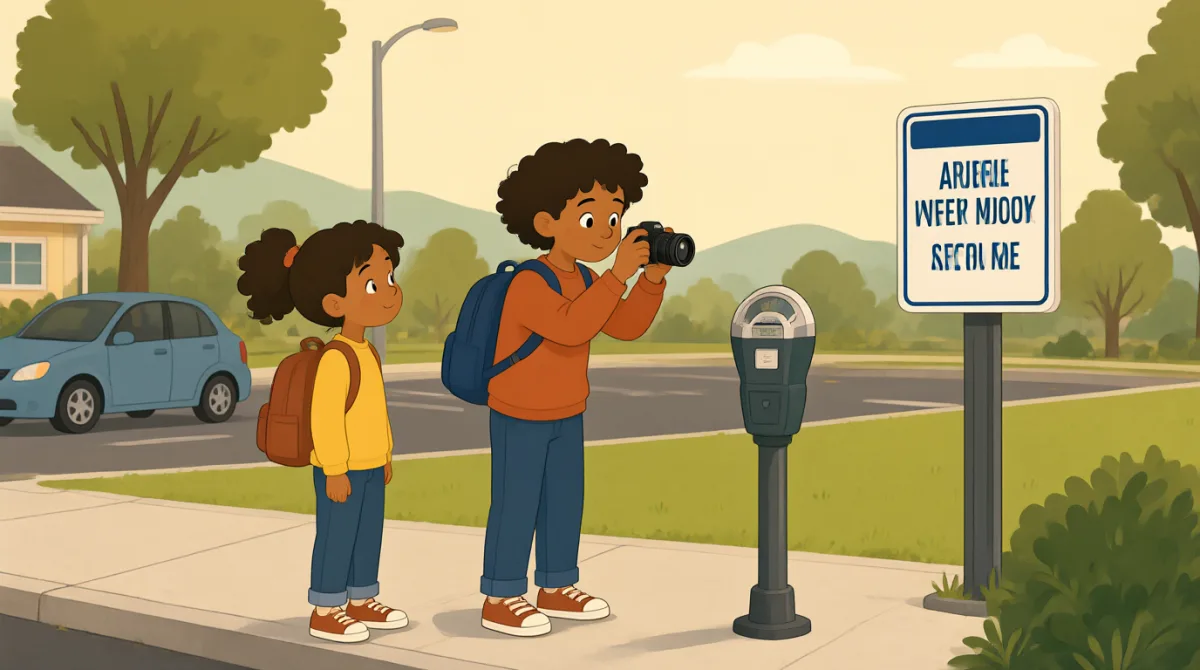

Here’s the spot where I parked. The meter shows I paid until two, but the ticket says I overstayed.
Aqui é a vaga onde estacionei. O parquímetro mostra que paguei até as duas, mas a multa diz que fiquei estacionado além do tempo permitido.

Let’s take a clear photo of the meter first. Make sure the time and the space number are easy to see.
Vamos tirar primeiro uma foto nítida do parquímetro. Confira se dá para ver bem o horário e o número da vaga.
Got it. Now I’ll take a picture of the sign from here. Wait, the lower part is really hard to read.
Beleza. Agora vou fotografar a placa daqui. Espera, está muito difícil ler a parte de baixo.
You’re right. The paint is faded, and a branch is blocking some of the words. Let’s get a closer shot, too.
É verdade. A pintura está desbotada, e um galho está cobrindo algumas palavras. Vamos tirar também uma foto mais de perto.
I’ll take one straight on and another from the side, so it’s clear what the sign looks like from the sidewalk.
Vou tirar uma foto de frente e outra de lado, para mostrar claramente como a placa é vista da calçada.
Good idea. Let’s include the parking space and the meter in a wider photo, so the location is clear.
Boa ideia. Vamos incluir a vaga e o parquímetro em uma foto mais ampla, para deixar claro onde fica.
Done. I’ll keep these with my payment receipt. I hope the photos show why I thought parking was allowed.
Pronto. Vou guardar essas fotos junto com o comprovante de pagamento. Espero que elas mostrem por que achei que podia estacionar.
They should help. Check that the pictures aren’t blurry, and save the originals in case the city asks for them.
Elas devem ajudar. Confira se as fotos não estão tremidas e guarde os arquivos originais caso a prefeitura peça.
They’re clear enough. I’ll write down when we took them, too. That way, I’ll have the details ready for my appeal.
Elas estão nítidas o bastante. Também vou anotar quando tiramos as fotos. Assim, vou ter os detalhes prontos para o meu recurso.
Vocabulário7
- overstayedoverstayed — ficou estacionado além do tempo permitido
Here, it means Leo parked longer than the allowed time. You can use “overstay” to describe staying somewhere past the permitted time.
Aqui, significa que Leo estacionou por mais tempo do que o permitido. Você pode usar “overstay” para falar de ficar em algum lugar além do tempo autorizado.
- fadedfaded — desbotado
The paint has become less bright or clear over time. It can describe colors, writing, or signs that are difficult to see.
A pintura perdeu o brilho ou a nitidez com o tempo. A palavra pode descrever cores, textos ou placas difíceis de enxergar.
- blockingblocking — cobrindo
A branch is blocking the words because it is in front of them and makes them hard to see. Use “blocking” for anything that gets in the way of a view or path.
Um galho está cobrindo as palavras porque fica na frente delas e dificulta a leitura. Use “blocking” para falar de algo que atrapalha a visão ou bloqueia uma passagem.
- straight onstraight on — de frente
This means facing the sign directly, rather than taking the photo from an angle. It’s useful when explaining how you want a photo or view to look.
Significa estar de frente para a placa, em vez de tirar a foto de um ângulo. É útil para explicar como você quer que uma foto ou imagem fique.
- blurryblurry — tremido
A blurry picture is not sharp or clear. You can use this word to describe photos, writing, or things you cannot see clearly.
Uma foto “blurry” não está nítida. Você pode usar essa palavra para descrever fotos, textos ou coisas que não dá para enxergar direito.
- in casein case — caso
“In case” means as a precaution, because something might happen. Mia suggests saving the originals in case the city asks to see them.
“In case” significa como precaução, porque algo pode acontecer. Mia sugere guardar os arquivos originais caso a prefeitura peça para vê-los.
- appealappeal — recurso
An appeal is a formal request to review or change a decision. Here, Leo plans to use his evidence to challenge the parking ticket.
Um recurso é um pedido formal para que uma decisão seja revista ou alterada. Aqui, Leo pretende usar as provas para contestar a multa de estacionamento.
Frases-chave7
- 1
Make sure the time and the space number are easy to see.
Confira se dá para ver bem o horário e o número da vaga.
Use “Make sure…” to give a practical reminder or instruction. You can replace the details with anything someone should check, such as “Make sure the address is easy to read.”
Use “Make sure…” para dar um lembrete ou uma instrução prática. Você pode trocar os detalhes por qualquer coisa que alguém precise verificar, como em “Make sure the address is easy to read.” (Confira se o endereço está fácil de ler.)
- 2
The paint is faded, and a branch is blocking some of the words.
A pintura está desbotada, e um galho está cobrindo algumas palavras.
This sentence gives two reasons something is difficult to see. Use “X is faded” and “Y is blocking…” to describe problems with signs, views, or photos.
Esta frase apresenta dois motivos pelos quais algo está difícil de enxergar. Use “X is faded” e “Y is blocking…” para descrever problemas em placas, imagens ou fotos.
- 3
I’ll take one straight on and another from the side, so it’s clear what the sign looks like from the sidewalk.
Vou tirar uma foto de frente e outra de lado, para mostrar claramente como a placa é vista da calçada.
This explains a plan and gives its purpose with “so.” You can reuse the structure to describe taking photos from different angles or doing something to make information clearer.
A frase explica um plano e seu objetivo usando “so”. Você pode reutilizar essa estrutura para falar de fotos tiradas de ângulos diferentes ou de algo feito para deixar uma informação mais clara.
- 4
Let’s include the parking space and the meter in a wider photo, so the location is clear.
Vamos incluir a vaga e o parquímetro em uma foto mais ampla, para deixar claro onde fica.
Use “Let’s include…” to suggest adding something to a photo or plan. The phrase “so the location is clear” explains why it will help.
Use “Let’s include…” para sugerir incluir algo em uma foto ou em um plano. A expressão “so the location is clear” explica por que isso vai ajudar.
- 5
I hope the photos show why I thought parking was allowed.
Espero que as fotos mostrem por que achei que podia estacionar.
This is a natural way to express hope that evidence will explain your point of view. You can use “I hope [something] shows why…” when sharing a reason or opinion.
Esta é uma forma natural de expressar a esperança de que as provas expliquem seu ponto de vista. Você pode usar “I hope [something] shows why…” para apresentar um motivo ou uma opinião.
- 6
Check that the pictures aren’t blurry, and save the originals in case the city asks for them.
Confira se as fotos não estão tremidas e guarde os arquivos originais caso a prefeitura peça.
This combines two practical instructions: check the photo quality and keep the original files as a precaution. Use “in case…” when you want someone to prepare for a possible future request.
A frase combina duas instruções práticas: verificar a qualidade das fotos e guardar os arquivos originais por precaução. Use “in case…” quando quiser que alguém se prepare para um possível pedido futuro.
- 7
That way, I’ll have the details ready for my appeal.
Assim, vou ter os detalhes prontos para o meu recurso.
“That way” introduces the result of an action. You can use it to explain how a plan will make something easier later, such as preparing for an application or meeting.
“That way” introduz o resultado de uma ação. Você pode usar essa expressão para explicar como um plano vai facilitar algo mais tarde, como se preparar para uma inscrição ou reunião.