Taking Photos of the Parking Sign
Leo and Mia return to the parking spot to photograph the sign and the nearby meter. They notice that part of the sign is hard to read.
Dialogue9
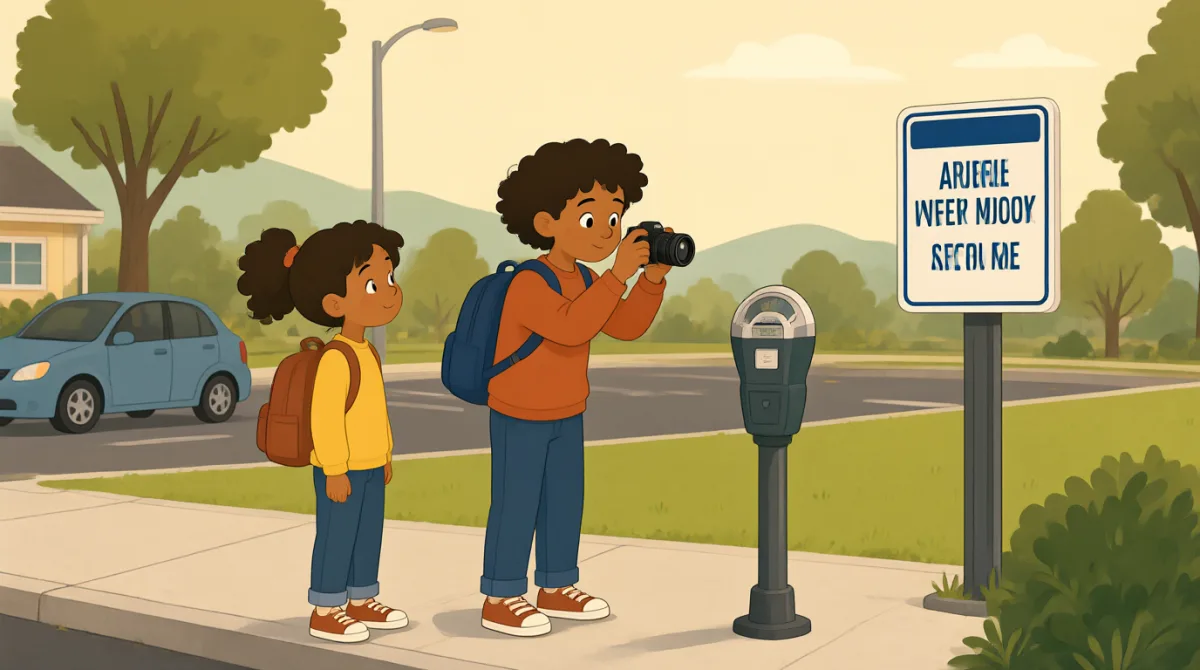

Here’s the spot where I parked. The meter shows I paid until two, but the ticket says I overstayed.

Let’s take a clear photo of the meter first. Make sure the time and the space number are easy to see.
Got it. Now I’ll take a picture of the sign from here. Wait, the lower part is really hard to read.
You’re right. The paint is faded, and a branch is blocking some of the words. Let’s get a closer shot, too.
I’ll take one straight on and another from the side, so it’s clear what the sign looks like from the sidewalk.
Good idea. Let’s include the parking space and the meter in a wider photo, so the location is clear.
Done. I’ll keep these with my payment receipt. I hope the photos show why I thought parking was allowed.
They should help. Check that the pictures aren’t blurry, and save the originals in case the city asks for them.
They’re clear enough. I’ll write down when we took them, too. That way, I’ll have the details ready for my appeal.
Vocabulary7
- overstayed
Here, it means Leo parked longer than the allowed time. You can use “overstay” to describe staying somewhere past the permitted time.
- faded
The paint has become less bright or clear over time. It can describe colors, writing, or signs that are difficult to see.
- blocking
A branch is blocking the words because it is in front of them and makes them hard to see. Use “blocking” for anything that gets in the way of a view or path.
- straight on
This means facing the sign directly, rather than taking the photo from an angle. It’s useful when explaining how you want a photo or view to look.
- blurry
A blurry picture is not sharp or clear. You can use this word to describe photos, writing, or things you cannot see clearly.
- in case
“In case” means as a precaution, because something might happen. Mia suggests saving the originals in case the city asks to see them.
- appeal
An appeal is a formal request to review or change a decision. Here, Leo plans to use his evidence to challenge the parking ticket.
Key Sentences7
- 1
Make sure the time and the space number are easy to see.
Use “Make sure…” to give a practical reminder or instruction. You can replace the details with anything someone should check, such as “Make sure the address is easy to read.”
- 2
The paint is faded, and a branch is blocking some of the words.
This sentence gives two reasons something is difficult to see. Use “X is faded” and “Y is blocking…” to describe problems with signs, views, or photos.
- 3
I’ll take one straight on and another from the side, so it’s clear what the sign looks like from the sidewalk.
This explains a plan and gives its purpose with “so.” You can reuse the structure to describe taking photos from different angles or doing something to make information clearer.
- 4
Let’s include the parking space and the meter in a wider photo, so the location is clear.
Use “Let’s include…” to suggest adding something to a photo or plan. The phrase “so the location is clear” explains why it will help.
- 5
I hope the photos show why I thought parking was allowed.
This is a natural way to express hope that evidence will explain your point of view. You can use “I hope [something] shows why…” when sharing a reason or opinion.
- 6
Check that the pictures aren’t blurry, and save the originals in case the city asks for them.
This combines two practical instructions: check the photo quality and keep the original files as a precaution. Use “in case…” when you want someone to prepare for a possible future request.
- 7
That way, I’ll have the details ready for my appeal.
“That way” introduces the result of an action. You can use it to explain how a plan will make something easier later, such as preparing for an application or meeting.