Taking Photos of the Parking Sign
Tomar fotos de la señal de estacionamiento
Leo and Mia return to the parking spot to photograph the sign and the nearby meter. They notice that part of the sign is hard to read.
Leo y Mia vuelven al lugar donde estacionaron para fotografiar la señal y el parquímetro cercano. Se dan cuenta de que una parte de la señal es difícil de leer.
Diálogo9
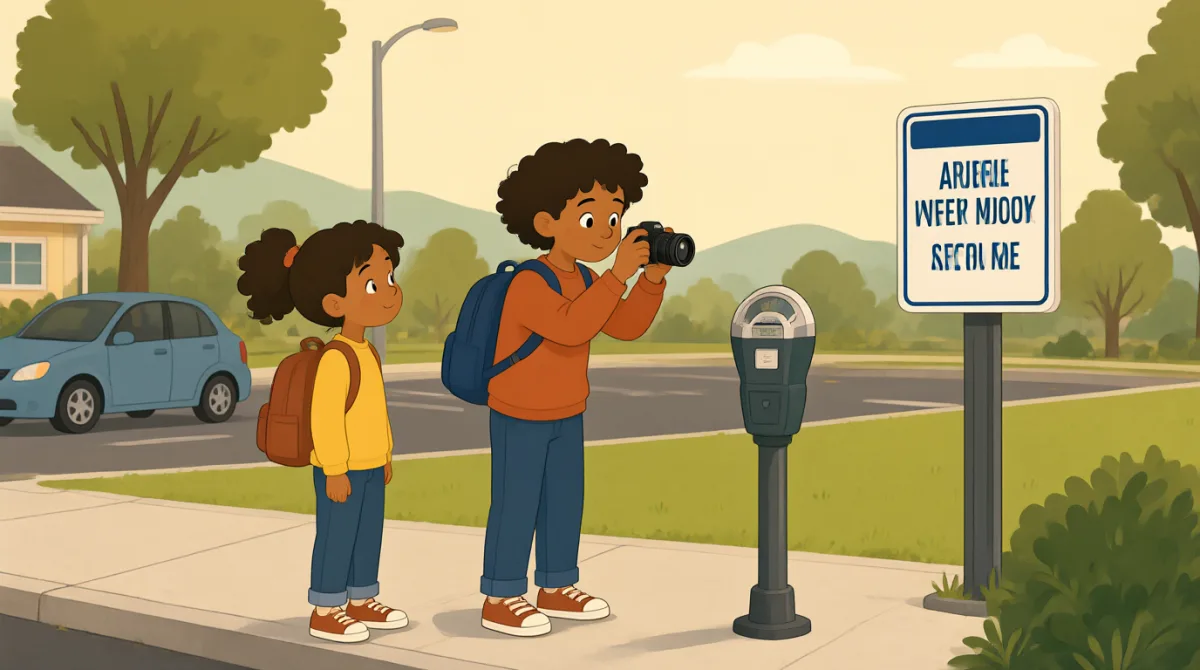

Here’s the spot where I parked. The meter shows I paid until two, but the ticket says I overstayed.
Aquí es donde estacioné. El parquímetro indica que pagué hasta las dos, pero la multa dice que me pasé del tiempo permitido.

Let’s take a clear photo of the meter first. Make sure the time and the space number are easy to see.
Primero, tomemos una foto nítida del parquímetro. Asegúrate de que se vean bien la hora y el número del espacio.
Got it. Now I’ll take a picture of the sign from here. Wait, the lower part is really hard to read.
Entendido. Ahora voy a tomar una foto de la señal desde aquí. Espera, la parte de abajo es muy difícil de leer.
You’re right. The paint is faded, and a branch is blocking some of the words. Let’s get a closer shot, too.
Tienes razón. La pintura está desgastada y una rama tapa algunas palabras. Tomemos también una foto más de cerca.
I’ll take one straight on and another from the side, so it’s clear what the sign looks like from the sidewalk.
Voy a tomar una de frente y otra desde un lado, para que se vea claramente cómo es la señal desde la acera.
Good idea. Let’s include the parking space and the meter in a wider photo, so the location is clear.
Buena idea. Incluyamos el espacio de estacionamiento y el parquímetro en una foto más amplia para que quede claro dónde es.
Done. I’ll keep these with my payment receipt. I hope the photos show why I thought parking was allowed.
Listo. Guardaré estas fotos junto con el recibo del pago. Espero que muestren por qué pensé que estaba permitido estacionar.
They should help. Check that the pictures aren’t blurry, and save the originals in case the city asks for them.
Deberían servir. Comprueba que las fotos no estén borrosas y guarda los archivos originales por si la ciudad te los pide.
They’re clear enough. I’ll write down when we took them, too. That way, I’ll have the details ready for my appeal.
Se ven bastante claras. También anotaré cuándo las tomamos. Así tendré todos los datos listos para mi apelación.
Vocabulario7
- overstayedpasarse del tiempo permitido
Here, it means Leo parked longer than the allowed time. You can use “overstay” to describe staying somewhere past the permitted time.
Aquí significa que Leo estacionó durante más tiempo del permitido. Puedes usar “overstay” para describir que alguien se queda en un lugar más allá del tiempo autorizado.
- fadeddesgastado
The paint has become less bright or clear over time. It can describe colors, writing, or signs that are difficult to see.
La pintura ha perdido intensidad o claridad con el paso del tiempo. Puede describir colores, textos o señales que son difíciles de ver.
- blockingtapar
A branch is blocking the words because it is in front of them and makes them hard to see. Use “blocking” for anything that gets in the way of a view or path.
La rama tapa las palabras porque está delante de ellas y dificulta verlas. Usa “blocking” para hablar de algo que obstaculiza la vista o el paso.
- straight onde frente
This means facing the sign directly, rather than taking the photo from an angle. It’s useful when explaining how you want a photo or view to look.
Significa estar frente a la señal, en lugar de tomar la foto desde un ángulo. Es útil para explicar cómo quieres que se vea una foto o una imagen.
- blurryborroso
A blurry picture is not sharp or clear. You can use this word to describe photos, writing, or things you cannot see clearly.
Una foto borrosa no se ve nítida ni clara. Puedes usar esta palabra para describir fotos, textos o cosas que no se distinguen bien.
- in casepor si acaso
“In case” means as a precaution, because something might happen. Mia suggests saving the originals in case the city asks to see them.
“In case” significa como precaución, porque algo podría pasar. Mia sugiere guardar los archivos originales por si la ciudad pide verlos.
- appealapelación
An appeal is a formal request to review or change a decision. Here, Leo plans to use his evidence to challenge the parking ticket.
Una apelación es una solicitud formal para que revisen o cambien una decisión. Aquí, Leo piensa usar sus pruebas para impugnar la multa de estacionamiento.
Frases clave7
- 1
Make sure the time and the space number are easy to see.
Asegúrate de que se vean bien la hora y el número del espacio.
Use “Make sure…” to give a practical reminder or instruction. You can replace the details with anything someone should check, such as “Make sure the address is easy to read.”
Usa “Make sure…” para dar un recordatorio o una instrucción práctica. Puedes cambiar los detalles por cualquier cosa que alguien deba comprobar, como en “Make sure the address is easy to read.”
- 2
The paint is faded, and a branch is blocking some of the words.
La pintura está desgastada y una rama tapa algunas palabras.
This sentence gives two reasons something is difficult to see. Use “X is faded” and “Y is blocking…” to describe problems with signs, views, or photos.
Esta oración da dos razones por las que algo es difícil de ver. Usa “X is faded” y “Y is blocking…” para describir problemas con señales, vistas o fotos.
- 3
I’ll take one straight on and another from the side, so it’s clear what the sign looks like from the sidewalk.
Voy a tomar una de frente y otra desde un lado, para que se vea claramente cómo es la señal desde la acera.
This explains a plan and gives its purpose with “so.” You can reuse the structure to describe taking photos from different angles or doing something to make information clearer.
Esta oración explica un plan y su propósito con “so”. Puedes reutilizar esta estructura para describir fotos tomadas desde distintos ángulos o acciones que ayuden a aclarar la información.
- 4
Let’s include the parking space and the meter in a wider photo, so the location is clear.
Incluyamos el espacio de estacionamiento y el parquímetro en una foto más amplia para que quede claro dónde es.
Use “Let’s include…” to suggest adding something to a photo or plan. The phrase “so the location is clear” explains why it will help.
Usa “Let’s include…” para sugerir que se añada algo a una foto o a un plan. La frase “so the location is clear” explica por qué será útil.
- 5
I hope the photos show why I thought parking was allowed.
Espero que las fotos muestren por qué pensé que estaba permitido estacionar.
This is a natural way to express hope that evidence will explain your point of view. You can use “I hope [something] shows why…” when sharing a reason or opinion.
Esta es una forma natural de expresar la esperanza de que unas pruebas expliquen tu punto de vista. Puedes usar “I hope [something] shows why…” para explicar una razón o una opinión.
- 6
Check that the pictures aren’t blurry, and save the originals in case the city asks for them.
Comprueba que las fotos no estén borrosas y guarda los archivos originales por si la ciudad te los pide.
This combines two practical instructions: check the photo quality and keep the original files as a precaution. Use “in case…” when you want someone to prepare for a possible future request.
Esta oración combina dos instrucciones prácticas: comprobar la calidad de las fotos y conservar los archivos originales como precaución. Usa “in case…” cuando quieras que alguien se prepare para una posible solicitud futura.
- 7
That way, I’ll have the details ready for my appeal.
Así tendré todos los datos listos para mi apelación.
“That way” introduces the result of an action. You can use it to explain how a plan will make something easier later, such as preparing for an application or meeting.
“That way” introduce el resultado de una acción. Puedes usarlo para explicar cómo un plan facilitará algo más adelante, por ejemplo, prepararse para una solicitud o una reunión.