Asking the Chef a Question
Fazendo uma pergunta à chef
Emma asks Grace how to make the sauce less salty. Grace suggests adding a little water and tasting it again.
Emma pergunta a Grace como deixar o molho menos salgado. Grace sugere adicionar um pouco de água e prová-lo novamente.
Diálogo8
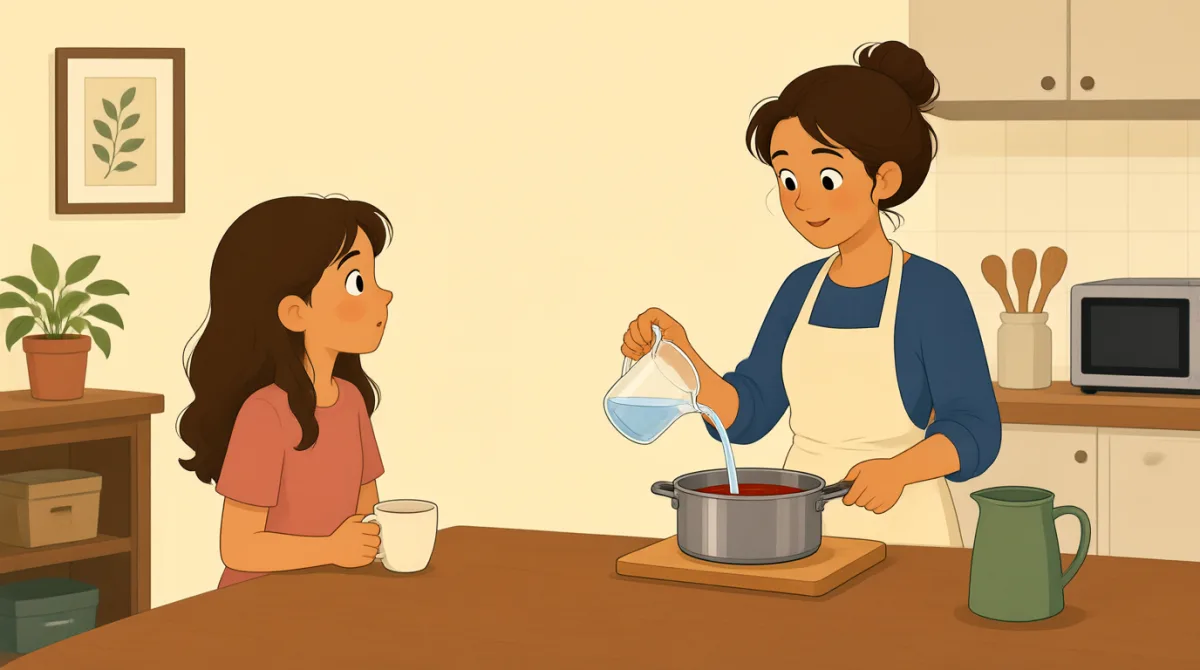

Grace, I think the sauce is too salty. Can I fix it?
Grace, acho que o molho está salgado demais. Posso consertar?

Yes. Add a little water, and then stir it well.
Sim. Adicione um pouco de água e mexa bem.
Should I add the water now, while it’s still hot?
Devo adicionar a água agora, enquanto ainda está quente?
Yes, that’s fine. Add just a little at first.
Sim, tudo bem. Adicione só um pouquinho no começo.
Okay, I added some. Should I taste it again?
Está bem, adicionei um pouco. Devo provar de novo?
Yes, use a clean spoon and taste it carefully.
Sim, use uma colher limpa e prove com cuidado.
It tastes much better now. Should I add more water?
Agora está bem melhor. Devo adicionar mais água?
No, it’s good now. A little water made a big difference.
Não, agora está bom. Um pouco de água fez uma grande diferença.
Vocabulário7
- too saltysalgado demais
This means the sauce has more salt than you want. You can use “too” before an adjective to say something is more than you like.
Isso quer dizer que o molho tem mais sal do que você gostaria. Você pode usar “too” antes de um adjetivo para dizer que algo está mais do que você considera agradável.
- fix itconsertar
Here, this means to make the sauce taste better. You can use “fix it” when you want to correct a problem.
Aqui, significa melhorar o sabor do molho. Você pode usar “fix it” quando quiser corrigir um problema.
- stir it wellmexer bem
This means to mix the sauce thoroughly with a spoon. You can say “stir it well” when giving someone a cooking instruction.
Isso significa misturar bem o molho com uma colher. Você pode dizer “stir it well” ao dar uma instrução de cozinha.
- at firstno começo
This means at the beginning. Here, Grace says to add only a small amount of water at the beginning.
Isso significa no início. Aqui, Grace diz para adicionar apenas um pouco de água no começo.
- taste it againprovar de novo
This means to try the sauce once more to check its flavor. You can use this phrase after changing or adding something to food.
Isso significa provar o molho mais uma vez para conferir o sabor. Você pode usar essa expressão depois de mudar ou adicionar algo à comida.
- a clean spoonuma colher limpa
This means a spoon that has been washed and is ready to use. It is useful advice when tasting food while cooking.
Isso significa uma colher que foi lavada e está pronta para usar. É uma dica útil para provar a comida enquanto cozinha.
- made a big differencefez uma grande diferença
This means caused a noticeable change. You can use it to describe how a small action improved a situation.
Isso significa que causou uma mudança perceptível. Você pode usar essa expressão para descrever como uma pequena ação melhorou uma situação.
Frases-chave7
- 1
I think the sauce is too salty.
Acho que o molho está salgado demais.
Use this sentence to describe a problem with food. You can replace “the sauce” and “too salty” to talk about other dishes or problems.
Use esta frase para descrever um problema com a comida. Você pode substituir “the sauce” e “too salty” para falar de outros pratos ou problemas.
- 2
Can I fix it?
Posso consertar?
This is a simple way to ask if you can correct a problem. You can use “Can I fix it?” in many everyday situations.
Esta é uma maneira simples de perguntar se você pode corrigir um problema. Você pode usar “Can I fix it?” em muitas situações do dia a dia.
- 3
Add a little water, and then stir it well.
Adicione um pouco de água e depois mexa bem.
This gives two clear cooking instructions in order. You can use “Add a little [ingredient], and then stir it well” for other recipes.
Esta frase dá duas instruções claras de cozinha, em ordem. Você pode usar “Add a little [ingredient], and then stir it well” em outras receitas.
- 4
Should I add the water now, while it’s still hot?
Devo adicionar a água agora, enquanto ainda está quente?
Use this question to ask if it is the right time to do something. You can replace “add the water” with another action.
Use esta pergunta para saber se este é o momento certo de fazer algo. Você pode substituir “add the water” por outra ação.
- 5
Should I taste it again?
Devo provar de novo?
This is a useful way to check what to do next while cooking. You can use “Should I [action] again?” to ask for advice.
Esta é uma maneira útil de perguntar o que fazer em seguida enquanto cozinha. Você pode usar “Should I [action] again?” para pedir uma orientação.
- 6
Yes, use a clean spoon and taste it carefully.
Sim, use uma colher limpa e prove com cuidado.
This sentence gives practical advice for tasting food safely. You can use “Use a clean [item] and [action] carefully” to give similar instructions.
Esta frase dá um conselho prático para provar a comida com segurança. Você pode usar “Use a clean [item] and [action] carefully” para dar instruções semelhantes.
- 7
A little water made a big difference.
Um pouco de água fez uma grande diferença.
Use this sentence to say that a small change had a noticeable effect. You can replace “water” with another thing that helped.
Use esta frase para dizer que uma pequena mudança teve um efeito perceptível. Você pode substituir “water” por outra coisa que tenha ajudado.