Following the Recipe
Seguindo a receita
The class follows the recipe and adds the ingredients to a pot. Grace explains when to stir and how long to cook the food.
A turma segue a receita e coloca os ingredientes na panela. Grace explica quando mexer e por quanto tempo cozinhar os alimentos.
Diálogo9
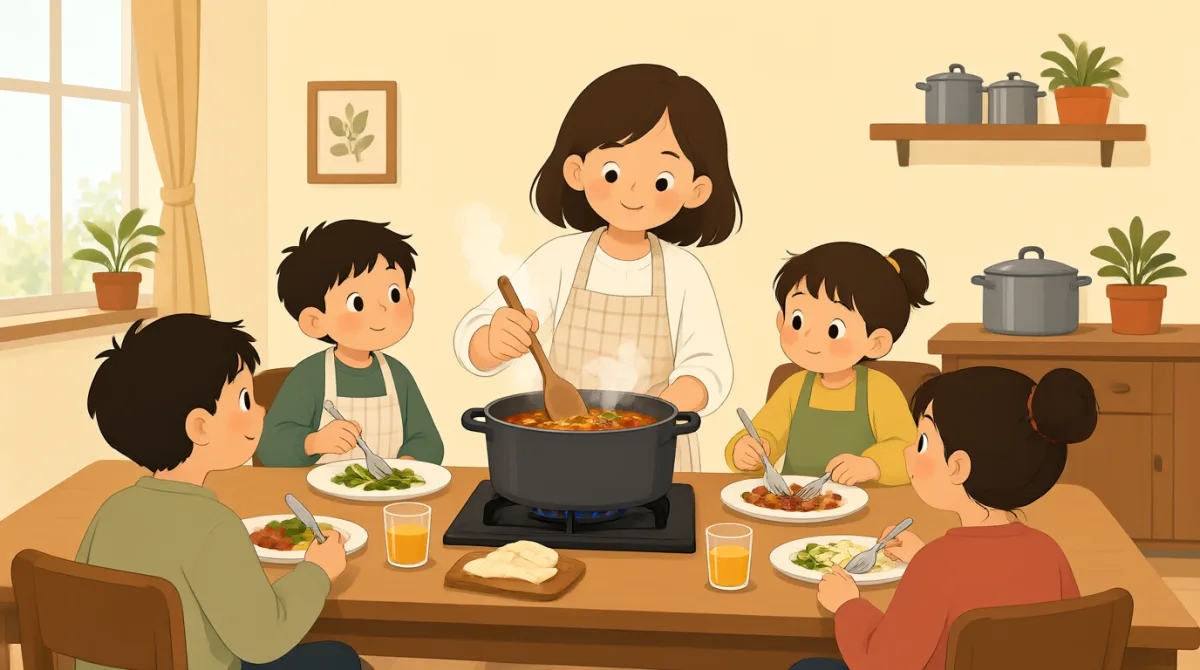

Now, read the recipe. First, pour two cups of water into the pot.
Agora, leiam a receita. Primeiro, coloquem duas xícaras de água na panela.

Should I add the tomatoes now, or wait until the water gets hot?
Devo colocar os tomates agora ou esperar a água esquentar?
Wait until it boils. Then add the tomatoes, beans, and a little salt.
Esperem até ferver. Depois, acrescentem os tomates, o feijão e um pouco de sal.

How long should we cook everything? I don't want to burn lunch.
Por quanto tempo devemos cozinhar tudo? Não quero queimar o almoço.
Cook it for ten minutes. Stir it gently every few minutes.
Cozinhem por dez minutos. Mexam delicadamente a cada poucos minutos.
The soup is bubbling now. Should I turn the heat down?
A sopa está borbulhando agora. Devo abaixar o fogo?
Yes, turn it down to low. Keep stirring so nothing sticks.
Sim, abaixe para fogo baixo. Continue mexendo para nada grudar.
I stirred it, and the beans feel soft. Can we taste it now?
Mexi, e o feijão está macio. Podemos provar agora?
Sure. Take a small spoonful, and tell me if it needs more salt.
Claro. Pegue uma colheradinha e me diga se precisa de mais sal.
Vocabulário8
- pour two cups of watercolocar duas xícaras de água
This means to put two cups of water into the pot. You can use “pour” when adding a liquid to a container.
Significa colocar duas xícaras de água na panela. Você pode usar “pour” ao acrescentar um líquido a um recipiente.
- until it boilsaté ferver
This means to wait until the water gets very hot and starts bubbling. You can say “until it boils” when explaining when to do something.
Significa esperar até a água ficar bem quente e começar a borbulhar. Você pode dizer “until it boils” para explicar quando fazer algo.
- add the tomatoesacrescentar os tomates
This means to put the tomatoes into the pot. Use “add” when putting an ingredient into food.
Significa colocar os tomates na panela. Use “add” ao colocar um ingrediente na comida.
- stir it gentlymexer delicadamente
This means to mix the food slowly and carefully with a spoon. You can use “stir gently” when giving cooking instructions.
Significa misturar a comida devagar e com cuidado usando uma colher. Você pode usar “stir gently” ao dar instruções de cozinha.
- turn it down to lowabaixar para fogo baixo
This means to lower the heat to a low setting. You can use this phrase when a dish needs to cook more slowly.
Significa reduzir o fogo para uma temperatura baixa. Você pode usar essa expressão quando um prato precisa cozinhar mais devagar.
- sticksgruda
Here, “sticks” means food gets attached to the bottom of the pot. You can say “so nothing sticks” when explaining why you should stir.
Aqui, “sticks” significa que a comida fica grudada no fundo da panela. Você pode dizer “so nothing sticks” para explicar por que é preciso mexer.
- a small spoonfuluma colheradinha
This means a small amount of food that fits on a spoon. Use it when tasting food or serving a little.
Significa uma pequena quantidade de comida que cabe numa colher. Use essa expressão ao provar a comida ou servir um pouquinho.
- needs more saltprecisa de mais sal
This means the food may need extra salt to taste better. You can use this phrase when asking someone to check the flavor.
Significa que talvez a comida precise de um pouco mais de sal para ficar mais saborosa. Você pode usar essa expressão para pedir que alguém confira o sabor.
Frases-chave8
- 1
First, pour two cups of water into the pot.
Primeiro, coloquem duas xícaras de água na panela.
This gives a clear first step in a recipe. You can reuse the pattern “First, pour [amount] of [liquid] into the [container].”
Esta frase dá uma instrução clara para o primeiro passo de uma receita. Você pode reutilizar o padrão “First, pour [amount] of [liquid] into the [container].” (Primeiro, coloque [quantidade] de [líquido] no(a) [recipiente].)
- 2
Should I add the tomatoes now, or wait until the water gets hot?
Devo colocar os tomates agora ou esperar a água esquentar?
This is a useful way to ask whether to do something now or later. Replace “add the tomatoes” with another task to ask about the right time.
Esta é uma maneira útil de perguntar se você deve fazer algo agora ou mais tarde. Troque “add the tomatoes” por outra tarefa para perguntar qual é o momento certo.
- 3
Cook it for ten minutes.
Cozinhe por dez minutos.
This tells someone how long to cook something. You can use “Cook it for [time]” to give a simple cooking instruction.
Esta frase diz a alguém por quanto tempo cozinhar algo. Você pode usar “Cook it for [time]” (Cozinhe por [tempo]) para dar uma instrução simples de cozinha.
- 4
Stir it gently every few minutes.
Mexa delicadamente a cada poucos minutos.
This gives both the action and how often to do it. You can change “gently” or “every few minutes” to give different instructions.
Esta frase indica tanto a ação quanto a frequência com que ela deve ser feita. Você pode mudar “gently” ou “every few minutes” para dar instruções diferentes.
- 5
Yes, turn it down to low.
Sim, abaixe para fogo baixo.
This is a short, practical instruction for lowering the heat. You can replace “low” with another heat setting, such as “medium.”
Esta é uma instrução curta e prática para diminuir o fogo. Você pode substituir “low” por outro nível de temperatura, como “medium.”
- 6
Keep stirring so nothing sticks.
Continue mexendo para nada grudar.
This explains what to keep doing and why. Use “Keep [verb]-ing so [result]” to give a helpful reminder.
Esta frase explica o que continuar fazendo e por quê. Use “Keep [verb]-ing so [result]” para dar um lembrete útil.
- 7
Can we taste it now?
Podemos provar agora?
This is a simple way to ask if it is okay to try some food. You can replace “taste it” with another action to ask permission.
Esta é uma maneira simples de perguntar se podemos provar um pouco da comida. Você pode substituir “taste it” por outra ação para pedir permissão.
- 8
Take a small spoonful, and tell me if it needs more salt.
Pegue uma colheradinha e me diga se precisa de mais sal.
This gives someone two clear steps: taste a little and say what the food needs. You can replace “more salt” with another ingredient or seasoning.
Esta frase dá duas instruções claras: provar um pouco e dizer do que a comida precisa. Você pode substituir “more salt” por outro ingrediente ou tempero.