Clearing a Paper Jam
Retirando papel preso
Jack opens the printer and finds a paper jam. Emma helps him pull out the paper carefully.
Jack abre a impressora e encontra papel preso. Emma o ajuda a puxar o papel com cuidado.
Diálogo9
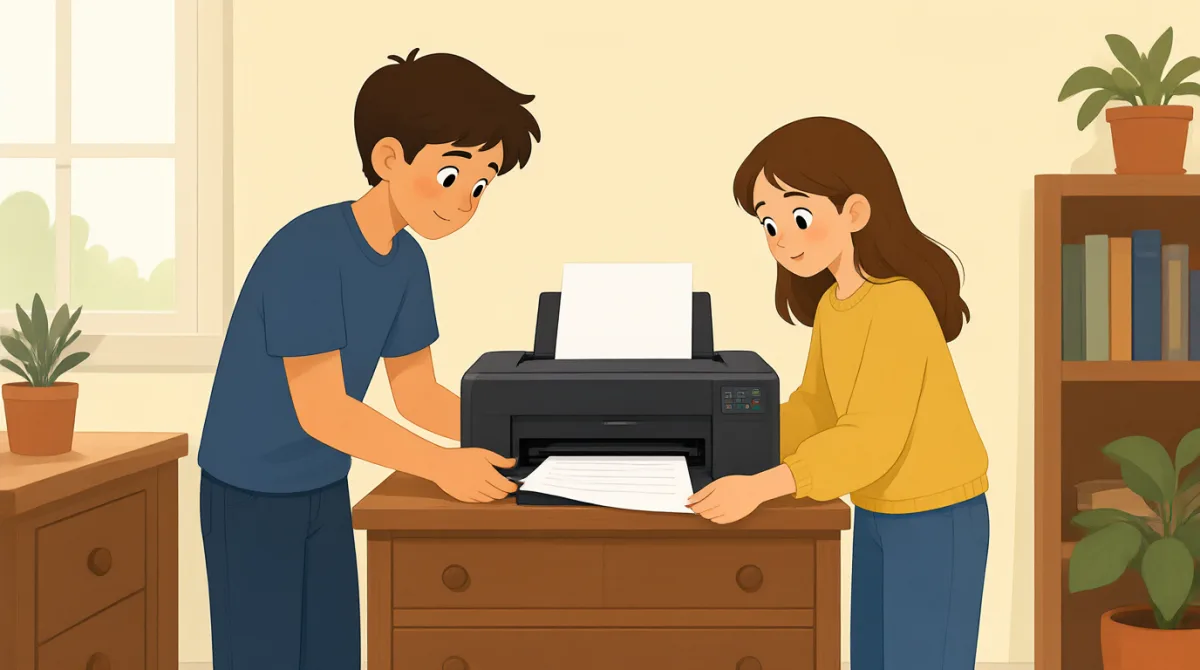

I found the paper jam. The paper is stuck near the back.
Encontrei o papel preso. Ele está preso perto da parte de trás.

Can I help? Should I pull it out?
Posso ajudar? Quer que eu puxe o papel?
Yes, but pull slowly. We don’t want to tear the paper.
Sim, mas puxe devagar. Não queremos rasgar o papel.
Okay, I can see the edge. I’ll pull it gently.
Está bem, estou vendo a ponta. Vou puxar com cuidado.
That’s right. Keep it straight, and don’t pull too hard.
Isso mesmo. Mantenha-o reto e não puxe com muita força.
It’s coming out now. Oh, the paper tore a little.
Está saindo agora. Ah, o papel rasgou um pouquinho.
That’s fine. Let’s take out the small piece, too.
Tudo bem. Vamos tirar o pedacinho também.
Got it. Is the printer ready to use now?
Pronto. A impressora já está pronta para usar?
Yes. Close the cover, then try printing your report again.
Sim. Feche a tampa e tente imprimir seu relatório de novo.
Vocabulário8
- paper jampapel preso
A paper jam happens when paper gets stuck inside a printer. You can use this phrase to describe the problem.
Papel preso é quando uma folha fica emperrada dentro da impressora. Você pode usar essa expressão para descrever o problema.
- stuck near the backpreso perto da parte de trás
This means the paper cannot move and is close to the back of the printer. Use “stuck” to describe something that cannot move.
Isso quer dizer que o papel não consegue se mover e está perto da parte de trás da impressora. Use “stuck” para descrever algo que não consegue se mover.
- pull it outpuxar para fora
This means to take something out by pulling it. You can use it when removing paper or another object.
Isso significa tirar algo puxando. Você pode usar essa expressão ao remover papel ou outro objeto.
- tear the paperrasgar o papel
This means to rip the paper into pieces. Use “tear” when paper breaks while you are pulling it.
Isso significa rasgar o papel em pedaços. Use “tear” quando o papel se rasga enquanto você o puxa.
- pull it gentlypuxar com cuidado
This means to pull something carefully and not too strongly. You can use it when an object might break or tear.
Isso significa puxar algo com cuidado e sem muita força. Você pode usar essa expressão quando um objeto pode quebrar ou rasgar.
- coming outsaindo
Here, this means the paper is moving out of the printer. Use “coming out” to describe something that is being removed.
Aqui, isso significa que o papel está saindo da impressora. Use “coming out” para descrever algo que está sendo retirado.
- small piecepedacinho
A small piece is a little part of something. You can use this phrase for a piece of paper, food, or another object.
Um pedacinho é uma parte pequena de alguma coisa. Você pode usar essa expressão para falar de um pedaço de papel, comida ou outro objeto.
- ready to usepronto para usar
This means something can be used now. You can ask “Is it ready to use?” when checking if a machine or item is working.
Isso significa que algo já pode ser usado. Você pode perguntar “Is it ready to use?” quando quiser saber se uma máquina ou um objeto está funcionando.
Frases-chave8
- 1
Can I help?
Posso ajudar?
This is a simple, friendly way to offer help. Use it when someone is having difficulty with a task.
Essa é uma forma simples e simpática de oferecer ajuda. Use-a quando alguém estiver com dificuldade para realizar uma tarefa.
- 2
Should I pull it out?
Quer que eu puxe para fora?
Use this question to ask if you should remove something. Replace “pull it out” with another action to check what to do.
Use essa pergunta para saber se você deve tirar alguma coisa. Substitua “pull it out” por outra ação para confirmar o que deve fazer.
- 3
We don’t want to tear the paper.
Não queremos rasgar o papel.
This explains why someone should be careful. You can use “We don’t want to…” to give a simple reason for an action.
Essa frase explica por que alguém deve ter cuidado. Você pode usar “We don’t want to…” para dar uma razão simples para fazer algo.
- 4
I’ll pull it gently.
Vou puxar com cuidado.
This tells someone what you plan to do carefully. Use “I’ll” plus an action to describe what you will do next.
Essa frase diz a alguém o que você pretende fazer com cuidado. Use “I’ll” seguido de uma ação para dizer o que fará em seguida.
- 5
Keep it straight, and don’t pull too hard.
Mantenha-o reto e não puxe com muita força.
This gives two clear instructions. Use “Keep it…” and “Don’t…” to guide someone doing a task.
Essa frase dá duas instruções claras. Use “Keep it…” e “Don’t…” para orientar alguém que está realizando uma tarefa.
- 6
Let’s take out the small piece, too.
Vamos tirar o pedacinho também.
Use “Let’s” to suggest doing something together. “Take out” means to remove something from inside.
Use “Let’s” para sugerir que vocês façam algo juntos. “Take out” significa tirar algo de dentro.
- 7
Is the printer ready to use now?
A impressora já está pronta para usar?
This is a useful way to check if a machine can be used. Replace “the printer” with another item, such as “the computer” or “the room.”
Essa é uma forma útil de verificar se uma máquina pode ser usada. Substitua “the printer” por outro item, como “the computer” ou “the room”.
- 8
Close the cover, then try printing your report again.
Feche a tampa e depois tente imprimir seu relatório de novo.
This gives two steps in the right order. Use “then” to show what to do after the first action.
Essa frase dá duas instruções na ordem certa. Use “then” para indicar o que fazer depois da primeira ação.