Clearing a Paper Jam
Débloquer le papier
Jack opens the printer and finds a paper jam. Emma helps him pull out the paper carefully.
Jack ouvre l’imprimante et découvre un bourrage papier. Emma l’aide à retirer le papier avec précaution.
Dialogue9
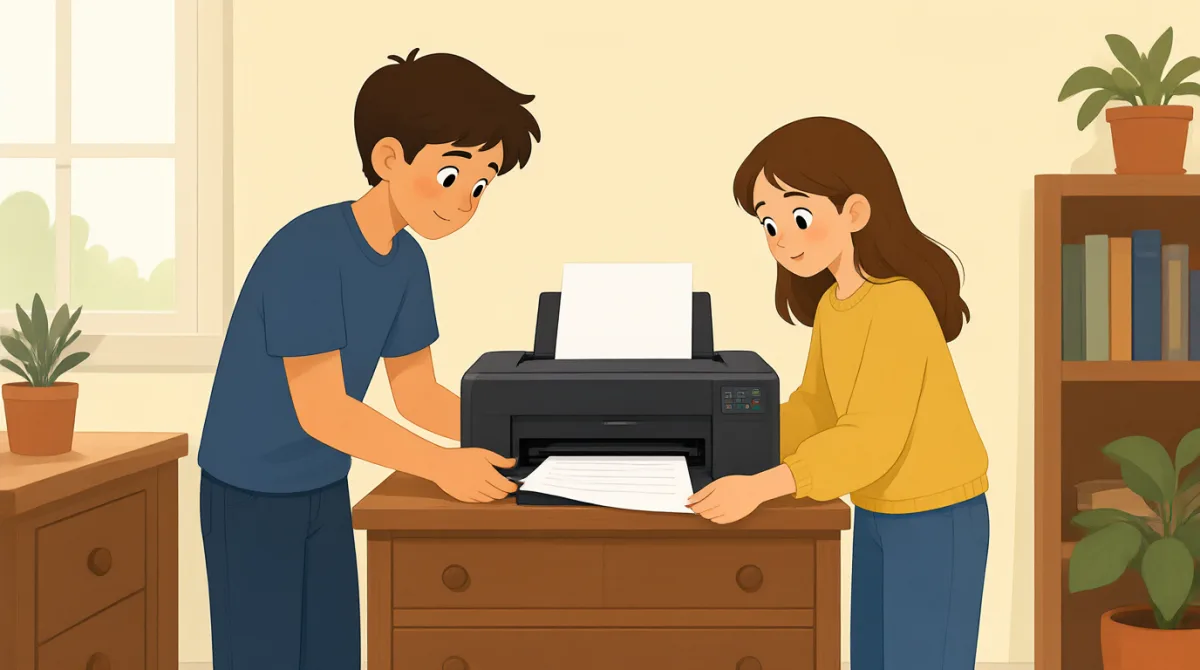

I found the paper jam. The paper is stuck near the back.
J’ai trouvé le papier coincé. Il est bloqué vers l’arrière.

Can I help? Should I pull it out?
Je peux t’aider ? Je le tire ?
Yes, but pull slowly. We don’t want to tear the paper.
Oui, mais tire doucement. On ne voudrait pas déchirer le papier.
Okay, I can see the edge. I’ll pull it gently.
D’accord, je vois le bord. Je vais tirer doucement.
That’s right. Keep it straight, and don’t pull too hard.
C’est ça. Garde-le bien droit et ne tire pas trop fort.
It’s coming out now. Oh, the paper tore a little.
Il sort maintenant. Oh, le papier s’est un peu déchiré.
That’s fine. Let’s take out the small piece, too.
Ce n’est pas grave. Retirons aussi le petit morceau.
Got it. Is the printer ready to use now?
C’est bon. L’imprimante est prête à être utilisée ?
Yes. Close the cover, then try printing your report again.
Oui. Referme le capot, puis réessaie d’imprimer ton rapport.
Vocabulaire8
- paper jambourrage papier
A paper jam happens when paper gets stuck inside a printer. You can use this phrase to describe the problem.
Un « paper jam » se produit quand du papier reste coincé dans une imprimante. Cette expression permet de décrire le problème.
- stuck near the backcoincé vers l’arrière
This means the paper cannot move and is close to the back of the printer. Use “stuck” to describe something that cannot move.
Cela signifie que le papier ne peut pas bouger et qu’il se trouve près de l’arrière de l’imprimante. Utilise « stuck » pour décrire quelque chose qui ne peut pas bouger.
- pull it outle retirer
This means to take something out by pulling it. You can use it when removing paper or another object.
Cela signifie enlever quelque chose en tirant dessus. Tu peux employer cette expression pour retirer du papier ou un autre objet.
- tear the paperdéchirer le papier
This means to rip the paper into pieces. Use “tear” when paper breaks while you are pulling it.
Cela signifie mettre le papier en morceaux en le déchirant. Utilise « tear » quand le papier se déchire pendant que tu tires dessus.
- pull it gentlytirer doucement
This means to pull something carefully and not too strongly. You can use it when an object might break or tear.
Cela signifie tirer quelque chose avec précaution, sans trop forcer. Tu peux employer cette expression quand un objet risque de se casser ou de se déchirer.
- coming outsortir
Here, this means the paper is moving out of the printer. Use “coming out” to describe something that is being removed.
Ici, cela signifie que le papier est en train de sortir de l’imprimante. Utilise « coming out » pour parler de quelque chose qu’on est en train de retirer.
- small piecepetit morceau
A small piece is a little part of something. You can use this phrase for a piece of paper, food, or another object.
Un petit morceau est une petite partie de quelque chose. Tu peux employer cette expression pour un morceau de papier, de nourriture ou d’un autre objet.
- ready to useprêt à être utilisé
This means something can be used now. You can ask “Is it ready to use?” when checking if a machine or item is working.
Cela signifie qu’on peut utiliser quelque chose maintenant. Tu peux demander « Is it ready to use? » pour vérifier si une machine ou un objet fonctionne.
Phrases clés8
- 1
Can I help?
Je peux t’aider ?
This is a simple, friendly way to offer help. Use it when someone is having difficulty with a task.
C’est une façon simple et amicale de proposer son aide. Utilise cette question quand quelqu’un a du mal à accomplir une tâche.
- 2
Should I pull it out?
Je le tire ?
Use this question to ask if you should remove something. Replace “pull it out” with another action to check what to do.
Utilise cette question pour demander si tu dois retirer quelque chose. Remplace « pull it out » par une autre action pour vérifier quoi faire.
- 3
We don’t want to tear the paper.
On ne voudrait pas déchirer le papier.
This explains why someone should be careful. You can use “We don’t want to…” to give a simple reason for an action.
Cette phrase explique pourquoi il faut faire attention. Tu peux utiliser « We don’t want to… » pour donner simplement la raison d’une action.
- 4
I’ll pull it gently.
Je vais tirer doucement.
This tells someone what you plan to do carefully. Use “I’ll” plus an action to describe what you will do next.
Cette phrase indique à quelqu’un ce que tu as l’intention de faire avec précaution. Utilise « I’ll » suivi d’une action pour dire ce que tu vas faire ensuite.
- 5
Keep it straight, and don’t pull too hard.
Garde-le bien droit et ne tire pas trop fort.
This gives two clear instructions. Use “Keep it…” and “Don’t…” to guide someone doing a task.
Cette phrase donne deux consignes claires. Utilise « Keep it… » et « Don’t… » pour guider quelqu’un qui effectue une tâche.
- 6
Let’s take out the small piece, too.
Retirons aussi le petit morceau.
Use “Let’s” to suggest doing something together. “Take out” means to remove something from inside.
Utilise « Let’s » pour proposer de faire quelque chose ensemble. « Take out » signifie retirer quelque chose de l’intérieur.
- 7
Is the printer ready to use now?
L’imprimante est prête à être utilisée ?
This is a useful way to check if a machine can be used. Replace “the printer” with another item, such as “the computer” or “the room.”
C’est une question utile pour vérifier si une machine peut être utilisée. Remplace « the printer » par un autre élément, comme « the computer » ou « the room ».
- 8
Close the cover, then try printing your report again.
Referme le capot, puis réessaie d’imprimer ton rapport.
This gives two steps in the right order. Use “then” to show what to do after the first action.
Cette phrase donne deux étapes dans le bon ordre. Utilise « then » pour indiquer quoi faire après la première action.