Clearing a Paper Jam
Gỡ giấy kẹt
Jack opens the printer and finds a paper jam. Emma helps him pull out the paper carefully.
Jack mở máy in và phát hiện giấy bị kẹt. Emma giúp anh cẩn thận kéo giấy ra.
Hội thoại9
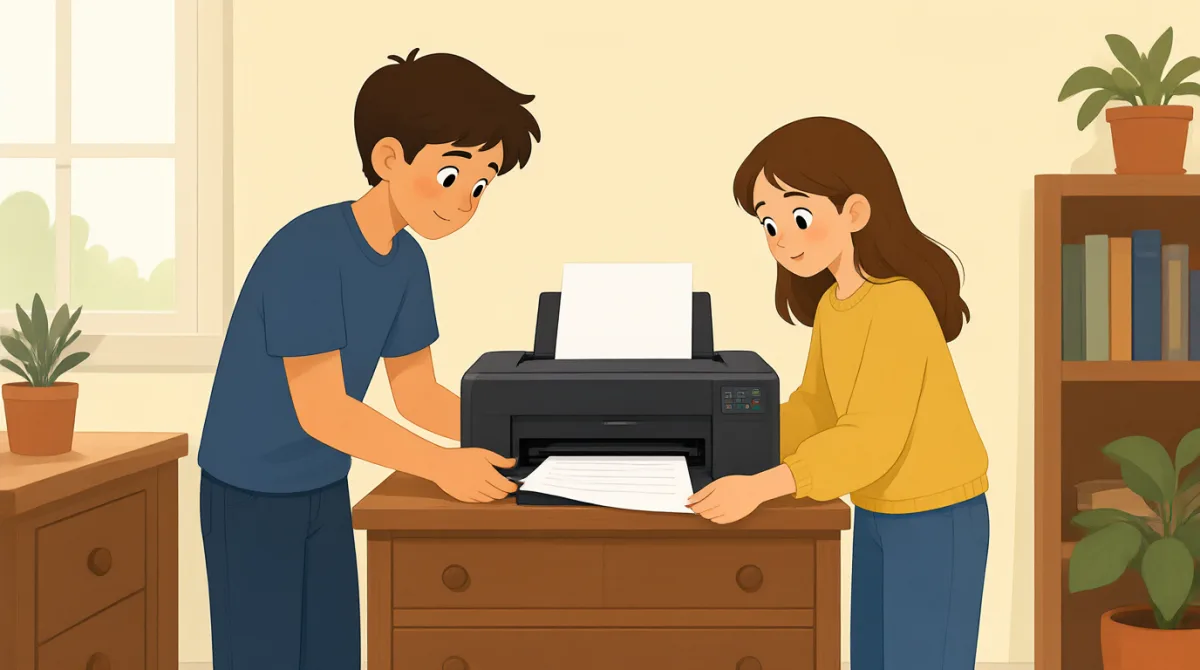

I found the paper jam. The paper is stuck near the back.
Tớ tìm thấy chỗ giấy bị kẹt rồi. Giấy mắc gần phía sau.

Can I help? Should I pull it out?
Tớ giúp được không? Tớ kéo giấy ra nhé?
Yes, but pull slowly. We don’t want to tear the paper.
Ừ, nhưng kéo từ từ thôi. Đừng để giấy bị rách.
Okay, I can see the edge. I’ll pull it gently.
Được rồi, tớ thấy mép giấy rồi. Tớ sẽ nhẹ nhàng kéo ra.
That’s right. Keep it straight, and don’t pull too hard.
Đúng rồi. Giữ cho giấy thẳng, đừng kéo mạnh quá.
It’s coming out now. Oh, the paper tore a little.
Giấy đang ra rồi. Ôi, giấy bị rách một chút.
That’s fine. Let’s take out the small piece, too.
Không sao. Mình lấy cả mảnh nhỏ đó ra nữa nhé.
Got it. Is the printer ready to use now?
Lấy ra được rồi. Bây giờ máy in dùng được chưa?
Yes. Close the cover, then try printing your report again.
Rồi. Đóng nắp lại, rồi thử in báo cáo của cậu lần nữa nhé.
Từ vựng8
- paper jamgiấy kẹt
A paper jam happens when paper gets stuck inside a printer. You can use this phrase to describe the problem.
Giấy kẹt xảy ra khi giấy mắc bên trong máy in. Bạn có thể dùng cụm từ này để nói về sự cố đó.
- stuck near the backmắc gần phía sau
This means the paper cannot move and is close to the back of the printer. Use “stuck” to describe something that cannot move.
Cụm này có nghĩa là giấy không thể di chuyển và nằm gần phía sau máy in. Dùng “stuck” để miêu tả thứ gì đó không thể di chuyển.
- pull it outkéo nó ra
This means to take something out by pulling it. You can use it when removing paper or another object.
Cụm này có nghĩa là kéo để lấy thứ gì đó ra. Bạn có thể dùng khi lấy giấy hoặc một vật khác ra.
- tear the paperlàm rách giấy
This means to rip the paper into pieces. Use “tear” when paper breaks while you are pulling it.
Cụm này có nghĩa là xé giấy thành nhiều mảnh. Dùng “tear” khi giấy bị rách trong lúc bạn kéo.
- pull it gentlynhẹ nhàng kéo nó
This means to pull something carefully and not too strongly. You can use it when an object might break or tear.
Cụm này có nghĩa là kéo thứ gì đó cẩn thận, không dùng quá nhiều lực. Bạn có thể dùng khi vật đó có thể bị hỏng hoặc rách.
- coming outđang đi ra
Here, this means the paper is moving out of the printer. Use “coming out” to describe something that is being removed.
Ở đây, cụm này có nghĩa là giấy đang di chuyển ra khỏi máy in. Dùng “coming out” để miêu tả thứ gì đó đang được lấy ra.
- small piecemảnh nhỏ
A small piece is a little part of something. You can use this phrase for a piece of paper, food, or another object.
“Mảnh nhỏ” là một phần nhỏ của thứ gì đó. Bạn có thể dùng cụm này để nói về một mảnh giấy, thức ăn hoặc vật khác.
- ready to usesẵn sàng để sử dụng
This means something can be used now. You can ask “Is it ready to use?” when checking if a machine or item is working.
Cụm này có nghĩa là có thể dùng ngay. Bạn có thể hỏi “Is it ready to use?” khi muốn kiểm tra xem máy móc hoặc đồ vật có hoạt động được không.
Câu trọng tâm8
- 1
Can I help?
Tớ giúp được không?
This is a simple, friendly way to offer help. Use it when someone is having difficulty with a task.
Đây là cách đơn giản, thân thiện để đề nghị giúp đỡ. Hãy dùng câu này khi ai đó đang gặp khó khăn với một việc.
- 2
Should I pull it out?
Tớ kéo nó ra nhé?
Use this question to ask if you should remove something. Replace “pull it out” with another action to check what to do.
Dùng câu hỏi này để hỏi xem bạn có nên lấy thứ gì đó ra không. Thay “pull it out” bằng một hành động khác để hỏi cần làm gì.
- 3
We don’t want to tear the paper.
Mình không muốn làm rách giấy.
This explains why someone should be careful. You can use “We don’t want to…” to give a simple reason for an action.
Câu này giải thích vì sao ai đó cần cẩn thận. Bạn có thể dùng “We don’t want to…” để nêu lý do đơn giản cho một hành động.
- 4
I’ll pull it gently.
Tớ sẽ nhẹ nhàng kéo nó ra.
This tells someone what you plan to do carefully. Use “I’ll” plus an action to describe what you will do next.
Câu này cho người khác biết bạn dự định làm gì một cách cẩn thận. Dùng “I’ll” cộng với một hành động để nói việc bạn sẽ làm tiếp theo.
- 5
Keep it straight, and don’t pull too hard.
Giữ cho nó thẳng, đừng kéo mạnh quá.
This gives two clear instructions. Use “Keep it…” and “Don’t…” to guide someone doing a task.
Câu này đưa ra hai chỉ dẫn rõ ràng. Dùng “Keep it…” và “Don’t…” để hướng dẫn ai đó đang làm một việc.
- 6
Let’s take out the small piece, too.
Mình lấy cả mảnh nhỏ đó ra nữa nhé.
Use “Let’s” to suggest doing something together. “Take out” means to remove something from inside.
Dùng “Let’s” để đề nghị cùng nhau làm việc gì đó. “Take out” có nghĩa là lấy thứ gì đó từ bên trong ra.
- 7
Is the printer ready to use now?
Bây giờ máy in dùng được chưa?
This is a useful way to check if a machine can be used. Replace “the printer” with another item, such as “the computer” or “the room.”
Đây là cách hữu ích để kiểm tra xem máy móc có dùng được không. Thay “the printer” bằng một vật khác, chẳng hạn “the computer” hoặc “the room.”
- 8
Close the cover, then try printing your report again.
Đóng nắp lại, rồi thử in báo cáo của cậu lần nữa.
This gives two steps in the right order. Use “then” to show what to do after the first action.
Câu này nêu hai bước theo đúng thứ tự. Dùng “then” để cho biết cần làm gì sau hành động đầu tiên.