Clearing a Paper Jam
Usuwanie zaciętego papieru
Jack opens the printer and finds a paper jam. Emma helps him pull out the paper carefully.
Jack otwiera drukarkę i znajduje zacięty papier. Emma pomaga mu ostrożnie go wyciągnąć.
Dialog9
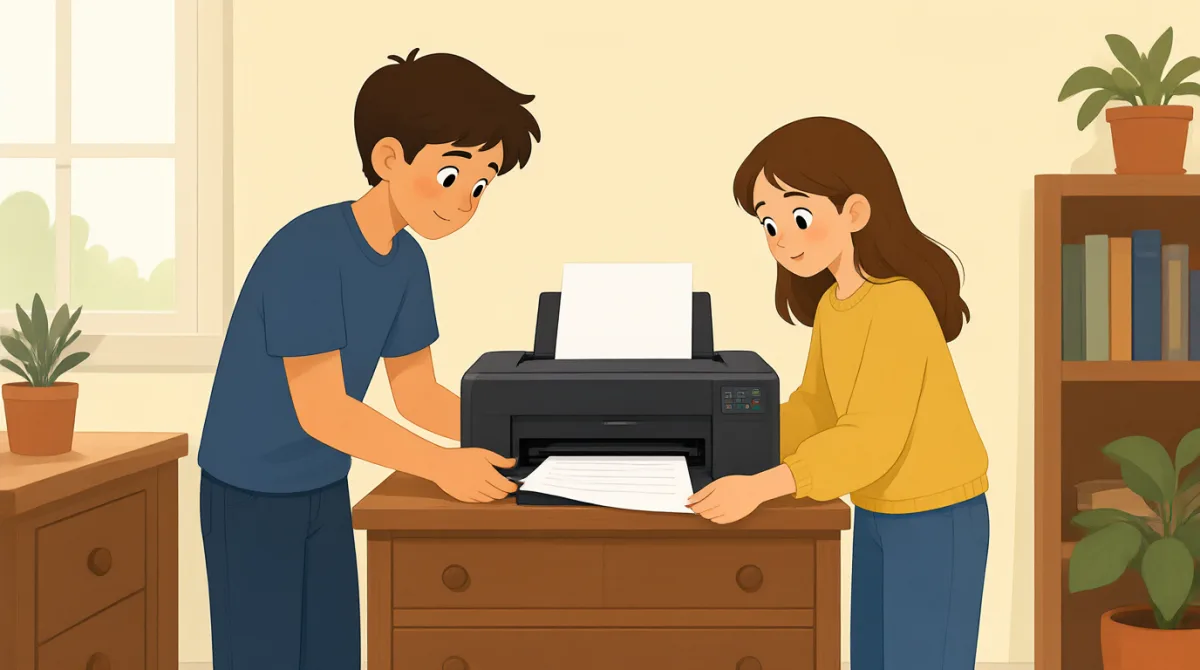

I found the paper jam. The paper is stuck near the back.
Znalazłem zacięty papier. Zablokował się z tyłu.

Can I help? Should I pull it out?
Mogę pomóc? Mam go wyciągnąć?
Yes, but pull slowly. We don’t want to tear the paper.
Tak, ale powoli. Nie chcemy podrzeć papieru.
Okay, I can see the edge. I’ll pull it gently.
Dobra, widzę brzeg. Wyciągnę go delikatnie.
That’s right. Keep it straight, and don’t pull too hard.
Właśnie tak. Trzymaj go prosto i nie ciągnij za mocno.
It’s coming out now. Oh, the paper tore a little.
Już wychodzi. O, papier trochę się podarł.
That’s fine. Let’s take out the small piece, too.
Nic nie szkodzi. Wyjmijmy też ten mały kawałek.
Got it. Is the printer ready to use now?
Gotowe. Czy można już korzystać z drukarki?
Yes. Close the cover, then try printing your report again.
Tak. Zamknij pokrywę, a potem spróbuj jeszcze raz wydrukować swój raport.
Słownictwo8
- paper jamzacięty papier
A paper jam happens when paper gets stuck inside a printer. You can use this phrase to describe the problem.
Paper jam to sytuacja, w której papier zacina się wewnątrz drukarki. Tego wyrażenia używasz, żeby opisać ten problem.
- stuck near the backzablokowany z tyłu
This means the paper cannot move and is close to the back of the printer. Use “stuck” to describe something that cannot move.
Stuck near the back oznacza, że papier nie może się poruszyć i znajduje się blisko tylnej części drukarki. Słowa stuck używa się, by opisać coś, co nie może się poruszyć.
- pull it outwyciągnąć
This means to take something out by pulling it. You can use it when removing paper or another object.
Pull it out oznacza wyjąć coś, ciągnąc. Możesz użyć tego wyrażenia, gdy wyjmujesz papier lub inny przedmiot.
- tear the paperpodrzeć papier
This means to rip the paper into pieces. Use “tear” when paper breaks while you are pulling it.
Tear the paper oznacza rozerwać papier na kawałki. Słowa tear używa się, gdy papier rwie się podczas wyciągania.
- pull it gentlywyciągać delikatnie
This means to pull something carefully and not too strongly. You can use it when an object might break or tear.
Pull it gently oznacza ciągnąć coś ostrożnie i bez używania zbyt dużej siły. Możesz użyć tego wyrażenia, gdy przedmiot może się złamać lub podrzeć.
- coming outwychodzić
Here, this means the paper is moving out of the printer. Use “coming out” to describe something that is being removed.
Tutaj coming out oznacza, że papier wysuwa się z drukarki. Tego wyrażenia używa się, by opisać coś, co jest wyjmowane.
- small piecemały kawałek
A small piece is a little part of something. You can use this phrase for a piece of paper, food, or another object.
Small piece to niewielka część czegoś. Możesz użyć tego wyrażenia w odniesieniu do kawałka papieru, jedzenia lub innego przedmiotu.
- ready to usegotowy do użycia
This means something can be used now. You can ask “Is it ready to use?” when checking if a machine or item is working.
Ready to use oznacza, że można już czegoś używać. Możesz zapytać „Is it ready to use?”, żeby sprawdzić, czy urządzenie lub przedmiot działa.
Kluczowe zdania8
- 1
Can I help?
Mogę pomóc?
This is a simple, friendly way to offer help. Use it when someone is having difficulty with a task.
To prosty, przyjazny sposób, by zaoferować pomoc. Użyj tego zdania, gdy ktoś ma trudności z wykonaniem zadania.
- 2
Should I pull it out?
Mam go wyciągnąć?
Use this question to ask if you should remove something. Replace “pull it out” with another action to check what to do.
Tego pytania używasz, by zapytać, czy masz coś wyjąć. Zastąp „pull it out” inną czynnością, żeby dowiedzieć się, co zrobić.
- 3
We don’t want to tear the paper.
Nie chcemy podrzeć papieru.
This explains why someone should be careful. You can use “We don’t want to…” to give a simple reason for an action.
To wyjaśnia, dlaczego trzeba zachować ostrożność. Możesz użyć „We don’t want to…”, by krótko uzasadnić, dlaczego należy coś zrobić w określony sposób.
- 4
I’ll pull it gently.
Wyciągnę go delikatnie.
This tells someone what you plan to do carefully. Use “I’ll” plus an action to describe what you will do next.
W ten sposób mówisz komuś, co zamierzasz zrobić ostrożnie. Użyj „I’ll” i czasownika opisującego czynność, żeby powiedzieć, co zrobisz za chwilę.
- 5
Keep it straight, and don’t pull too hard.
Trzymaj go prosto i nie ciągnij za mocno.
This gives two clear instructions. Use “Keep it…” and “Don’t…” to guide someone doing a task.
To dwie jasne instrukcje. Użyj „Keep it…” i „Don’t…”, by pokierować kimś wykonującym zadanie.
- 6
Let’s take out the small piece, too.
Wyjmijmy też ten mały kawałek.
Use “Let’s” to suggest doing something together. “Take out” means to remove something from inside.
Użyj „Let’s”, by zaproponować wspólne zrobienie czegoś. „Take out” oznacza wyjąć coś ze środka.
- 7
Is the printer ready to use now?
Czy można już korzystać z drukarki?
This is a useful way to check if a machine can be used. Replace “the printer” with another item, such as “the computer” or “the room.”
To przydatny sposób, by sprawdzić, czy można już używać urządzenia. Zastąp „the printer” innym określeniem, na przykład „the computer” lub „the room”.
- 8
Close the cover, then try printing your report again.
Zamknij pokrywę, a potem spróbuj jeszcze raz wydrukować swój raport.
This gives two steps in the right order. Use “then” to show what to do after the first action.
To dwie czynności podane we właściwej kolejności. Użyj „then”, by wskazać, co należy zrobić po pierwszej czynności.