Clearing a Paper Jam
Einen Papierstau beheben
Jack opens the printer and finds a paper jam. Emma helps him pull out the paper carefully.
Jack öffnet den Drucker und entdeckt einen Papierstau. Emma hilft ihm, das Papier vorsichtig herauszuziehen.
Dialog9
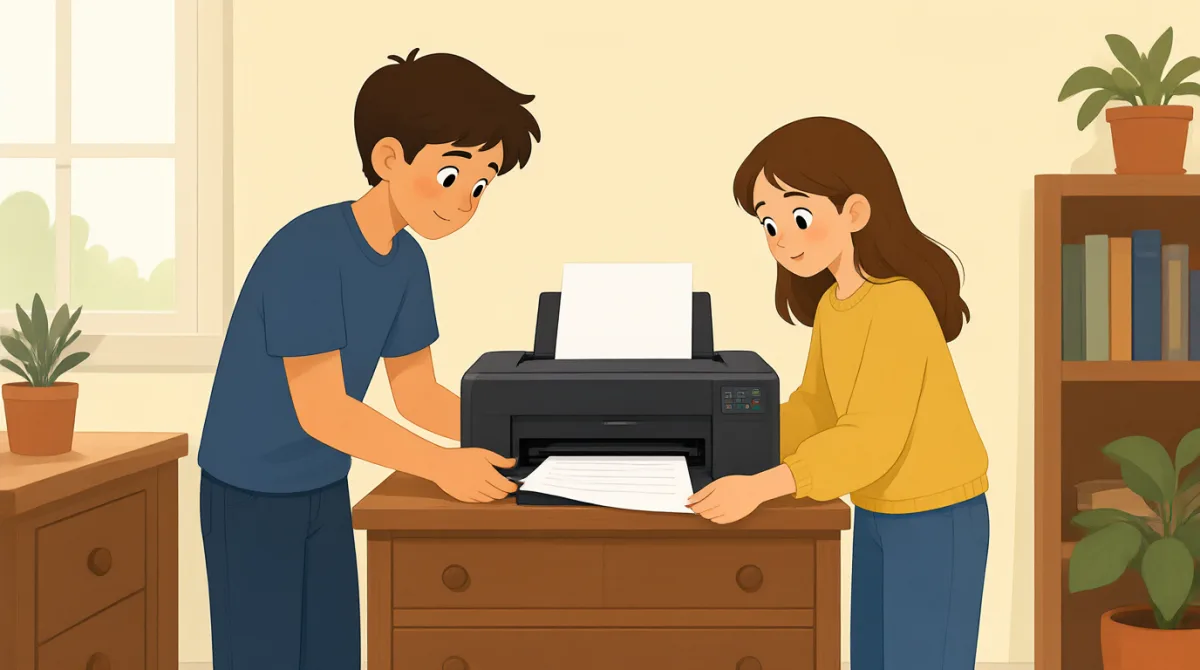

I found the paper jam. The paper is stuck near the back.
Ich hab den Papierstau gefunden. Das Papier steckt hinten fest.

Can I help? Should I pull it out?
Kann ich helfen? Soll ich es herausziehen?
Yes, but pull slowly. We don’t want to tear the paper.
Ja, aber zieh langsam. Wir wollen das Papier ja nicht zerreißen.
Okay, I can see the edge. I’ll pull it gently.
Okay, ich sehe die Kante. Ich zieh vorsichtig daran.
That’s right. Keep it straight, and don’t pull too hard.
Genau. Halte es gerade und zieh nicht zu fest.
It’s coming out now. Oh, the paper tore a little.
Es kommt jetzt raus. Oh, das Papier ist ein bisschen eingerissen.
That’s fine. Let’s take out the small piece, too.
Macht nichts. Holen wir das kleine Stück auch noch raus.
Got it. Is the printer ready to use now?
Geschafft. Kann man den Drucker jetzt wieder benutzen?
Yes. Close the cover, then try printing your report again.
Ja. Mach die Abdeckung zu und druck dann deinen Bericht noch einmal.
Wortschatz8
- paper jamPapierstau
A paper jam happens when paper gets stuck inside a printer. You can use this phrase to describe the problem.
Ein Papierstau entsteht, wenn Papier im Drucker stecken bleibt. Mit diesem Ausdruck kannst du das Problem beschreiben.
- stuck near the backhinten feststecken
This means the paper cannot move and is close to the back of the printer. Use “stuck” to describe something that cannot move.
Das bedeutet, dass sich das Papier nicht bewegen lässt und sich hinten im Drucker befindet. Mit „stuck“ beschreibst du etwas, das sich nicht bewegen kann.
- pull it outes herausziehen
This means to take something out by pulling it. You can use it when removing paper or another object.
Das bedeutet, etwas durch Ziehen herauszunehmen. Du kannst den Ausdruck verwenden, wenn du Papier oder einen anderen Gegenstand entfernst.
- tear the paperdas Papier zerreißen
This means to rip the paper into pieces. Use “tear” when paper breaks while you are pulling it.
Das bedeutet, das Papier in Stücke zu reißen. Verwende „tear“, wenn Papier beim Ziehen einreißt oder zerreißt.
- pull it gentlyvorsichtig daran ziehen
This means to pull something carefully and not too strongly. You can use it when an object might break or tear.
Das bedeutet, etwas behutsam und nicht zu kräftig zu ziehen. Du kannst den Ausdruck verwenden, wenn etwas kaputtgehen oder reißen könnte.
- coming outherauskommen
Here, this means the paper is moving out of the printer. Use “coming out” to describe something that is being removed.
Hier bedeutet das, dass das Papier aus dem Drucker herauskommt. Mit „coming out“ beschreibst du, dass etwas entfernt wird.
- small piecekleines Stück
A small piece is a little part of something. You can use this phrase for a piece of paper, food, or another object.
Ein kleines Stück ist ein kleiner Teil von etwas. Du kannst den Ausdruck für ein Stück Papier, Essen oder einen anderen Gegenstand verwenden.
- ready to useeinsatzbereit sein
This means something can be used now. You can ask “Is it ready to use?” when checking if a machine or item is working.
Das bedeutet, dass man etwas jetzt benutzen kann. Du kannst fragen „Is it ready to use?“, wenn du überprüfen willst, ob ein Gerät oder Gegenstand funktioniert und benutzt werden kann.
Wichtige Sätze8
- 1
Can I help?
Kann ich helfen?
This is a simple, friendly way to offer help. Use it when someone is having difficulty with a task.
Das ist eine einfache, freundliche Art, Hilfe anzubieten. Verwende den Satz, wenn jemand bei einer Aufgabe Schwierigkeiten hat.
- 2
Should I pull it out?
Soll ich es herausziehen?
Use this question to ask if you should remove something. Replace “pull it out” with another action to check what to do.
Mit dieser Frage erkundigst du dich, ob du etwas entfernen sollst. Ersetze „pull it out“ durch eine andere Handlung, um nachzufragen, was zu tun ist.
- 3
We don’t want to tear the paper.
Wir wollen das Papier ja nicht zerreißen.
This explains why someone should be careful. You can use “We don’t want to…” to give a simple reason for an action.
Damit erklärst du, warum jemand vorsichtig sein sollte. Mit „We don’t want to…“ kannst du einen einfachen Grund für eine Handlung nennen.
- 4
I’ll pull it gently.
Ich zieh vorsichtig daran.
This tells someone what you plan to do carefully. Use “I’ll” plus an action to describe what you will do next.
Damit sagst du jemandem, was du vorsichtig vorhast. Mit „I’ll“ und einer Handlung beschreibst du, was du als Nächstes tun wirst.
- 5
Keep it straight, and don’t pull too hard.
Halte es gerade und zieh nicht zu fest.
This gives two clear instructions. Use “Keep it…” and “Don’t…” to guide someone doing a task.
Das sind zwei klare Anweisungen. Mit „Keep it…“ und „Don’t…“ kannst du jemanden bei einer Aufgabe anleiten.
- 6
Let’s take out the small piece, too.
Holen wir das kleine Stück auch noch raus.
Use “Let’s” to suggest doing something together. “Take out” means to remove something from inside.
Mit „Let’s“ schlägst du vor, etwas gemeinsam zu tun. „Take out“ bedeutet, etwas aus dem Inneren herauszunehmen.
- 7
Is the printer ready to use now?
Kann man den Drucker jetzt wieder benutzen?
This is a useful way to check if a machine can be used. Replace “the printer” with another item, such as “the computer” or “the room.”
So kannst du nachfragen, ob ein Gerät benutzt werden kann. Ersetze „the printer“ durch einen anderen Gegenstand, zum Beispiel „the computer“ oder „the room“.
- 8
Close the cover, then try printing your report again.
Mach die Abdeckung zu und druck dann deinen Bericht noch einmal.
This gives two steps in the right order. Use “then” to show what to do after the first action.
Damit gibst du zwei Schritte in der richtigen Reihenfolge vor. Verwende „then“, um zu zeigen, was nach der ersten Handlung zu tun ist.