Asking About House Rules and Parking
Emma checks with Jack about quiet hours, taking out the trash, and where she can park. Jack explains the rules and offers a practical tip about the narrow driveway.
Dialogue8
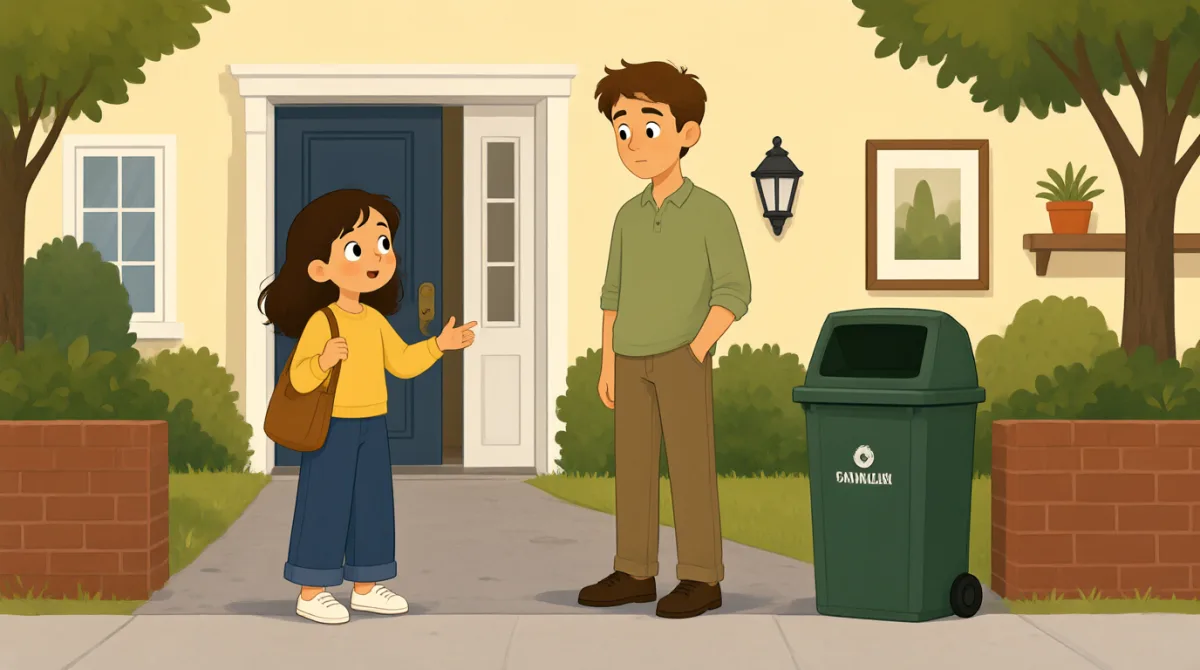

Jack, I wanted to check on a couple of house rules. Are there quiet hours in the evening?

Yes, please keep things quiet after ten. The neighbors are friendly, but sound carries pretty easily here.
Of course. And what should I do with the trash? Should I put it outside before I leave?
There are bins beside the shed. Please separate recycling, and take the bags out before checkout if they're full.
Got it. One more thing: where should I park? I noticed the driveway looks a little narrow.
You can park in the space by the fence. The driveway is tight, so it’s easier to back in slowly from the street.
Thanks for the heads-up. Is it okay if I leave my car there overnight?
Absolutely. Just leave enough room for the gate to open, and you’ll be all set.
Vocabulary8
- quiet hours
Times when people are expected to keep noise down. Here, guests should be quiet after ten in the evening.
- sound carries
Sound travels easily from one place to another. You can use this phrase to explain why people nearby may hear noise.
- separate recycling
Sort recyclable items from other trash. This phrase is useful when asking or explaining how to dispose of waste.
- before checkout
Before you leave the rental at the end of your stay. Use it to describe a task that needs to be done before departing.
- heads-up
A helpful warning or piece of information given in advance. You can say “Thanks for the heads-up” when someone alerts you to something useful.
- back in
To drive a vehicle into a parking space in reverse. It is often used when giving instructions about how to park.
- tight
Narrow or difficult to move through, with little extra space. Here, it describes a driveway that may be hard to drive into.
- all set
Ready, finished, or arranged without any problems. It’s a casual way to reassure someone that everything is taken care of.
Key Sentences7
- 1
Are there quiet hours in the evening?
Use this polite question to ask about rules for noise at a place you are visiting. You can replace “quiet hours” with another rule or restriction.
- 2
And what should I do with the trash?
This is a natural way to ask how to handle something during your stay. Replace “the trash” with another item or task, such as the towels or dishes.
- 3
Should I put it outside before I leave?
Use this question to check whether you need to do something before departing. Replace “put it outside” with the action you want to confirm.
- 4
Please separate recycling, and take the bags out before checkout if they're full.
This sentence gives two practical instructions and includes a condition with “if.” You can use the same pattern to explain what someone should do and when.
- 5
I noticed the driveway looks a little narrow.
Use “I noticed…” to introduce something you have observed before asking a follow-up question. “A little” softens the description and makes it sound less direct.
- 6
The driveway is tight, so it’s easier to back in slowly from the street.
This explains a problem and offers a practical solution using “so.” You can use this structure to give advice and a reason for it.
- 7
Just leave enough room for the gate to open, and you’ll be all set.
This gives a simple instruction followed by reassurance. Use “leave enough room for…” when someone needs to keep space clear for something.