Joining an Orientation Event
At an orientation event, Emma and Leo join a small group led by Grace and introduce themselves to other students. They exchange ideas about settling in and decide to meet up for lunch.
Dialogue9
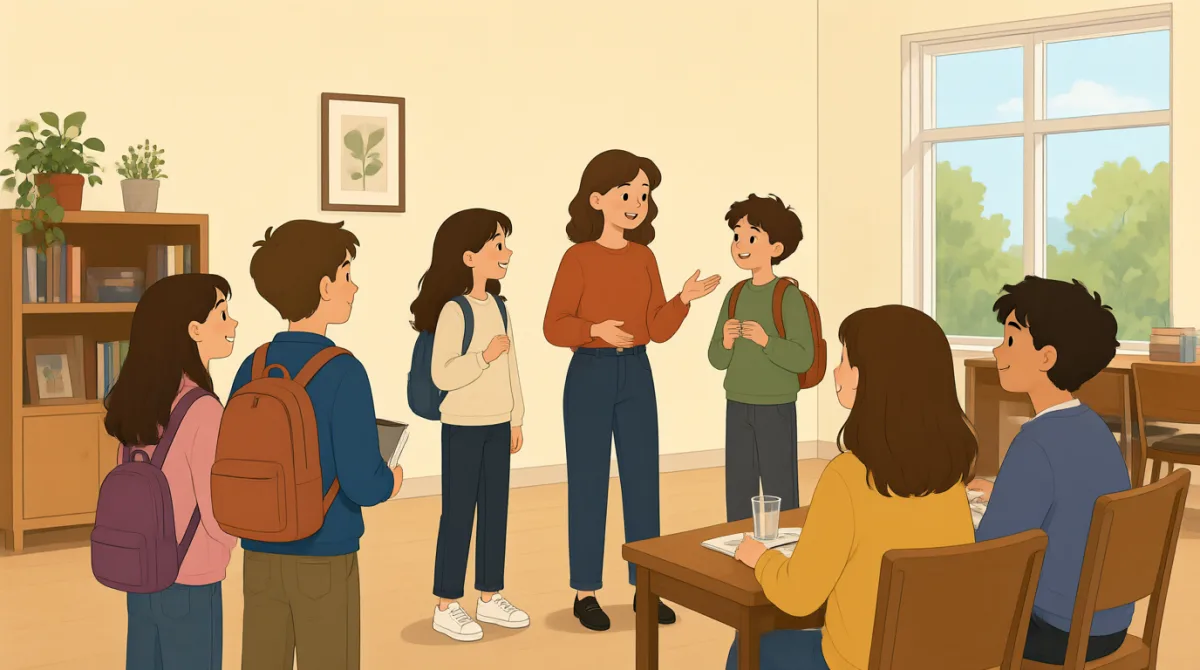

Welcome to orientation! Let’s start with a quick introduction. Share your name, what you’re studying, and one thing you’re hoping to do this week.

I’m Emma, and I’m studying environmental science. I’d love to find a good place to study and get to know the campus.

I’m Leo, a business student. I’ve been here a few days, but I still get turned around trying to find my classes.
That’s completely normal. The campus map helps, but the best way to learn is to walk around with someone who knows the area.
I’m still figuring out the buses and where to get groceries. It’s a lot to take in, but everyone’s been really welcoming.
I know what you mean. I found a little café near the library yesterday, and the sandwiches are pretty good.
That sounds like a useful tip. Why don’t you two grab lunch together after this? It’s an easy way to make the first week feel less overwhelming.
I’d love to. Leo, want to show me that café? We can compare notes on getting around campus.
Sure! Let’s meet by the library entrance at noon. And if we get lost, we’ll just call it a campus tour.
Vocabulary8
- get to know the campus
To become familiar with the campus and the places there. You might use this phrase when talking about exploring a new school.
- get turned around
To become confused about which way to go or where you are. It is a casual way to describe getting lost.
- figuring out
Learning how something works or finding a solution. Here, Emma is learning how to use the buses and where to shop.
- a lot to take in
A lot of new information or experiences to understand at once. You can use this when a new situation feels overwhelming.
- welcoming
Friendly and making someone feel accepted. It is useful for describing people or a place that helps newcomers feel comfortable.
- compare notes
To share and discuss what you each know or have experienced. Students might compare notes about classes, campus, or settling in.
- grab lunch
To have lunch, often in a casual or informal way. You can use this phrase to suggest eating together.
- meet by
To arrange to meet near a particular place. For example, you can say, “Let’s meet by the main entrance.”
Key Sentences8
- 1
The campus map helps, but the best way to learn is to walk around with someone who knows the area.
This sentence gives advice and contrasts two ways of learning a place. Reuse “The best way to learn is to…” to suggest a practical way to gain experience.
- 2
I’m still figuring out the buses and where to get groceries.
This is a natural way to explain what you are still learning in a new place. Replace “the buses” and “where to get groceries” with other things you are working out.
- 3
It’s a lot to take in, but everyone’s been really welcoming.
This sentence acknowledges that a new experience can feel overwhelming while also sharing a positive impression. Use “It’s a lot to take in, but…” to balance a challenge with a reassuring point.
- 4
I know what you mean.
This short phrase shows that you understand and relate to someone’s experience. It is useful in conversation before adding your own example or opinion.
- 5
Why don’t you two grab lunch together after this?
This is a friendly way to suggest an activity. Use “Why don’t you…?” to make an informal suggestion to one person or a group.
- 6
I’d love to.
This is a warm, enthusiastic way to accept an invitation. You can use it on its own before confirming the details.
- 7
We can compare notes on getting around campus.
This sentence suggests sharing information about a common topic. Reuse “We can compare notes on…” when you want to discuss what you each know or have experienced.
- 8
Let’s meet by the library entrance at noon.
This clearly sets a meeting place and time. Use “Let’s meet by [place] at [time]” to make a simple plan.