Falling Down
Emma falls while practicing on a gentle slope. Grace calmly shows her how to get back up and try again.
Dialogue8
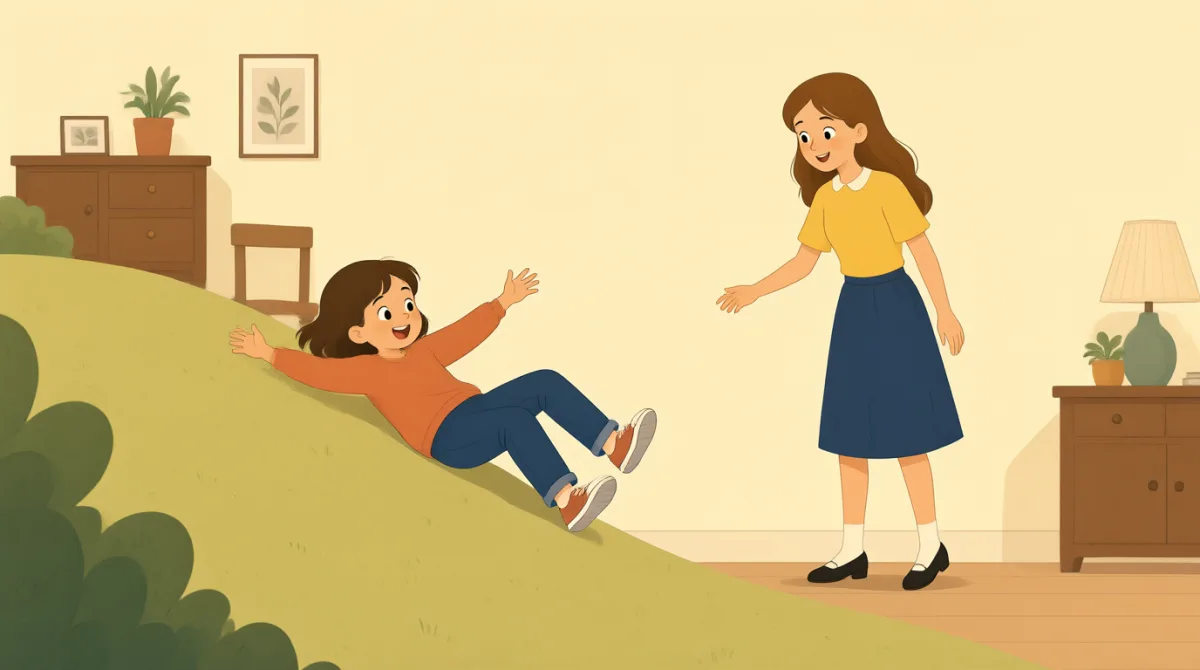

Oh! I fell down. I can't get up with my skis on.

It's okay, Emma. Stay calm. We'll get you back up.
Should I take my skis off first?
No, keep them on. Turn onto your side and point your skis across the slope.
All right. My legs feel a little tangled.
Move your skis apart. Put your hands in the snow, then push yourself up.
I did it! That was harder than I thought.
You did great. Take a breath, then try the slope again when you're ready.
Vocabulary7
- fell down
This means you dropped to the ground. Use it to describe a fall that happened in the past.
- get up
This means to move from the ground to a standing position. You can use it after a fall or when you wake up.
- stay calm
This means to remain relaxed and not panic. It is useful advice in a difficult or surprising situation.
- turn onto your side
This means to roll your body so that one side faces the ground. It is a simple instruction for changing your position.
- across the slope
This means from one side of the hill to the other, rather than straight down. It describes the direction to point your skis.
- push yourself up
This means to use your arms and body to rise from the ground. You can use it when you need to stand up after falling.
- when you're ready
This means when you feel prepared to do something. It is a gentle way to let someone choose when to begin.
Key Sentences7
- 1
I can't get up with my skis on.
Use this to explain that you cannot stand while wearing or carrying something. Replace “my skis” with another item to describe your situation.
- 2
Stay calm.
This is a short way to tell someone not to panic. You can use it to comfort someone in a stressful moment.
- 3
Should I take my skis off first?
Use “Should I...?” to ask for advice about what to do. Replace “take my skis off” with another action to ask about the best next step.
- 4
Turn onto your side and point your skis across the slope.
This sentence gives two clear instructions. You can use “Turn onto...” and “point...” to explain how to move or position something.
- 5
Put your hands in the snow, then push yourself up.
Use “Put..., then...” to give steps in order. You can replace “your hands” and “the snow” with other body parts and places.
- 6
I did it!
This is a happy way to say you completed something difficult. Use it after finishing a task or trying something new.
- 7
Take a breath, then try the slope again when you're ready.
This gives gentle advice to pause before trying again. You can use “Take a breath, then...” to encourage someone to continue at their own pace.