Explaining the Children's Routine
Emma explains when the children eat, play, and go to bed. Grace asks a few questions to make sure she understands the routine.
Dialogue9
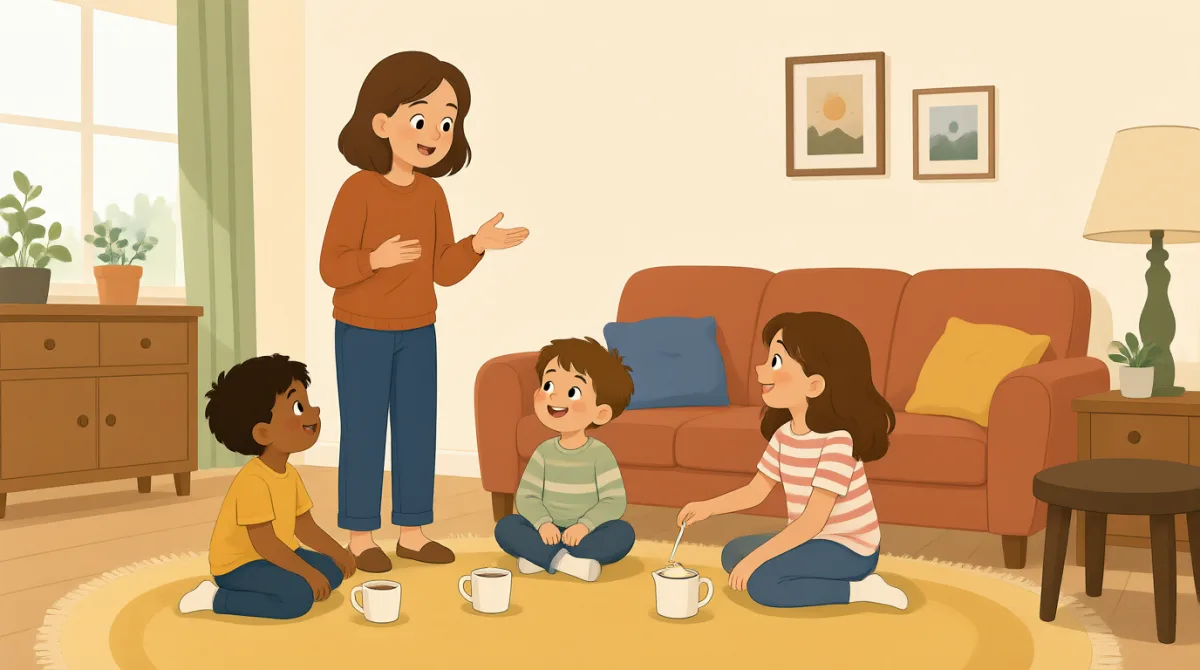

The kids usually eat dinner at six, and then they play for a little while.

What do they like to eat? Do they have any food allergies?
They like pasta and fruit. No allergies, but please cut the grapes in half.
Of course. What time do they start getting ready for bed?
At seven thirty, they brush their teeth and put on their pajamas.
Do you read them a story, or do they choose one?
They each choose a book. Lights out is at eight o’clock.
Got it. Where do they keep their books and pajamas?
The books are on the shelf, and their pajamas are in the top drawer.
Vocabulary6
- for a little while
This means for a short time. Use it to say how long an activity lasts.
- food allergies
These are health problems caused by certain foods. You can ask, “Do you have any food allergies?” to check what someone can safely eat.
- cut the grapes in half
This means cut each grape into two pieces. Use “cut [something] in half” to explain how to prepare food.
- put on their pajamas
This means dress in their sleep clothes. Use “put on” to talk about wearing clothes.
- Lights out is at eight o’clock.
This means it is time to turn off the lights and go to sleep at eight. You can use “Lights out is at [time]” to explain a bedtime.
- top drawer
This is the highest drawer in a piece of furniture. Use it to tell someone where something is kept.
Key Sentences7
- 1
The kids usually eat dinner at six, and then they play for a little while.
This sentence explains a simple daily routine in order. Use “usually” and “and then” to describe what happens and when.
- 2
What do they like to eat?
This is a useful way to ask about someone’s food preferences. You can replace “they” with “you,” “he,” or “she.”
- 3
Do they have any food allergies?
Use this question to check whether someone needs to avoid certain foods. You can also ask, “Do you have any food allergies?”
- 4
Of course.
This is a friendly way to say yes or agree to do something. It is useful when someone makes a request.
- 5
What time do they start getting ready for bed?
This question asks when a bedtime routine begins. Replace “they” with another person or group to ask about their routine.
- 6
They each choose a book.
This explains that every child chooses one book. Use “each” to talk about people doing something individually.
- 7
The books are on the shelf, and their pajamas are in the top drawer.
This sentence gives two clear locations. Use “on” for something on a surface and “in” for something inside a drawer.