Reading the Letters
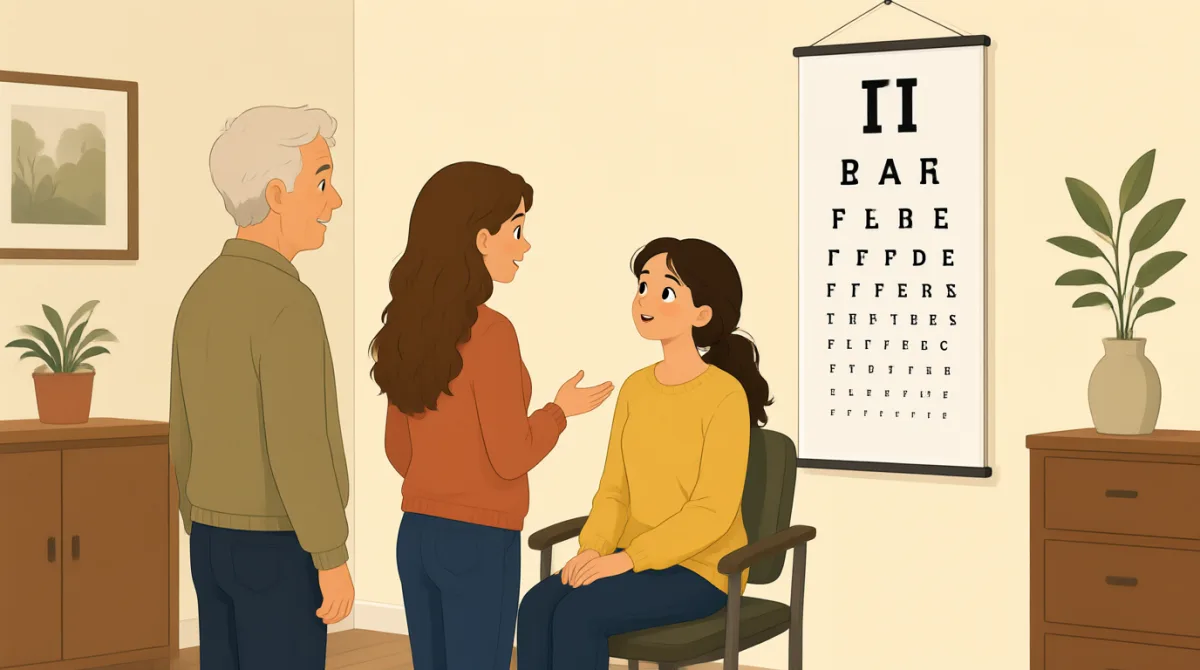
At the eye test, Grace asks Emma to read letters on a chart. Emma answers and asks if her eyesight has changed.
Dialogue9

Please cover one eye and read the letters on the top line.

Okay, I see a big E and a few smaller letters.
Good. Now cover your other eye and read the next line.
I can read most of them, but the last two look blurry.
That’s fine. Look through these lenses. Is it clearer now?
Yes, much clearer. Has my eyesight changed since my last test?
A little. You need a slightly stronger prescription for distance.
I see. Could that be why road signs look blurry?
Yes, that’s likely. We’ll write down your new prescription today.
Vocabulary6
- cover one eye
Put something over one eye so you cannot see through it. It is a simple instruction during an eye test.
- top line
The first line at the top of the eye chart. You can use “top line” to talk about the highest row of words or letters.
- blurry
Not clear or easy to see. You can say something looks blurry when you cannot see its details well.
- look through these lenses
Look through these pieces of glass or plastic to test how well you can see. It is a useful phrase at an eye test.
- prescription
Instructions for the glasses you need, including the strength of the lenses. A stronger prescription means the lenses need to correct your vision more.
- road signs
Signs beside roads that give drivers information or directions. You might mention them when explaining what is hard to see.
Key Sentences8
- 1
Please cover one eye and read the letters on the top line.
This is a polite, clear instruction. You can reuse “Please [action] and [action]” to give someone two simple steps.
- 2
I can read most of them, but the last two look blurry.
This sentence explains what you can see and what you cannot see clearly. Use “I can…, but…” to compare two things.
- 3
Look through these lenses.
This is a short instruction for trying glasses or lenses. You can use “Look through these…” when asking someone to test their vision.
- 4
Is it clearer now?
This question checks whether something is easier to see after a change. You can reuse “Is it [adjective] now?” to ask about a result.
- 5
Has my eyesight changed since my last test?
This is a useful question when comparing your vision with an earlier test. Use “Has my [noun] changed since…?” to ask about a change over time.
- 6
You need a slightly stronger prescription for distance.
This tells someone what kind of glasses they need. “Slightly stronger” means a little stronger, and “for distance” means for seeing things far away.
- 7
Could that be why road signs look blurry?
This is a polite way to ask if one thing may explain another. You can reuse “Could that be why…?” when checking a possible reason.
- 8
We’ll write down your new prescription today.
This explains what will happen next. Use “We’ll [action] today” to tell someone about a planned action.