Reading the Letters
Membaca Huruf
At the eye test, Grace asks Emma to read letters on a chart. Emma answers and asks if her eyesight has changed.
Saat pemeriksaan mata, Grace meminta Emma membaca huruf-huruf pada bagan. Emma menjawab dan bertanya apakah penglihatannya berubah.
Dialog9
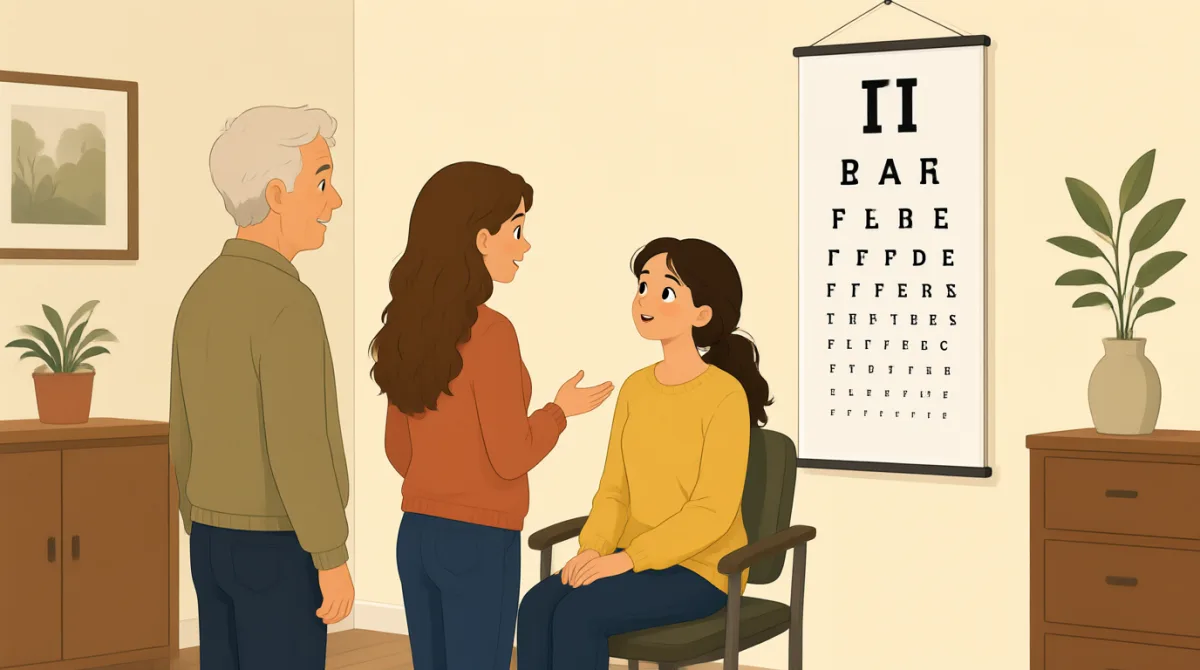

Please cover one eye and read the letters on the top line.
Silakan tutup satu mata dan baca huruf-huruf di baris paling atas.

Okay, I see a big E and a few smaller letters.
Baik. Aku melihat huruf E besar dan beberapa huruf yang lebih kecil.
Good. Now cover your other eye and read the next line.
Bagus. Sekarang tutup mata yang satunya dan baca baris berikutnya.
I can read most of them, but the last two look blurry.
Aku bisa membaca sebagian besar hurufnya, tapi dua huruf terakhir terlihat buram.
That’s fine. Look through these lenses. Is it clearer now?
Tidak apa-apa. Lihat melalui lensa ini. Sekarang lebih jelas?
Yes, much clearer. Has my eyesight changed since my last test?
Ya, jauh lebih jelas. Apakah penglihatanku berubah sejak pemeriksaan terakhir?
A little. You need a slightly stronger prescription for distance.
Sedikit. Kamu perlu resep kacamata yang sedikit lebih kuat untuk melihat jauh.
I see. Could that be why road signs look blurry?
Begitu. Apa itu mungkin sebabnya rambu jalan terlihat buram?
Yes, that’s likely. We’ll write down your new prescription today.
Ya, kemungkinan begitu. Hari ini kami akan mencatat resep kacamata barumu.
Kosakata6
- cover one eyemenutup satu mata
Put something over one eye so you cannot see through it. It is a simple instruction during an eye test.
Tutup satu mata dengan sesuatu agar kamu tidak bisa melihat melalui mata itu. Ini instruksi sederhana saat pemeriksaan mata.
- top linebaris paling atas
The first line at the top of the eye chart. You can use “top line” to talk about the highest row of words or letters.
Baris pertama yang berada di bagian paling atas bagan pemeriksaan mata. Kamu bisa memakai “top line” untuk membicarakan baris kata atau huruf yang paling atas.
- blurryburam
Not clear or easy to see. You can say something looks blurry when you cannot see its details well.
Tidak jelas atau sulit dilihat. Kamu bisa mengatakan sesuatu terlihat buram saat detailnya tidak terlihat dengan baik.
- look through these lenseslihat melalui lensa ini
Look through these pieces of glass or plastic to test how well you can see. It is a useful phrase at an eye test.
Lihat melalui potongan kaca atau plastik ini untuk menguji seberapa baik kamu bisa melihat. Ini ungkapan yang berguna saat pemeriksaan mata.
- prescriptionresep kacamata
Instructions for the glasses you need, including the strength of the lenses. A stronger prescription means the lenses need to correct your vision more.
Petunjuk tentang kacamata yang kamu butuhkan, termasuk kekuatan lensanya. Resep yang lebih kuat berarti lensa harus mengoreksi penglihatanmu lebih banyak.
- road signsrambu jalan
Signs beside roads that give drivers information or directions. You might mention them when explaining what is hard to see.
Rambu di tepi jalan yang memberikan informasi atau petunjuk arah kepada pengemudi. Kamu mungkin menyebutkannya saat menjelaskan apa yang sulit dilihat.
Kalimat Kunci8
- 1
Please cover one eye and read the letters on the top line.
Silakan tutup satu mata dan baca huruf-huruf di baris paling atas.
This is a polite, clear instruction. You can reuse “Please [action] and [action]” to give someone two simple steps.
Ini instruksi yang sopan dan jelas. Kamu bisa menggunakan kembali “Please [action] and [action]” untuk memberi seseorang dua langkah sederhana.
- 2
I can read most of them, but the last two look blurry.
Aku bisa membaca sebagian besar hurufnya, tapi dua huruf terakhir terlihat buram.
This sentence explains what you can see and what you cannot see clearly. Use “I can…, but…” to compare two things.
Kalimat ini menjelaskan apa yang bisa dan tidak bisa kamu lihat dengan jelas. Gunakan “I can…, but…” untuk membandingkan dua hal.
- 3
Look through these lenses.
Lihat melalui lensa ini.
This is a short instruction for trying glasses or lenses. You can use “Look through these…” when asking someone to test their vision.
Ini instruksi singkat untuk mencoba kacamata atau lensa. Kamu bisa menggunakan “Look through these…” saat meminta seseorang menguji penglihatannya.
- 4
Is it clearer now?
Sekarang lebih jelas?
This question checks whether something is easier to see after a change. You can reuse “Is it [adjective] now?” to ask about a result.
Pertanyaan ini memeriksa apakah sesuatu lebih mudah dilihat setelah ada perubahan. Kamu bisa menggunakan kembali “Is it [adjective] now?” untuk menanyakan hasilnya.
- 5
Has my eyesight changed since my last test?
Apakah penglihatanku berubah sejak pemeriksaan terakhir?
This is a useful question when comparing your vision with an earlier test. Use “Has my [noun] changed since…?” to ask about a change over time.
Ini pertanyaan yang berguna untuk membandingkan penglihatanmu dengan hasil pemeriksaan sebelumnya. Gunakan “Has my [noun] changed since…?” untuk menanyakan perubahan dari waktu ke waktu.
- 6
You need a slightly stronger prescription for distance.
Kamu perlu resep kacamata yang sedikit lebih kuat untuk melihat jauh.
This tells someone what kind of glasses they need. “Slightly stronger” means a little stronger, and “for distance” means for seeing things far away.
Kalimat ini memberi tahu seseorang jenis kacamata yang mereka butuhkan. “Slightly stronger” berarti sedikit lebih kuat, dan “for distance” berarti untuk melihat benda yang jauh.
- 7
Could that be why road signs look blurry?
Apa itu mungkin sebabnya rambu jalan terlihat buram?
This is a polite way to ask if one thing may explain another. You can reuse “Could that be why…?” when checking a possible reason.
Ini cara yang sopan untuk menanyakan apakah satu hal mungkin menjelaskan hal lain. Kamu bisa menggunakan kembali “Could that be why…?” saat memastikan kemungkinan penyebab.
- 8
We’ll write down your new prescription today.
Hari ini kami akan mencatat resep kacamata barumu.
This explains what will happen next. Use “We’ll [action] today” to tell someone about a planned action.
Kalimat ini menjelaskan apa yang akan terjadi selanjutnya. Gunakan “We’ll [action] today” untuk memberi tahu seseorang tentang tindakan yang direncanakan.