Where Is Your Hometown?
Emma asks Mia where she grew up. Mia tells her which part of the country her hometown is in.
Dialogue8
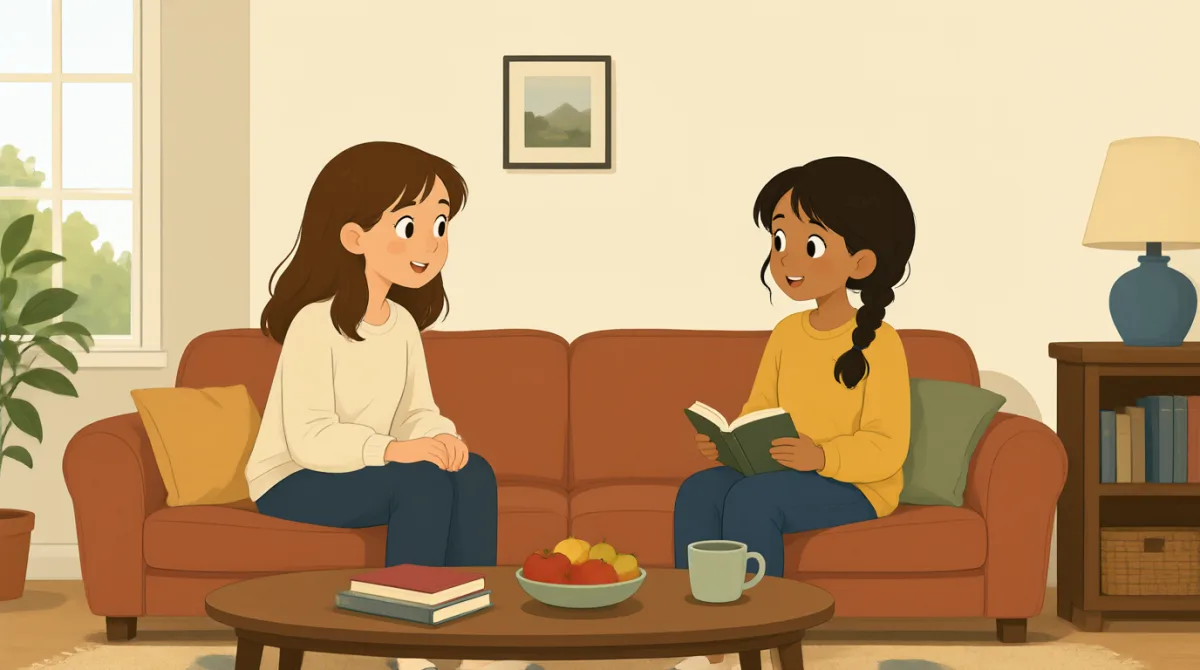

Mia, where is your hometown? I don't think you've told me.

It's in the eastern part of the country, not far from the coast.
Oh, nice! What state is it in?
It's in North Carolina. I grew up there and lived there until college.
I've never been there. Is it near the mountains or the ocean?
It's closer to the ocean, but you can drive to the mountains in a few hours.
That sounds like a great place to grow up!
It was. I still miss it, especially when I visit my family there.
Vocabulary8
- hometown
The town or city where someone grew up or comes from. You can ask, “Where is your hometown?”
- the eastern part of the country
The area in the east of a country. Use “the [direction] part of the country” to describe where a place is.
- not far from the coast
Close to the land beside the sea. You can use “not far from” to say that one place is near another.
- I grew up there
This means “I spent my childhood there.” Use “I grew up in” or “I grew up there” to talk about your childhood home.
- until college
This means up to the time when college started. Use “until” to say when an action or situation ended.
- closer to the ocean
This means nearer to the ocean than to another place or feature. Use “closer to” when comparing distances.
- in a few hours
This means after traveling for a few hours. You can use it to describe how long it takes to reach a place.
- I still miss it
This means you continue to feel sad because you are away from a place. Use “I still miss” to talk about a place or person you remember fondly.
Key Sentences8
- 1
Mia, where is your hometown?
This is a simple, friendly way to ask where someone comes from. You can replace “your hometown” with another place, such as “your school” or “your hotel.”
- 2
It's in the eastern part of the country, not far from the coast.
This sentence describes a place using a direction and a nearby landmark. You can change “eastern” and “the coast” to give different location details.
- 3
I grew up there and lived there until college.
This sentence tells someone where you spent your childhood and how long you lived there. Use “I grew up there” and “until” to share similar information about your past.
- 4
I've never been there.
This is a common way to say you have not visited a place at any time. Replace “there” with a place name to talk about somewhere specific.
- 5
Is it near the mountains or the ocean?
This is a useful question when you want to know what a place is close to. You can replace “the mountains or the ocean” with other landmarks.
- 6
It's closer to the ocean, but you can drive to the mountains in a few hours.
This sentence compares distances and explains how long a trip takes. Use “closer to” to compare places and “you can drive to” to describe a journey by car.
- 7
That sounds like a great place to grow up!
This is a friendly way to respond when someone describes their hometown. You can replace “a great place” with another description, such as “a fun place.”
- 8
I still miss it, especially when I visit my family there.
This sentence explains that someone continues to miss a place and gives a reason or situation. Use “especially when” to add when a feeling is strongest.