Too Scared for the Roller Coaster
Leo is excited to ride the roller coaster, but Emma feels nervous when she sees how high it is. Mia encourages her, and Emma decides whether to get on.
Dialogue8
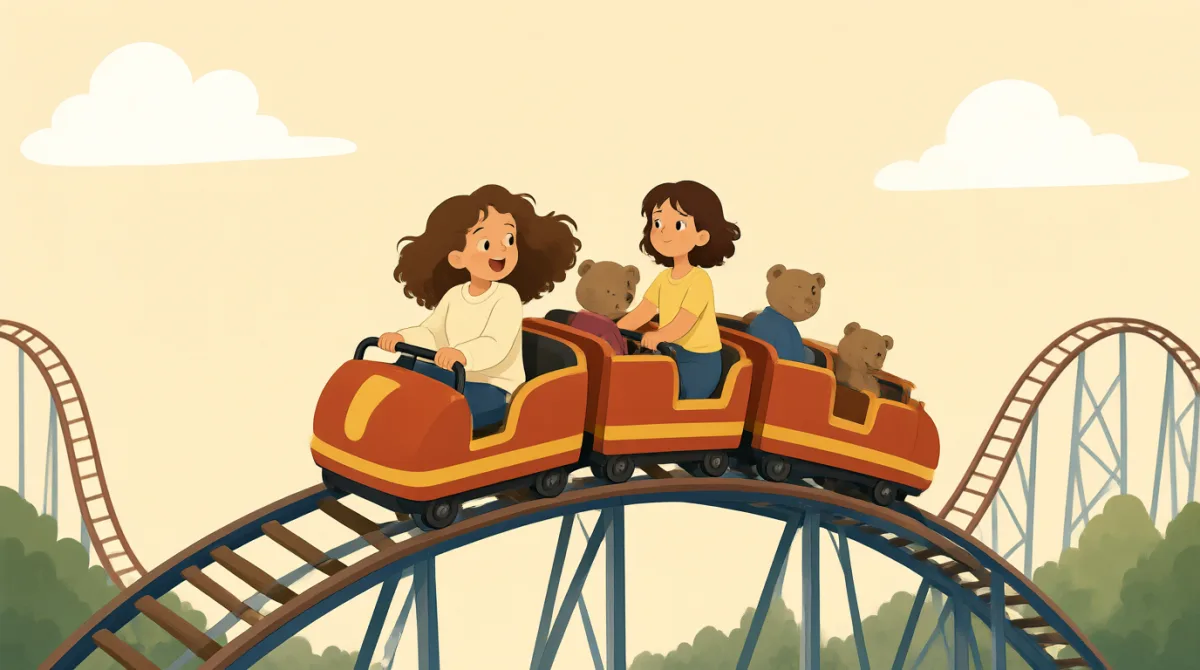

There it is! The roller coaster looks amazing. Let's get in line!

Whoa, it's really high. I didn't think it would be this scary.

That's okay, Emma. We can watch it go around once before you decide.
I rode one like this last summer. It was fast, but a lot of fun.
Did you feel scared at the top? I don't like that big drop.
A little, but it was over quickly. You can sit beside Mia if you want.
We don't have to ride it. We can try the gentle ride nearby instead.
I want to try it, but I'll sit beside you, Mia. Let's get in line!
Vocabulary6
- get in line
To join the people waiting for something. You can say this when you are ready to wait for a ride or to buy something.
- really high
Very tall or far above the ground. Here, Emma uses it to describe the roller coaster.
- go around
To move along a path and come back around. Here, it describes the roller coaster moving on its track.
- a lot of fun
Very enjoyable. You can use this phrase to say that an activity was enjoyable.
- sit beside
To sit next to someone. You can use this phrase when choosing where to sit.
- nearby
Close to where you are. Here, Mia uses it to describe a gentle ride close to the roller coaster.
Key Sentences8
- 1
Let's get in line!
This is a friendly way to suggest joining a queue. Replace “in line” with another activity to make a suggestion, such as “Let's get started!”
- 2
I didn't think it would be this scary.
Use this sentence when something feels more frightening than you expected. You can replace “scary” with another adjective, like “difficult” or “expensive.”
- 3
We can watch it go around once before you decide.
This offers someone time to observe before making a choice. Use “before you decide” when you want to give someone time to think.
- 4
I rode one like this last summer.
This is a useful way to talk about a similar experience in the past. Replace “last summer” with another past time, such as “last week.”
- 5
Did you feel scared at the top?
Use this question to ask whether someone felt afraid at a particular moment or place. Change “scared” to another feeling, like “nervous” or “excited.”
- 6
We don't have to ride it.
This reassures someone that an activity is optional. You can use “We don't have to” before another verb, such as “wait” or “leave.”
- 7
I want to try it, but I'll sit beside you, Mia.
This sentence shows both a decision and a condition that makes someone feel more comfortable. Use “I want to…, but I'll…” to explain what you are willing to do.
- 8
Let's get in line!
This is a natural way to suggest joining a queue together. You can use “Let's” followed by a verb to make friendly suggestions.