Choosing the First Ride
The friends look at the ride map and decide where to go first. Leo wants an exciting ride, while Mia suggests starting with something gentle.
Dialogue8
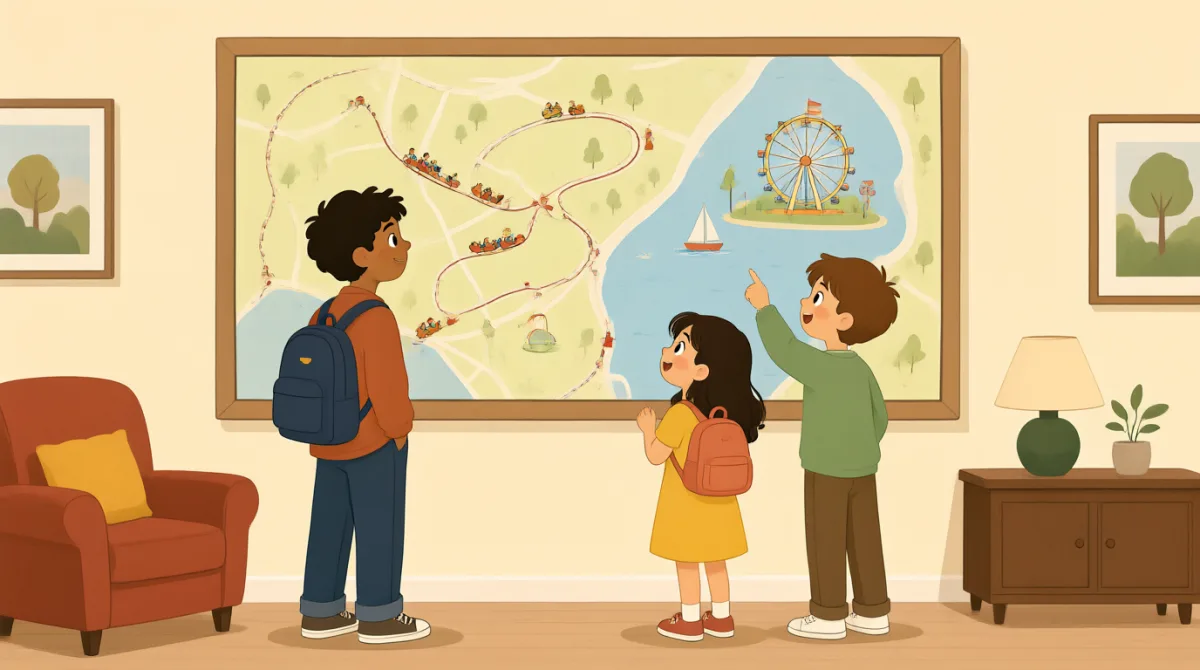

Here’s the ride map. What should we try first?

Let’s go to the big roller coaster! It looks amazing.

It does, but maybe we should start with something gentle.
Come on, Mia! We didn’t come here to take it easy.
What about the little boat ride? It’s right over there.
Good idea. We can warm up there, then try a bigger ride.
Fine, but after that, we’re going straight to the coaster.
Deal! Let’s follow the map and head to the boats.
Vocabulary7
- ride map
A ride map shows where the rides are in the amusement park. You can use it to decide where to go.
- try first
This means to choose something to do before the other options. You can say, “What should we try first?” when making a plan.
- something gentle
This means an activity that is not too fast or scary. You can use it to suggest an easy way to start.
- take it easy
This means to relax or do something without rushing. Here, Leo says they did not come to the park to choose an easy ride.
- warm up
To warm up means to start with an easy activity before doing something more difficult. You can warm up before trying a bigger ride.
- straight to
This means going directly to a place or activity. You can say, “Let’s go straight to the entrance.”
- head to
To head to a place means to go there. You can say, “Let’s head to the boats” when you are ready to leave.
Key Sentences7
- 1
What should we try first?
Use this question when you need to choose the first activity or place. Replace “try” with another verb, such as “visit” or “eat.”
- 2
Let’s go to the big roller coaster!
This is a friendly way to suggest an activity. You can change the place or activity after “go to.”
- 3
Maybe we should start with something gentle.
Use this to suggest beginning with an easy or calm activity. “Maybe we should” makes the suggestion sound polite.
- 4
What about the little boat ride?
Use “What about...?” to offer an idea or suggestion. You can use it with a place, activity, or plan.
- 5
We can warm up there, then try a bigger ride.
This sentence explains a plan with two steps. Use “then” to show what you will do next.
- 6
After that, we’re going straight to the coaster.
Use “after that” to say what you plan to do next. “We’re going” can describe a future plan.
- 7
Let’s follow the map and head to the boats.
This is a useful way to suggest going somewhere together. Replace “the boats” with another destination.