Putting Your Bag Under the Bus
Wkładanie bagażu pod autobus
At the bus station, Emma asks the driver, David, where to put her suitcase. David helps her store it safely under the bus.
Na dworcu autobusowym Emma pyta kierowcę, Davida, gdzie powinna umieścić swoją walizkę. David pomaga jej bezpiecznie schować ją pod autobusem.
Dialog8
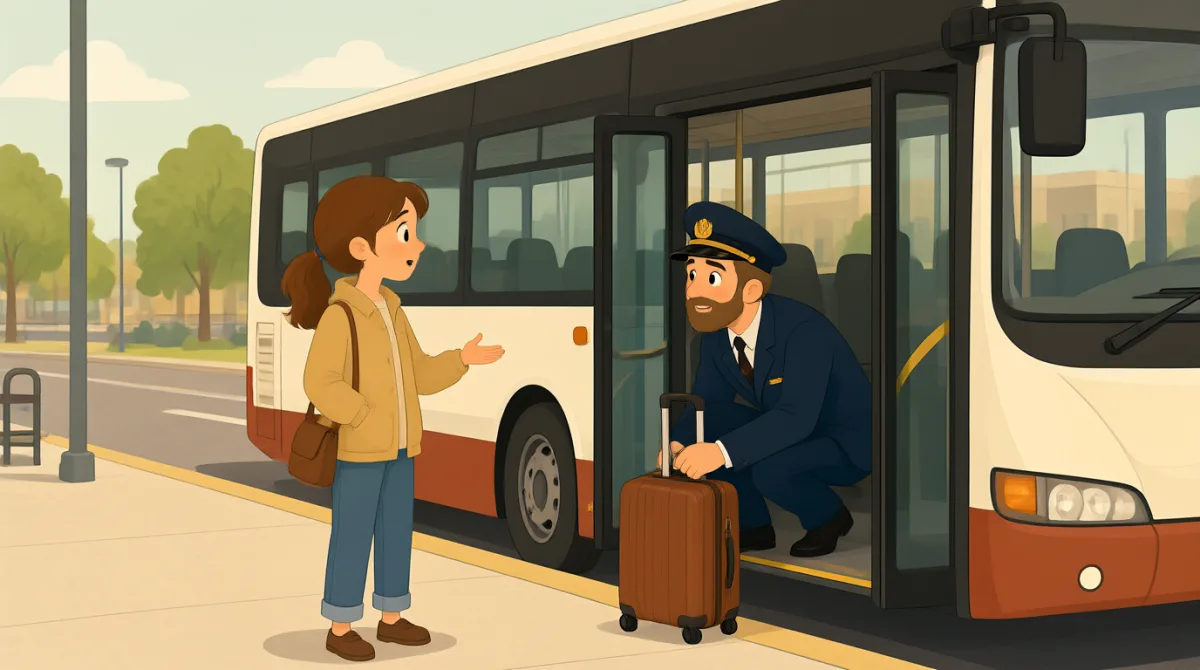

Excuse me, where should I put my suitcase?
Przepraszam, gdzie powinnam postawić walizkę?

Put it under the bus, please. I’ll open the luggage door.
Proszę ją umieścić pod autobusem. Otworzę luk bagażowy.
Is this the right place? It’s a little heavy.
Czy to właściwe miejsce? Jest trochę ciężka.
Yes, that’s right. I can help you lift it.
Tak, właśnie tutaj. Mogę pomóc ją podnieść.
Thank you. Should I take my small bag with me?
Dziękuję. Czy małą torbę powinnam zabrać ze sobą?
Yes, keep your small bag with you on the bus.
Tak, proszę zabrać małą torbę ze sobą do autobusu.
Okay. Is my suitcase safe under the bus?
Dobrze. Czy moja walizka będzie bezpieczna pod autobusem?
Yes. I’ll close the door now. Please keep your ticket with you.
Tak. Zaraz zamknę luk bagażowy. Proszę mieć przy sobie bilet.
Słownictwo7
- put it under the busumieścić pod autobusem
This means to place an item in the storage space below the bus. You can use “put it under” to say where to store something.
To znaczy umieścić jakiś przedmiot w schowku pod autobusem. Możesz użyć wyrażenia “put it under”, żeby powiedzieć, gdzie coś schować.
- luggage doorluk bagażowy
This is the door to the bus’s luggage storage space. You may hear this phrase when a driver helps you store a suitcase.
To drzwiczki do schowka na bagaż w autobusie. Kierowca może użyć tego wyrażenia, pomagając ci schować walizkę.
- a little heavytrochę ciężki
This means something is somewhat difficult to lift because of its weight. You can say “It’s a little heavy” when asking someone for help.
To znaczy, że podniesienie czegoś jest dość trudne ze względu na jego wagę. Możesz powiedzieć “It’s a little heavy”, gdy chcesz poprosić kogoś o pomoc.
- lift itpodnieść to
This means to raise something off the ground. Use “lift” when talking about picking up a heavy bag or box.
To znaczy unieść coś z ziemi. Użyj “lift”, gdy mówisz o podnoszeniu ciężkiej torby lub pudełka.
- keep your small bag with youmieć przy sobie małą torbę
This means to take your small bag onto the bus instead of putting it in the luggage storage. You can use “keep … with you” for things you want to carry.
To znaczy zabrać małą torbę do autobusu zamiast wkładać ją do schowka bagażowego. Wyrażenia “keep … with you” możesz użyć w odniesieniu do rzeczy, które chcesz mieć przy sobie.
- close the doorzamknąć drzwi
This means to shut the door. You can use “close” when asking someone to shut a door or other opening.
To znaczy domknąć drzwi. Możesz użyć “close”, prosząc kogoś o zamknięcie drzwi lub innego otworu.
- keep your ticket with youmieć przy sobie bilet
This means to hold on to your ticket and not leave it behind. You can use “keep … with you” for important things you need while traveling.
To znaczy zatrzymać bilet przy sobie i go nie zostawić. Wyrażenia “keep … with you” możesz użyć w odniesieniu do ważnych rzeczy potrzebnych w podróży.
Kluczowe zdania7
- 1
Excuse me, where should I put my suitcase?
Przepraszam, gdzie powinnam postawić walizkę?
Use this polite question to ask where to place your luggage. You can replace “my suitcase” with another item, such as “my backpack.”
Użyj tego uprzejmego pytania, żeby zapytać, gdzie postawić bagaż. Zamiast “my suitcase” możesz podać inną rzecz, na przykład “my backpack”.
- 2
I’ll open the luggage door.
Otworzę luk bagażowy.
This tells someone what you are going to do to help. Use “I’ll” plus a verb to offer or explain an action.
W ten sposób mówisz komuś, co zrobisz, żeby mu pomóc. Użyj “I’ll” i czasownika, aby zaoferować pomoc lub powiedzieć, co zaraz zrobisz.
- 3
It’s a little heavy.
Jest trochę ciężka.
Use this sentence to explain that something is somewhat difficult to lift. You can say it when asking for help with a bag or box.
Użyj tego zdania, żeby wyjaśnić, że podniesienie czegoś jest dość trudne. Możesz tak powiedzieć, prosząc o pomoc z torbą lub pudełkiem.
- 4
I can help you lift it.
Mogę pomóc ci ją podnieść.
This is a simple way to offer help with something heavy. Replace “lift it” with another action, such as “carry it.”
To prosty sposób, by zaoferować pomoc przy podnoszeniu czegoś ciężkiego. Zamiast “lift it” możesz użyć innego działania, na przykład “carry it”.
- 5
Should I take my small bag with me?
Czy małą torbę powinnam zabrać ze sobą?
Use this question to check whether you should bring an item along. Replace “my small bag” with another thing you may need.
Użyj tego pytania, by sprawdzić, czy zabrać ze sobą daną rzecz. Zamiast “my small bag” możesz podać coś innego, co może ci się przydać.
- 6
Yes, keep your small bag with you on the bus.
Tak, proszę zabrać małą torbę ze sobą do autobusu.
This gives a clear instruction about what to carry onto the bus. You can use “keep [item] with you” when someone should not put an item away.
To jasna instrukcja, co zabrać ze sobą do autobusu. Możesz użyć “keep [item] with you”, gdy ktoś powinien mieć daną rzecz przy sobie, zamiast ją chować.
- 7
Please keep your ticket with you.
Proszę mieć przy sobie bilet.
This is a polite reminder to hold on to an important item. Replace “your ticket” with something else you need to keep close.
To uprzejme przypomnienie, żeby nie zgubić ważnej rzeczy. Zamiast “your ticket” możesz podać coś innego, co warto mieć pod ręką.