Asking About Sizes
Demander les tailles
Mia asks a shop assistant what size clothes her child needs. They check the child's age and height.
Mia demande à une vendeuse quelle taille de vêtements il faut pour son enfant. Elles vérifient l’âge et la taille de l’enfant.
Dialogue8
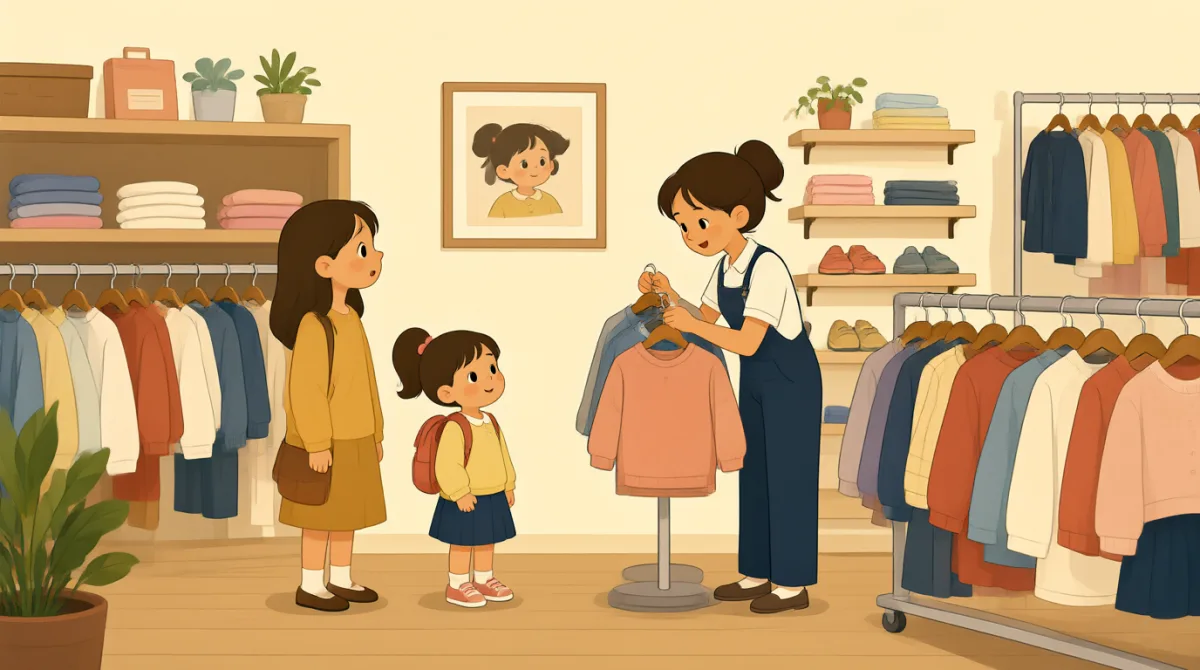

Hi, I need some clothes for my six-year-old. What size should I get?
Bonjour, je cherche des vêtements pour mon enfant de six ans. Quelle taille dois-je prendre ?

Sure. Do you know your child's height? That can help us choose.
Bien sûr. Vous connaissez sa taille ? Ça peut nous aider à choisir.
About 115 centimeters. The clothes he has now are getting too small.
Environ 115 centimètres. Les vêtements qu’il porte en ce moment deviennent trop petits.
For that height, size six may fit. Let's check this shirt.
Pour cette taille, le six pourrait lui aller. Regardons cette chemise.
The tag says size six. Is it true to size?
L’étiquette indique du six. Est-ce que ça taille normalement ?
Yes, it usually fits children around his age and height. He can try it on.
Oui, ça va généralement aux enfants de son âge et de sa taille. Il peut l’essayer.
Great. Where can he try it on?
Super. Où est-ce qu’il peut l’essayer ?
The fitting rooms are over there, next to the children's shoes.
Les cabines d’essayage sont là-bas, à côté des chaussures pour enfants.
Vocabulaire7
- What size should I get?Quelle taille dois-je prendre ?
Use this question when you need help choosing a clothing size. You can replace “size” with another choice, such as “color.”
Utilisez cette question quand vous avez besoin d’aide pour choisir une taille de vêtement. Vous pouvez remplacer “size” par un autre choix, comme “color”.
- heightla taille
A person's height is how tall they are. It can help a shop assistant choose the right size.
La taille d’une personne indique combien elle mesure. Cela peut aider un vendeur ou une vendeuse à choisir la bonne taille de vêtement.
- getting too smalldevenir trop petit
This means the clothes are becoming too small to wear comfortably. You can use “getting too” before an adjective to describe a change.
Cela signifie que les vêtements deviennent trop petits pour être portés confortablement. Vous pouvez utiliser “getting too” avant un adjectif pour décrire un changement.
- may fitpourrait aller
This means something might be the right size. Use “may” to talk about a possibility.
Cela signifie qu’un vêtement pourrait être à la bonne taille. Utilisez “may” pour parler d’une possibilité.
- true to sizetailler normalement
This asks whether a clothing item fits as expected for its labeled size. You can use it when checking how an item fits.
Cette expression permet de demander si un vêtement correspond à la taille indiquée sur son étiquette. Vous pouvez l’utiliser pour vérifier comment un vêtement taille.
- try it onl’essayer
This means to put on a piece of clothing to see if it fits. For example, you can ask, “Can I try it on?”
Cela signifie enfiler un vêtement pour voir s’il va bien. Par exemple, vous pouvez demander : “Can I try it on?”
- fitting roomsles cabines d’essayage
These are private spaces in a store where customers try on clothes. You can ask where the fitting rooms are.
Ce sont des espaces privés dans un magasin où les clients peuvent essayer des vêtements. Vous pouvez demander où se trouvent les cabines d’essayage.
Phrases clés7
- 1
What size should I get?
Quelle taille dois-je prendre ?
Use this to ask for help choosing a size. You can change the item or person, as in “What size should I get for my child?”
Utilisez cette question pour demander de l’aide afin de choisir une taille. Vous pouvez changer le vêtement ou la personne, comme dans “What size should I get for my child?”
- 2
Do you know your child's height?
Vous connaissez la taille de votre enfant ?
This is a polite way to ask for information that can help with a choice. You can replace “height” with another useful detail.
C’est une façon polie de demander un renseignement qui peut aider à faire un choix. Vous pouvez remplacer “height” par un autre détail utile.
- 3
The clothes he has now are getting too small.
Les vêtements qu’il porte en ce moment deviennent trop petits.
Use this to explain that someone's clothes no longer fit well. You can replace “he” with another person or “small” with “short.”
Utilisez cette phrase pour expliquer que les vêtements de quelqu’un ne lui vont plus bien. Vous pouvez remplacer “he” par une autre personne ou “small” par “short.”
- 4
For that height, size six may fit.
Pour cette taille, le six pourrait lui aller.
This gives a possible size based on someone's height. Use “may fit” when you are not completely sure.
Cette phrase propose une taille possible en fonction de la taille d’une personne. Utilisez “may fit” quand vous n’en êtes pas tout à fait sûr.
- 5
Is it true to size?
Est-ce que ça taille normalement ?
Ask this when you want to know if an item fits as expected for its labeled size. You can use “it” to refer to a piece of clothing.
Posez cette question quand vous voulez savoir si un vêtement correspond à la taille indiquée sur son étiquette. Vous pouvez utiliser “it” pour parler d’un vêtement.
- 6
He can try it on.
Il peut l’essayer.
This tells someone that a person can put on an item to check the fit. Replace “he” with another person and “it” with the item.
Cette phrase indique qu’une personne peut enfiler un vêtement pour vérifier s’il lui va bien. Remplacez “he” par une autre personne et “it” par le vêtement.
- 7
Where can he try it on?
Où est-ce qu’il peut l’essayer ?
Use this to ask where someone can try on clothes in a store. You can replace “he” with “I” or “we.”
Utilisez cette question pour demander où quelqu’un peut essayer des vêtements dans un magasin. Vous pouvez remplacer “he” par “I” ou “we.”