Asking About Sizes
Preguntar por las tallas
Mia asks a shop assistant what size clothes her child needs. They check the child's age and height.
Mia le pregunta a una dependienta qué talla necesita su hijo. Comprueban la edad y la altura del niño.
Diálogo8
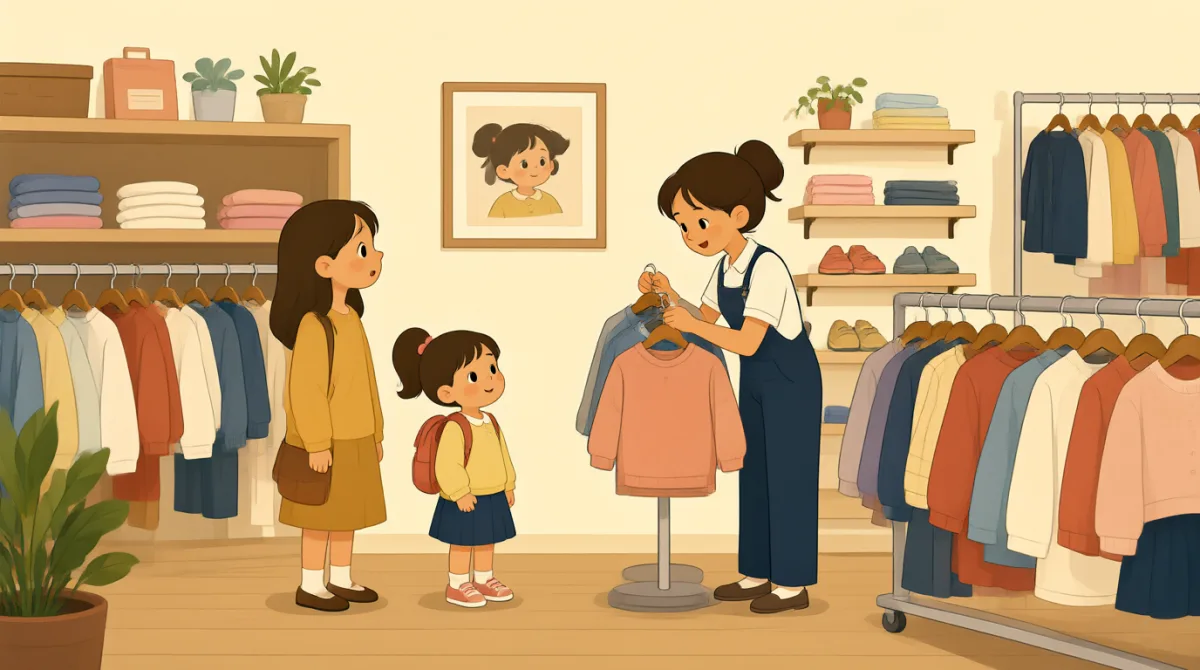

Hi, I need some clothes for my six-year-old. What size should I get?
Hola, necesito ropa para mi hijo de seis años. ¿Qué talla debería llevar?

Sure. Do you know your child's height? That can help us choose.
Claro. ¿Sabe cuánto mide su hijo? Eso puede ayudarnos a elegir.
About 115 centimeters. The clothes he has now are getting too small.
Mide unos 115 centímetros. La ropa que tiene ahora le está quedando pequeña.
For that height, size six may fit. Let's check this shirt.
Para esa altura, puede que le quede bien la talla seis. Vamos a mirar esta camisa.
The tag says size six. Is it true to size?
La etiqueta dice talla seis. ¿La talla corresponde a lo habitual?
Yes, it usually fits children around his age and height. He can try it on.
Sí, normalmente les queda bien a los niños de su edad y altura. Puede probársela.
Great. Where can he try it on?
Genial. ¿Dónde puede probársela?
The fitting rooms are over there, next to the children's shoes.
Los probadores están allí, al lado del calzado infantil.
Vocabulario7
- What size should I get?¿Qué talla debería llevar?
Use this question when you need help choosing a clothing size. You can replace “size” with another choice, such as “color.”
Usa esta pregunta cuando necesites ayuda para elegir una talla de ropa. Puedes sustituir “size” por otra opción, como “color”.
- heightaltura
A person's height is how tall they are. It can help a shop assistant choose the right size.
La altura de una persona indica cuánto mide. Puede ayudar a un dependiente a elegir la talla adecuada.
- getting too smallle está quedando pequeña
This means the clothes are becoming too small to wear comfortably. You can use “getting too” before an adjective to describe a change.
Significa que la ropa se está volviendo demasiado pequeña para llevarla cómodamente. Puedes usar “getting too” delante de un adjetivo para describir un cambio.
- may fitpuede que le quede bien
This means something might be the right size. Use “may” to talk about a possibility.
Significa que algo quizá sea de la talla adecuada. Usa “may” para hablar de una posibilidad.
- true to sizecorresponde a la talla habitual
This asks whether a clothing item fits as expected for its labeled size. You can use it when checking how an item fits.
Esta expresión pregunta si una prenda queda como se espera según la talla indicada en la etiqueta. Puedes usarla para preguntar cómo queda una prenda.
- try it onprobárselo
This means to put on a piece of clothing to see if it fits. For example, you can ask, “Can I try it on?”
Significa ponerse una prenda para ver si queda bien. Por ejemplo, puedes preguntar: “Can I try it on?” (¿Puedo probármelo?).
- fitting roomsprobadores
These are private spaces in a store where customers try on clothes. You can ask where the fitting rooms are.
Son espacios privados de una tienda donde los clientes se prueban la ropa. Puedes preguntar dónde están los probadores.
Frases clave7
- 1
What size should I get?
¿Qué talla debería llevar?
Use this to ask for help choosing a size. You can change the item or person, as in “What size should I get for my child?”
Usa esta frase para pedir ayuda al elegir una talla. Puedes cambiar la prenda o la persona, como en “What size should I get for my child?” (¿Qué talla debería llevar para mi hijo?).
- 2
Do you know your child's height?
¿Sabe cuánto mide su hijo?
This is a polite way to ask for information that can help with a choice. You can replace “height” with another useful detail.
Es una forma educada de pedir información que puede ayudar a elegir. Puedes sustituir “height” por otro dato útil.
- 3
The clothes he has now are getting too small.
La ropa que tiene ahora le está quedando pequeña.
Use this to explain that someone's clothes no longer fit well. You can replace “he” with another person or “small” with “short.”
Usa esta frase para explicar que la ropa de alguien ya no le queda bien. Puedes sustituir “he” por otra persona o “small” por “short.”
- 4
For that height, size six may fit.
Para esa altura, puede que le quede bien la talla seis.
This gives a possible size based on someone's height. Use “may fit” when you are not completely sure.
Esta frase sugiere una talla posible según la altura de alguien. Usa “may fit” cuando no estés del todo seguro.
- 5
Is it true to size?
¿La talla corresponde a lo habitual?
Ask this when you want to know if an item fits as expected for its labeled size. You can use “it” to refer to a piece of clothing.
Pregunta esto cuando quieras saber si una prenda queda como se espera según la talla indicada en la etiqueta. Puedes usar “it” para referirte a una prenda.
- 6
He can try it on.
Puede probársela.
This tells someone that a person can put on an item to check the fit. Replace “he” with another person and “it” with the item.
Esta frase le indica a alguien que una persona puede ponerse una prenda para comprobar cómo le queda. Sustituye “he” por otra persona e “it” por la prenda.
- 7
Where can he try it on?
¿Dónde puede probársela?
Use this to ask where someone can try on clothes in a store. You can replace “he” with “I” or “we.”
Usa esta frase para preguntar dónde puede probarse la ropa alguien en una tienda. Puedes sustituir “he” por “I” o “we.”