Working With a Neighbor
Travailler avec un voisin
Emma and Mia work with Jack to pick up litter along a path. They share the work and find a safe way to move a heavy bag.
Emma et Mia aident Jack à ramasser des déchets le long d’un chemin. Ils se répartissent le travail et trouvent un moyen sûr de déplacer un sac lourd.
Dialogue8
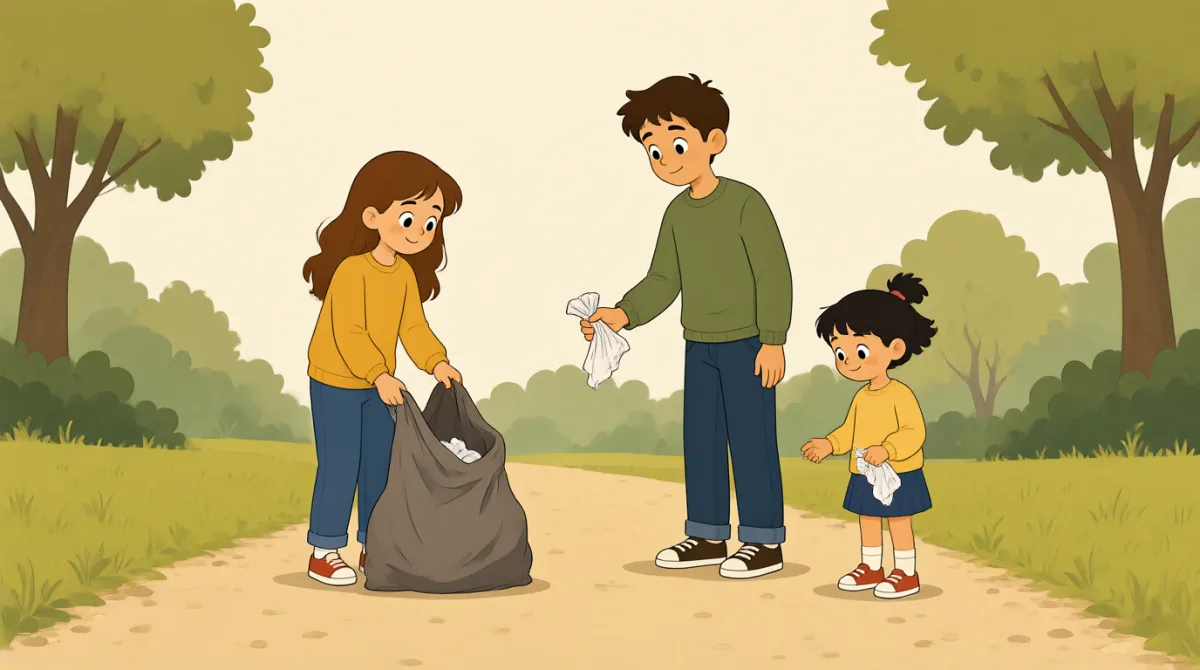

This path has a lot of wrappers. I’ll start on this side.
Il y a beaucoup d’emballages par terre sur ce chemin. Je vais commencer de ce côté.

Great. I’ll pick up the bottles near the bench.
Super. Je vais ramasser les bouteilles près du banc.

Thanks for helping. Let’s keep the path clear while we work.
Merci de nous aider. Gardons le chemin dégagé pendant qu’on travaille.
I found a big bag. It’s getting pretty heavy now.
J’ai trouvé un grand sac. Il devient assez lourd, maintenant.
Let’s not lift it alone. Jack, can you help us?
Ne le soulevons pas toutes seules. Jack, tu peux nous aider ?
Sure. Let’s tie it closed and carry it together, one side each.
Bien sûr. Fermons le sac en le nouant et portons-le ensemble, chacun d’un côté.
Good idea. Watch your step; there’s a root by your foot.
Bonne idée. Attention où tu mets les pieds : il y a une racine près de ton pied.
We can put the bag by the park entrance for pickup.
On peut déposer le sac près de l’entrée du parc pour qu’on vienne le récupérer.
Vocabulaire8
- pick upramasser
To pick up litter means to collect it from the ground. You can also use “pick up” for other things you find or drop.
“To pick up litter” signifie ramasser des déchets par terre. On peut aussi utiliser “pick up” pour parler d’autres choses qu’on trouve ou qu’on a fait tomber.
- wrappersemballages
Wrappers are pieces of paper or plastic around food or other items. Here, they are litter along the path.
Les “wrappers” sont des morceaux de papier ou de plastique qui entourent des aliments ou d’autres objets. Ici, ce sont des déchets qui traînent le long du chemin.
- keep the path cleargarder le chemin dégagé
This means to make sure the path does not have litter or other things in the way. You can say “keep the area clear” about other places, too.
“Keep the path clear” signifie veiller à ce qu’il n’y ait pas de déchets ni d’autres obstacles sur le chemin. On peut aussi dire “keep the area clear” pour parler d’autres endroits.
- heavylourd
Heavy means difficult to lift or carry. Here, the bag has become hard to move because it has a lot inside.
“Heavy” signifie difficile à soulever ou à porter. Ici, le sac est devenu difficile à déplacer parce qu’il contient beaucoup de choses.
- lift it alonele soulever tout seul
To lift something alone means to raise it without help. Use this phrase when something may be too heavy to move by yourself.
“Lift it alone” signifie soulever quelque chose sans aide. Utilise cette expression quand un objet risque d’être trop lourd à déplacer tout seul.
- tie it closedle fermer en le nouant
This means to close the bag by tying its opening. You can use “tie it closed” for a bag that needs to be carried.
“Tie it closed” signifie fermer le sac en nouant son ouverture. Tu peux utiliser cette expression pour un sac qu’il faut transporter.
- together, one side eachensemble, chacun d’un côté
This means two people will carry something at the same time, with each person holding one side. It is a useful way to share the work.
“Together, one side each” signifie que deux personnes portent quelque chose en même temps, chacune tenant un côté. C’est une bonne façon de se répartir le travail.
- Watch your stepAttention où tu mets les pieds
This is a warning to be careful where you walk. You can say it when there is something on the ground that someone could trip over.
“Watch your step” est un avertissement qui invite à faire attention où l’on marche. Tu peux le dire quand il y a quelque chose par terre sur lequel quelqu’un risque de trébucher.
Phrases clés8
- 1
I’ll start on this side.
Je vais commencer de ce côté.
Use this to say where you will begin a task. Replace “this side” with a place or part of the job, such as “I’ll start by the door.”
Utilise “I’ll start on this side.” pour dire où tu vas commencer une tâche. Remplace “this side” par un endroit ou une partie du travail, par exemple : “I’ll start by the door.”
- 2
I’ll pick up the bottles near the bench.
Je vais ramasser les bouteilles près du banc.
This sentence offers to collect specific things in a specific place. You can replace “the bottles” and “near the bench” with other items and locations.
Cette phrase propose de ramasser des objets précis à un endroit précis. Tu peux remplacer “the bottles” et “near the bench” par d’autres objets et lieux.
- 3
Let’s keep the path clear while we work.
Gardons le chemin dégagé pendant qu’on travaille.
Use “Let’s” to suggest doing something together. You can change “keep the path clear” to another shared goal, like “keep the room tidy.”
Utilise “Let’s” pour proposer de faire quelque chose ensemble. Tu peux remplacer “keep the path clear” par un autre objectif commun, comme “keep the room tidy.”
- 4
It’s getting pretty heavy now.
Il devient assez lourd, maintenant.
This is a simple way to say that something is becoming difficult to carry. Replace “heavy” with another adjective, such as “cold” or “busy.”
C’est une façon simple de dire que quelque chose devient difficile à porter. Remplace “heavy” par un autre adjectif, comme “cold” ou “busy.”
- 5
Let’s not lift it alone.
Ne le soulevons pas tout seuls.
Use “Let’s not” to suggest avoiding an action. You can use this pattern when a task may be difficult or unsafe to do by yourself.
Utilise “Let’s not” pour proposer d’éviter une action. Tu peux employer cette structure quand une tâche risque d’être difficile ou dangereuse à faire seul.
- 6
Jack, can you help us?
Jack, tu peux nous aider ?
This is a polite, direct way to ask someone for help. Replace “help us” with the task you need help with, such as “carry this box.”
C’est une façon polie et directe de demander de l’aide à quelqu’un. Remplace “help us” par la tâche pour laquelle tu as besoin d’aide, comme “carry this box.”
- 7
Let’s tie it closed and carry it together, one side each.
Fermons le sac en le nouant et portons-le ensemble, chacun d’un côté.
This sentence suggests a safe plan and explains how two people can share the work. Use “Let’s” to propose a plan, then describe the steps.
Cette phrase propose une solution sûre et explique comment deux personnes peuvent se répartir le travail. Utilise “Let’s” pour proposer un plan, puis décris les étapes.
- 8
Watch your step; there’s a root by your foot.
Attention où tu mets les pieds : il y a une racine près de ton pied.
Use “Watch your step” to warn someone about something on the ground. You can add a short explanation after it to show what to avoid.
Utilise “Watch your step” pour avertir quelqu’un de la présence d’un objet par terre. Tu peux ajouter une courte explication pour préciser ce qu’il faut éviter.