Having Lunch Together
Déjeuner ensemble
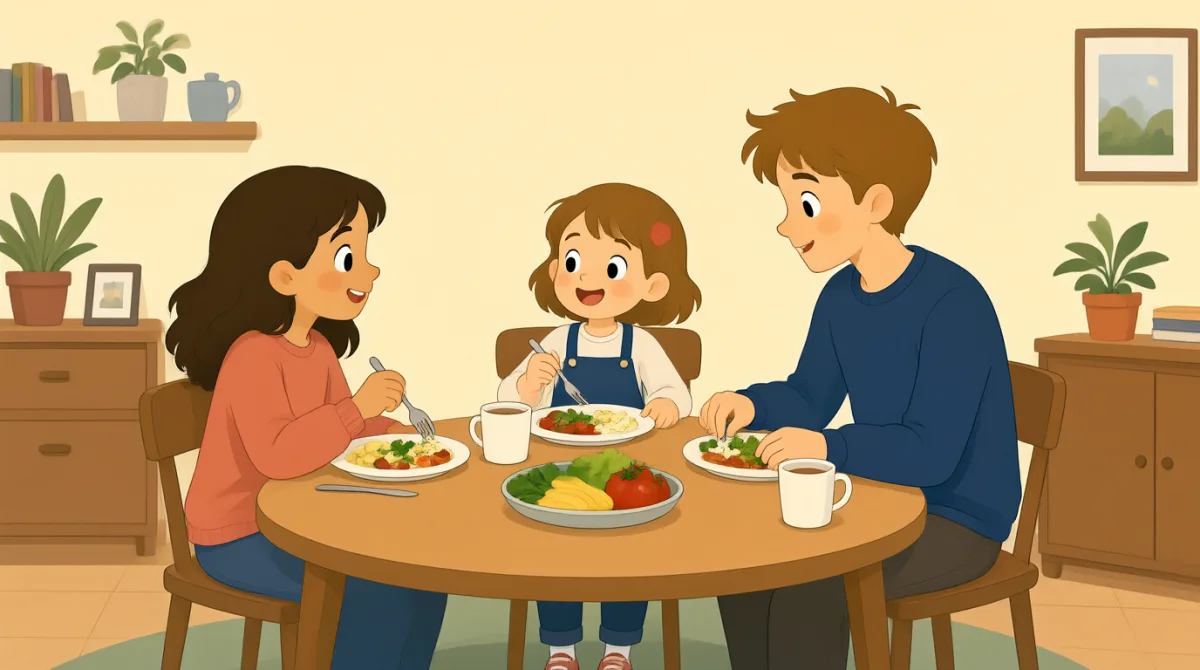
After the clean-up, Emma, Mia, and Jack have lunch together. They talk about the work and plan to help again next time.
Après le nettoyage, Emma, Mia et Jack déjeunent ensemble. Ils parlent du travail accompli et prévoient de donner à nouveau un coup de main la prochaine fois.
Dialogue8

This sandwich tastes great. I’m glad we finished cleaning the park.
Ce sandwich est délicieux. Je suis contente qu’on ait fini de nettoyer le parc.

Me too. The path looks much better now, and we got a lot done.
Moi aussi. Le sentier est beaucoup plus propre maintenant, et on a bien avancé.

That heavy bag was tough, but we moved it safely together.
Ce sac lourd était difficile à déplacer, mais on l’a transporté sans danger, ensemble.
I didn’t know there would be so much litter. My arms are tired!
Je ne pensais pas qu’il y aurait autant de déchets. J’ai les bras fatigués !
You both worked hard. Let’s sit here and enjoy our lunch.
Vous avez toutes les deux bien travaillé. Asseyons-nous ici et profitons de notre déjeuner.
I’d be happy to help again next time. We could bring more friends.
Ça me ferait plaisir de donner à nouveau un coup de main la prochaine fois. On pourrait amener d’autres amis.
Great idea! I’ll sign up again when they plan another clean-up.
Bonne idée ! Je m’inscrirai à nouveau quand ils organiseront un autre nettoyage.
Me too. It feels good to help our neighborhood together.
Moi aussi. Ça fait du bien d’aider notre quartier ensemble.
Vocabulaire7
- tastes greatêtre délicieux
This means the food has a very good flavor. You can use it to say you enjoy something you are eating.
Cela signifie que la nourriture a très bon goût. Tu peux dire « tastes great » pour montrer que tu apprécies ce que tu manges.
- got a lot donebien avancer
This means we finished many tasks. Use it to describe good progress on a job or project.
Cela signifie qu’on a terminé beaucoup de tâches. Tu peux employer « got a lot done » pour dire qu’un travail ou un projet a bien avancé.
- worked hardbien travailler
This means someone put a lot of effort into a task. You can use it to praise people after they finish a difficult job.
Cela signifie qu’une personne a fourni beaucoup d’efforts. Tu peux dire « worked hard » pour féliciter des gens après une tâche difficile.
- help again next timedonner à nouveau un coup de main la prochaine fois
This means you want to help when the activity happens again. Use it to offer help in the future.
Cela signifie que tu veux aider quand l’activité aura lieu à nouveau. Tu peux employer « help again next time » pour proposer ton aide à l’avenir.
- bring more friendsamener d’autres amis
This means invite or take additional friends along. You can use it when suggesting how to get more people involved.
Cela signifie inviter d’autres amis ou les emmener avec soi. Tu peux employer « bring more friends » pour suggérer d’impliquer davantage de personnes.
- sign up againse réinscrire
This means register once more for an activity. You can use it when you want to join a future event.
Cela signifie s’inscrire une nouvelle fois à une activité. Tu peux employer « sign up again » quand tu veux participer à un événement à venir.
- clean-upnettoyage collectif
This is an activity where people collect litter and make a place cleaner. You can use it for a community event like cleaning a park.
C’est une activité où des gens ramassent les déchets pour rendre un endroit plus propre. « Clean-up » peut désigner un événement de quartier, comme le nettoyage d’un parc.
Phrases clés8
- 1
I’m glad we finished cleaning the park.
Je suis contente qu’on ait fini de nettoyer le parc.
This sentence shares happiness about completing a task. You can reuse “I’m glad we finished…” to talk about other jobs or activities.
Cette phrase exprime la satisfaction d’avoir terminé une tâche. Tu peux reprendre « I’m glad we finished… » pour parler d’autres tâches ou activités.
- 2
The path looks much better now, and we got a lot done.
Le sentier est beaucoup plus propre maintenant, et on a bien avancé.
This is a useful way to describe a place after work and say that the group made good progress. Replace “the path” with another place or thing.
Cette phrase permet de décrire un endroit après y avoir travaillé et de dire que le groupe a bien avancé. Remplace « the path » par un autre endroit ou une autre chose.
- 3
That heavy bag was tough, but we moved it safely together.
Ce sac lourd était difficile à déplacer, mais on l’a transporté sans danger, ensemble.
Use this sentence to describe a difficult task that people completed as a team. You can replace “That heavy bag” with another challenge.
Utilise cette phrase pour parler d’une tâche difficile accomplie en équipe. Tu peux remplacer « That heavy bag » par un autre défi.
- 4
I didn’t know there would be so much litter.
Je ne pensais pas qu’il y aurait autant de déchets.
This sentence expresses surprise about how much of something there was. You can use “I didn’t know there would be so much…” in other situations.
Cette phrase exprime la surprise face à la quantité de quelque chose. Tu peux réutiliser « I didn’t know there would be so much… » dans d’autres situations.
- 5
You both worked hard.
Vous avez toutes les deux bien travaillé.
This is a simple way to praise two people for their effort. You can change “both” to “all” when speaking to a larger group.
C’est une façon simple de féliciter deux personnes pour leurs efforts. Tu peux remplacer « both » par « all » si tu t’adresses à un groupe plus nombreux.
- 6
Let’s sit here and enjoy our lunch.
Asseyons-nous ici et profitons de notre déjeuner.
Use “Let’s” to make a friendly suggestion about doing something together. You can replace “sit here and enjoy our lunch” with another activity.
Utilise « Let’s » pour proposer gentiment de faire quelque chose ensemble. Tu peux remplacer « sit here and enjoy our lunch » par une autre activité.
- 7
I’d be happy to help again next time.
Ça me ferait plaisir de donner à nouveau un coup de main la prochaine fois.
This is a polite way to offer help in the future. You can use it when someone may organize the same activity again.
C’est une façon polie de proposer son aide pour l’avenir. Tu peux l’utiliser si quelqu’un prévoit d’organiser à nouveau la même activité.
- 8
I’ll sign up again when they plan another clean-up.
Je m’inscrirai à nouveau quand ils organiseront un autre nettoyage.
This sentence says you plan to register for a future event. You can reuse “I’ll sign up again when they plan another…” for other activities.
Cette phrase indique que tu comptes t’inscrire à un événement à venir. Tu peux reprendre « I’ll sign up again when they plan another… » pour parler d’autres activités.