Working With a Neighbor
Trabajar con un vecino
Emma and Mia work with Jack to pick up litter along a path. They share the work and find a safe way to move a heavy bag.
Emma y Mia ayudan a Jack a recoger basura en un sendero. Se reparten el trabajo y encuentran una forma segura de mover una bolsa pesada.
Diálogo8
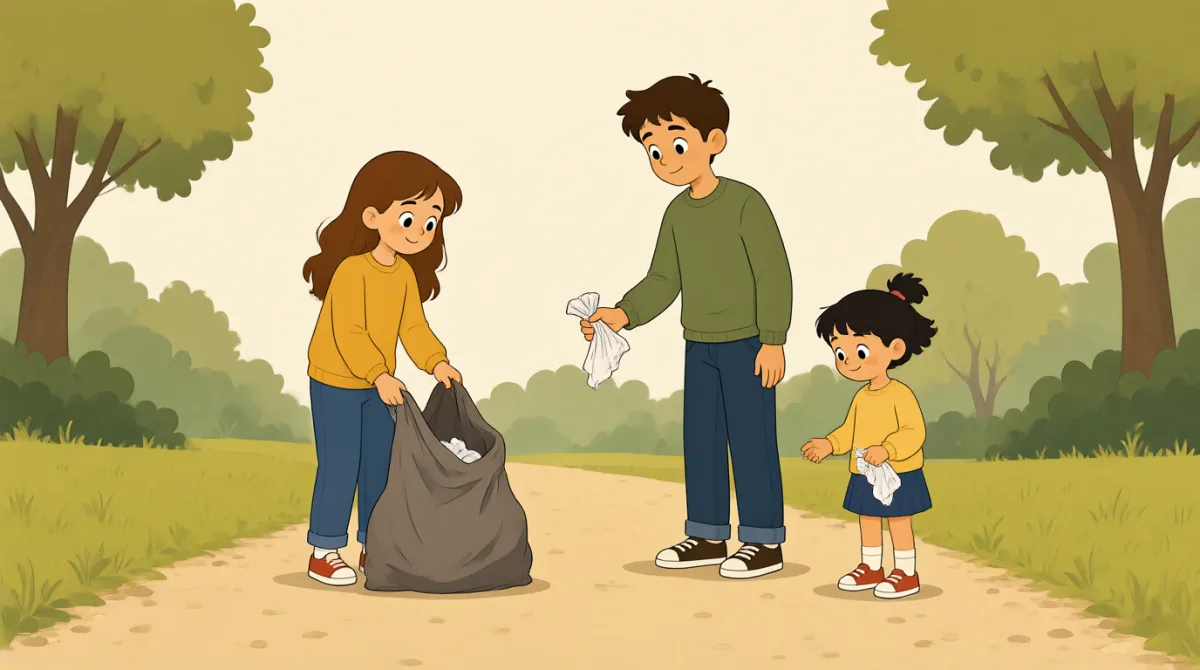

This path has a lot of wrappers. I’ll start on this side.
Hay muchos envoltorios en este sendero. Voy a empezar por este lado.

Great. I’ll pick up the bottles near the bench.
Genial. Voy a recoger las botellas que están cerca del banco.

Thanks for helping. Let’s keep the path clear while we work.
Gracias por ayudar. Mantengamos el sendero despejado mientras trabajamos.
I found a big bag. It’s getting pretty heavy now.
Encontré una bolsa grande. Ya está bastante pesada.
Let’s not lift it alone. Jack, can you help us?
Mejor no la levantemos solos. Jack, ¿puedes ayudarnos?
Sure. Let’s tie it closed and carry it together, one side each.
Claro. Vamos a atarla para cerrarla y la llevamos entre los dos, cada uno de un lado.
Good idea. Watch your step; there’s a root by your foot.
Buena idea. Fíjate por dónde pisas; tienes una raíz junto al pie.
We can put the bag by the park entrance for pickup.
Podemos dejar la bolsa junto a la entrada del parque para que la recojan.
Vocabulario8
- pick uprecoger
To pick up litter means to collect it from the ground. You can also use “pick up” for other things you find or drop.
“Pick up” significa recoger algo del suelo, como la basura. También puedes usar “pick up” para otras cosas que encuentres o se te caigan.
- wrappersenvoltorios
Wrappers are pieces of paper or plastic around food or other items. Here, they are litter along the path.
Los envoltorios son trozos de papel o plástico que cubren alimentos u otros productos. Aquí, son basura que está tirada en el sendero.
- keep the path clearmantener el sendero despejado
This means to make sure the path does not have litter or other things in the way. You can say “keep the area clear” about other places, too.
Significa asegurarse de que no haya basura ni otros obstáculos en el sendero. También puedes decir “keep the area clear” (mantener la zona despejada) para hablar de otros lugares.
- heavypesado
Heavy means difficult to lift or carry. Here, the bag has become hard to move because it has a lot inside.
“Heavy” significa que algo cuesta levantarlo o cargarlo. Aquí, la bolsa se ha vuelto difícil de mover porque tiene muchas cosas dentro.
- lift it alonelevantarlo sin ayuda
To lift something alone means to raise it without help. Use this phrase when something may be too heavy to move by yourself.
“Lift it alone” significa levantar algo sin ayuda. Usa esta expresión cuando algo pueda ser demasiado pesado para moverlo por tu cuenta.
- tie it closedatarlo para cerrarlo
This means to close the bag by tying its opening. You can use “tie it closed” for a bag that needs to be carried.
Significa cerrar la bolsa haciendo un nudo en la abertura. Puedes usar “tie it closed” para hablar de una bolsa que hay que cargar.
- together, one side eachentre los dos, cada uno de un lado
This means two people will carry something at the same time, with each person holding one side. It is a useful way to share the work.
Significa que dos personas cargarán algo al mismo tiempo, cada una sujetando un lado. Es una buena manera de repartirse el trabajo.
- Watch your stepFíjate por dónde pisas
This is a warning to be careful where you walk. You can say it when there is something on the ground that someone could trip over.
Es una advertencia para que alguien tenga cuidado al caminar. Puedes decirlo cuando hay algo en el suelo con lo que alguien podría tropezarse.
Frases clave8
- 1
I’ll start on this side.
Voy a empezar por este lado.
Use this to say where you will begin a task. Replace “this side” with a place or part of the job, such as “I’ll start by the door.”
Usa esta frase para decir dónde empezarás una tarea. Puedes cambiar “this side” por un lugar o una parte del trabajo, como en “I’ll start by the door.” (Voy a empezar junto a la puerta).
- 2
I’ll pick up the bottles near the bench.
Voy a recoger las botellas que están cerca del banco.
This sentence offers to collect specific things in a specific place. You can replace “the bottles” and “near the bench” with other items and locations.
Esta frase sirve para ofrecerte a recoger cosas concretas en un lugar específico. Puedes cambiar “the bottles” y “near the bench” por otros objetos y lugares.
- 3
Let’s keep the path clear while we work.
Mantengamos el sendero despejado mientras trabajamos.
Use “Let’s” to suggest doing something together. You can change “keep the path clear” to another shared goal, like “keep the room tidy.”
Usa “Let’s” para proponer hacer algo juntos. Puedes cambiar “keep the path clear” por otra meta compartida, como “keep the room tidy.” (mantener la habitación ordenada).
- 4
It’s getting pretty heavy now.
Ya está bastante pesada.
This is a simple way to say that something is becoming difficult to carry. Replace “heavy” with another adjective, such as “cold” or “busy.”
Esta es una forma sencilla de decir que algo se está volviendo difícil de cargar. Puedes cambiar “heavy” por otro adjetivo, como “cold” o “busy.”
- 5
Let’s not lift it alone.
Mejor no la levantemos solos.
Use “Let’s not” to suggest avoiding an action. You can use this pattern when a task may be difficult or unsafe to do by yourself.
Usa “Let’s not” para proponer que evitemos hacer algo. Este patrón sirve cuando una tarea puede ser difícil o peligrosa si la haces por tu cuenta.
- 6
Jack, can you help us?
Jack, ¿puedes ayudarnos?
This is a polite, direct way to ask someone for help. Replace “help us” with the task you need help with, such as “carry this box.”
Esta es una forma directa y amable de pedirle ayuda a alguien. Puedes cambiar “help us” por la tarea para la que necesitas ayuda, como “carry this box.” (llevar esta caja).
- 7
Let’s tie it closed and carry it together, one side each.
Vamos a atarla para cerrarla y la llevamos entre los dos, cada uno de un lado.
This sentence suggests a safe plan and explains how two people can share the work. Use “Let’s” to propose a plan, then describe the steps.
Esta frase propone un plan seguro y explica cómo pueden repartirse el trabajo dos personas. Usa “Let’s” para proponer un plan y luego describe los pasos.
- 8
Watch your step; there’s a root by your foot.
Fíjate por dónde pisas; tienes una raíz junto al pie.
Use “Watch your step” to warn someone about something on the ground. You can add a short explanation after it to show what to avoid.
Usa “Watch your step” para advertirle a alguien que tenga cuidado con algo en el suelo. Después puedes añadir una breve explicación para indicar qué debe evitar.