Working With a Neighbor
Trabalhando com um vizinho
Emma and Mia work with Jack to pick up litter along a path. They share the work and find a safe way to move a heavy bag.
Emma e Mia ajudam Jack a recolher o lixo ao longo de um caminho. Eles dividem o trabalho e encontram uma maneira segura de carregar um saco pesado.
Diálogo8
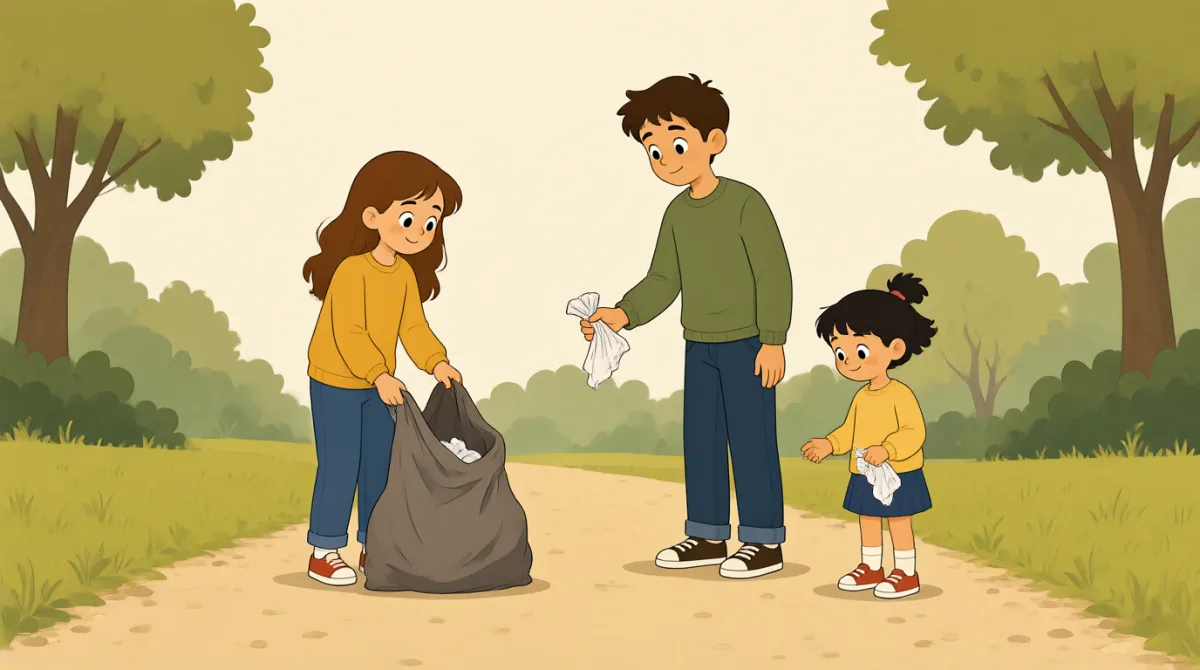

This path has a lot of wrappers. I’ll start on this side.
Tem um monte de embalagens neste caminho. Vou começar por este lado.

Great. I’ll pick up the bottles near the bench.
Ótimo. Vou recolher as garrafas perto do banco.

Thanks for helping. Let’s keep the path clear while we work.
Obrigado pela ajuda. Vamos manter o caminho livre enquanto trabalhamos.
I found a big bag. It’s getting pretty heavy now.
Encontrei um saco grande. Ele está ficando bem pesado.
Let’s not lift it alone. Jack, can you help us?
Não vamos levantá-lo sozinhas. Jack, você pode ajudar a gente?
Sure. Let’s tie it closed and carry it together, one side each.
Claro. Vamos amarrar a abertura e carregar juntos, cada um segurando um lado.
Good idea. Watch your step; there’s a root by your foot.
Boa ideia. Cuidado onde pisa; tem uma raiz perto do seu pé.
We can put the bag by the park entrance for pickup.
Podemos deixar o saco perto da entrada do parque para recolherem.
Vocabulário8
- pick uprecolher
To pick up litter means to collect it from the ground. You can also use “pick up” for other things you find or drop.
“Pick up” significa recolher algo do chão. Você também pode usar “pick up” para falar de outras coisas que encontra ou deixa cair.
- wrappersembalagens
Wrappers are pieces of paper or plastic around food or other items. Here, they are litter along the path.
“Wrappers” são pedaços de papel ou plástico que envolvem alimentos ou outros produtos. Aqui, são lixo espalhado pelo caminho.
- keep the path clearmanter o caminho livre
This means to make sure the path does not have litter or other things in the way. You can say “keep the area clear” about other places, too.
Isso significa garantir que não haja lixo nem outras coisas atrapalhando a passagem. Você também pode dizer “keep the area clear” para falar de outros lugares.
- heavypesado
Heavy means difficult to lift or carry. Here, the bag has become hard to move because it has a lot inside.
“Heavy” significa difícil de levantar ou carregar. Aqui, ficou difícil mover o saco porque ele está cheio de coisas.
- lift it alonelevantá-lo sozinho
To lift something alone means to raise it without help. Use this phrase when something may be too heavy to move by yourself.
“Lift it alone” significa levantar algo sem ajuda. Use essa expressão quando uma coisa pode ser pesada demais para você mover sozinho.
- tie it closedamarrar a abertura
This means to close the bag by tying its opening. You can use “tie it closed” for a bag that needs to be carried.
Isso significa fechar o saco amarrando a abertura. Você pode usar “tie it closed” para falar de um saco que precisa ser carregado.
- together, one side eachjuntos, cada um segurando um lado
This means two people will carry something at the same time, with each person holding one side. It is a useful way to share the work.
Isso significa que duas pessoas vão carregar algo ao mesmo tempo, cada uma segurando um lado. É uma maneira prática de dividir o trabalho.
- Watch your stepCuidado onde pisa
This is a warning to be careful where you walk. You can say it when there is something on the ground that someone could trip over.
Essa frase serve para avisar alguém para tomar cuidado ao andar. Você pode dizê-la quando há algo no chão em que a pessoa pode tropeçar.
Frases-chave8
- 1
I’ll start on this side.
Vou começar por este lado.
Use this to say where you will begin a task. Replace “this side” with a place or part of the job, such as “I’ll start by the door.”
Use essa frase para dizer onde você vai começar uma tarefa. Troque “this side” por um lugar ou uma parte do trabalho, como em “I’ll start by the door.”
- 2
I’ll pick up the bottles near the bench.
Vou recolher as garrafas perto do banco.
This sentence offers to collect specific things in a specific place. You can replace “the bottles” and “near the bench” with other items and locations.
Essa frase oferece ajuda para recolher coisas específicas em um lugar específico. Você pode trocar “the bottles” e “near the bench” por outros objetos e lugares.
- 3
Let’s keep the path clear while we work.
Vamos manter o caminho livre enquanto trabalhamos.
Use “Let’s” to suggest doing something together. You can change “keep the path clear” to another shared goal, like “keep the room tidy.”
Use “Let’s” para sugerir que vocês façam algo juntos. Você pode trocar “keep the path clear” por outro objetivo em comum, como “keep the room tidy.”
- 4
It’s getting pretty heavy now.
Ele está ficando bem pesado.
This is a simple way to say that something is becoming difficult to carry. Replace “heavy” with another adjective, such as “cold” or “busy.”
Essa é uma maneira simples de dizer que algo está ficando difícil de carregar. Troque “heavy” por outro adjetivo, como “cold” ou “busy.”
- 5
Let’s not lift it alone.
Não vamos levantá-lo sozinhos.
Use “Let’s not” to suggest avoiding an action. You can use this pattern when a task may be difficult or unsafe to do by yourself.
Use “Let’s not” para sugerir que vocês evitem fazer algo. Você pode usar essa estrutura quando uma tarefa for difícil ou perigosa para fazer sozinho.
- 6
Jack, can you help us?
Jack, você pode ajudar a gente?
This is a polite, direct way to ask someone for help. Replace “help us” with the task you need help with, such as “carry this box.”
Essa é uma maneira educada e direta de pedir ajuda a alguém. Troque “help us” pela tarefa em que você precisa de ajuda, como “carry this box.”
- 7
Let’s tie it closed and carry it together, one side each.
Vamos amarrar a abertura e carregar juntos, cada um segurando um lado.
This sentence suggests a safe plan and explains how two people can share the work. Use “Let’s” to propose a plan, then describe the steps.
Essa frase sugere um plano seguro e explica como duas pessoas podem dividir o trabalho. Use “Let’s” para propor um plano e depois descreva as etapas.
- 8
Watch your step; there’s a root by your foot.
Cuidado onde pisa; tem uma raiz perto do seu pé.
Use “Watch your step” to warn someone about something on the ground. You can add a short explanation after it to show what to avoid.
Use “Watch your step” para avisar alguém sobre algo no chão. Você pode acrescentar uma explicação curta para mostrar o que a pessoa deve evitar.