Meeting Outside the Venue
Retrouvailles devant la salle
Emma and Jack meet outside the concert venue. They talk about the singer and get ready to go in.
Emma et Jack se retrouvent devant la salle de concert. Ils parlent de la chanteuse et se préparent à entrer.
Dialogue8
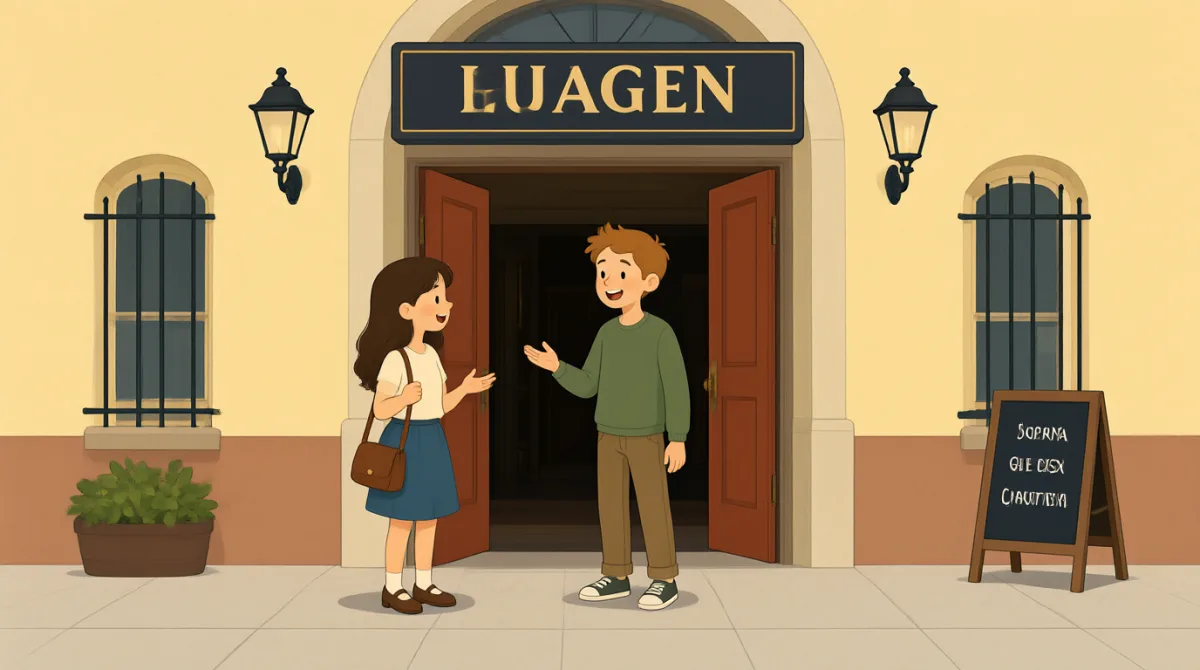

Hi, Jack! I’m glad we got here early. The concert starts in thirty minutes.
Salut, Jack ! Je suis contente qu’on soit arrivés tôt. Le concert commence dans trente minutes.

Me too. The line is already getting long. Do you have your tickets?
Moi aussi. La file d’attente commence déjà à être longue. Tu as tes billets ?
Yes, they’re on my phone. I’m so excited to hear the singer live!
Oui, ils sont sur mon téléphone. J’ai tellement hâte d’entendre la chanteuse en concert !
I know! Her new songs are great. I listened to the whole album yesterday.
Je sais ! Ses nouvelles chansons sont géniales. J’ai écouté l’album en entier hier.
Which song do you hope she sings tonight? I really like “Stay Close.”
Quelle chanson espères-tu qu’elle chantera ce soir ? J’aime beaucoup « Stay Close ».
That one’s my favorite, too. Let’s go in when the doors open.
C’est aussi ma préférée. Entrons quand les portes ouvriront.
Good idea. I’ll get my ticket ready. Do you know where our seats are?
Bonne idée. Je vais préparer mon billet. Tu sais où sont nos places ?
Yes, they’re on the floor level, near the middle. We should have a good view.
Oui, elles sont au niveau de la fosse, près du milieu. On devrait avoir une bonne vue.
Vocabulaire8
- got here earlyarrivés tôt
Arrived at this place before the expected time. Use it to say when you arrived somewhere.
Arrivé quelque part avant l’heure prévue. Cette expression sert à dire quand tu es arrivé quelque part.
- the line is already getting longla file d’attente commence déjà à être longue
More people are joining the line, so it is growing. Use this phrase to describe a line that is becoming longer.
De plus en plus de personnes font la queue, alors la file s’allonge. Utilise cette expression pour décrire une file qui s’allonge.
- on my phonesur mon téléphone
Stored or available on my phone. You can use this phrase for tickets, photos, or other things you keep on your phone.
Enregistré ou disponible sur mon téléphone. Tu peux utiliser cette expression pour parler de billets, de photos ou d’autres choses que tu gardes sur ton téléphone.
- liveen concert
Happening in person, not in a recording. Here, the speaker is excited to hear the singer perform in person.
Qui se passe en personne, et non dans un enregistrement. Ici, la personne a hâte d’entendre la chanteuse se produire en personne.
- the whole albuml’album en entier
All the songs on an album. Use “the whole” to say you listened to or watched something completely.
Toutes les chansons d’un album. Utilise « the whole » pour dire que tu as écouté ou regardé quelque chose en entier.
- go inentrer
Enter a place. You can use it when talking about entering a venue, building, or room.
Pénétrer dans un endroit. Tu peux utiliser ce verbe pour parler d’entrer dans une salle de spectacle, un bâtiment ou une pièce.
- get my ticket readypréparer mon billet
Prepare my ticket so I can show it or use it. This phrase is useful before entering an event.
Préparer mon billet pour pouvoir le montrer ou l’utiliser. Cette expression est utile avant d’entrer à un événement.
- floor levelau niveau de la fosse
The level of a venue where the floor is, rather than an upper level. Here, it tells where the seats are.
Le niveau de la salle où se trouve la fosse, plutôt qu’un étage supérieur. Ici, cela indique où se trouvent les places.
Phrases clés8
- 1
I’m glad we got here early.
Je suis contente qu’on soit arrivés tôt.
Use this to say you are happy you arrived before a busy time. You can replace “here” with another place, such as “I’m glad we got to the station early.”
Utilise cette phrase pour dire que tu es content d’être arrivé avant l’affluence. Tu peux remplacer « here » par un autre endroit, par exemple : « I’m glad we got to the station early. » (Je suis contente qu’on soit arrivés tôt à la gare.)
- 2
Do you have your tickets?
Tu as tes billets ?
This is a simple way to check whether someone has what they need to enter an event. Replace “tickets” with another item, such as “your keys” or “your phone.”
C’est une façon simple de vérifier si quelqu’un a ce qu’il lui faut pour entrer à un événement. Remplace « tickets » par un autre objet, comme dans « your keys » ou « your phone ».
- 3
I’m so excited to hear the singer live!
J’ai tellement hâte d’entendre la chanteuse en concert !
Use this to show strong excitement about an upcoming event. You can change the activity, as in “I’m so excited to see the band live!”
Utilise cette phrase pour montrer que tu es très impatient à l’idée d’un événement à venir. Tu peux changer l’activité, comme dans « I’m so excited to see the band live! » (J’ai tellement hâte de voir le groupe en concert !)
- 4
I listened to the whole album yesterday.
J’ai écouté l’album en entier hier.
This sentence says you listened to every song on an album. You can replace “the whole album” with another thing, such as “the whole podcast.”
Cette phrase signifie que tu as écouté toutes les chansons d’un album. Tu peux remplacer « the whole album » par autre chose, comme « the whole podcast ».
- 5
Which song do you hope she sings tonight?
Quelle chanson espères-tu qu’elle chantera ce soir ?
Use this question to ask which song someone wants to hear at a performance. Change “song” or “she” to fit the event.
Utilise cette question pour demander quelle chanson quelqu’un aimerait entendre pendant un concert. Change « song » ou « she » selon l’événement.
- 6
Let’s go in when the doors open.
Entrons quand les portes ouvriront.
Use “Let’s” to suggest doing something together, and “when” to say when you will do it. You can reuse the pattern with another action, such as “Let’s sit down when the show starts.”
Utilise « Let’s » pour proposer de faire quelque chose ensemble, et « when » pour indiquer quand vous le ferez. Tu peux reprendre cette structure avec une autre action, comme dans « Let’s sit down when the show starts. » (Asseyons-nous quand le spectacle commencera.)
- 7
I’ll get my ticket ready.
Je vais préparer mon billet.
Use “I’ll” to say what you plan to do. This sentence is useful when you are preparing to enter an event.
Utilise « I’ll » pour dire ce que tu as l’intention de faire. Cette phrase est utile quand tu te prépares à entrer à un événement.
- 8
We should have a good view.
On devrait avoir une bonne vue.
Use this to say you expect to see something well. You can change “view” to another noun, such as “We should have a good seat.”
Utilise cette phrase pour dire que tu penses bien voir quelque chose. Tu peux remplacer « view » par un autre nom, comme dans « We should have a good seat. » (On devrait avoir une bonne place.)