Talking About the Show
Parler du concert
After the concert, Emma and Jack talk about their favorite songs and the singer’s performance. They share what they enjoyed most.
Après le concert, Emma et Jack parlent de leurs chansons préférées et de la performance de la chanteuse. Ils racontent ce qu’ils ont le plus aimé.
Dialogue8
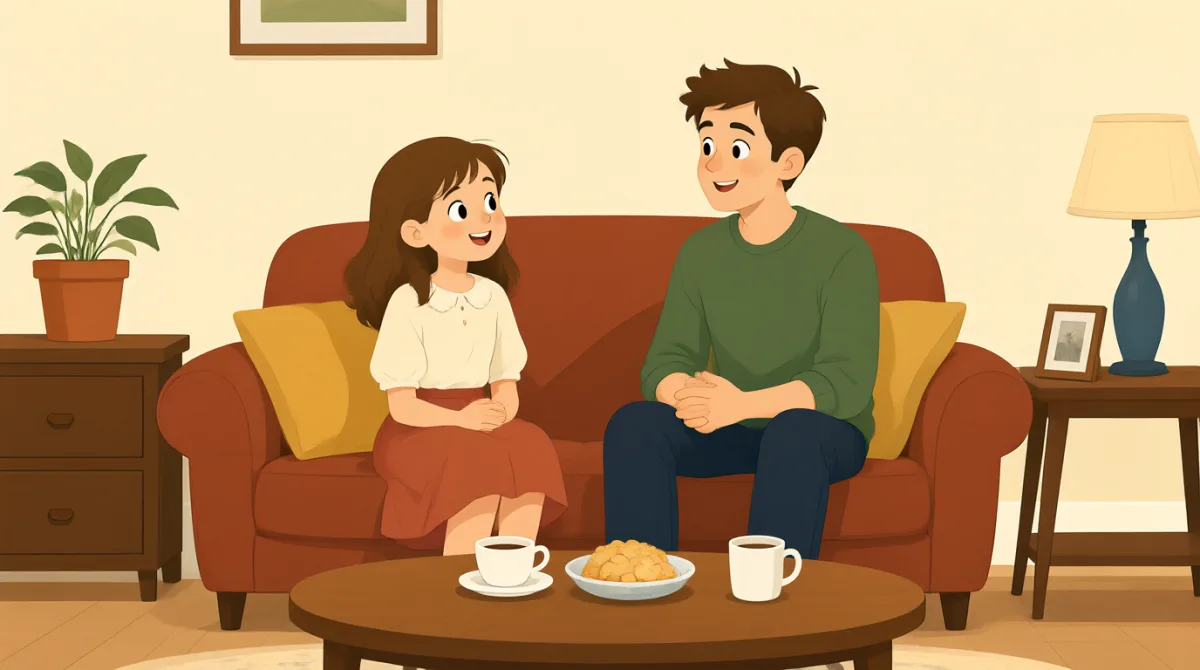

That was such a great show! The singer sounded even better live.
C’était vraiment un super concert ! La chanteuse était encore meilleure en live.

I agree. The band was great, too. I loved the last song.
Je suis d’accord. Le groupe était super aussi. J’ai adoré la dernière chanson.
Me too! The lights during that song were beautiful.
Moi aussi ! Les lumières pendant cette chanson étaient magnifiques.
I liked how the singer talked with the crowd between songs.
J’ai aimé la façon dont la chanteuse parlait avec le public entre les chansons.
Yes, it made the whole show feel friendly and fun.
Oui, ça rendait tout le concert chaleureux et sympa.
I’m glad we got seats near the stage. We could see everything.
Je suis content qu’on ait eu des places près de la scène. On voyait tout.
Let’s look up the singer’s next concert when we get home.
Quand on sera à la maison, cherchons le prochain concert de la chanteuse.
Good idea. I’d definitely go again.
Bonne idée. J’y retournerais sans hésiter.
Vocabulaire8
- liveen live
Here, “live” means performed in front of an audience, not recorded. You can say, “The band sounds great live.”
Ici, “live” signifie que le concert a lieu devant un public, et qu’il n’est pas enregistré. Tu peux dire : “The band sounds great live.”
- I agree.Je suis d’accord.
Use this phrase to show that you have the same opinion as someone. You can follow it with a reason or an example.
Utilise cette expression pour montrer que tu partages l’avis de quelqu’un. Tu peux ajouter une raison ou un exemple.
- the last songla dernière chanson
This means the final song in a show or event. You can use “the last” to talk about the final item in a series.
Cela désigne la chanson qui termine un concert ou un événement. Tu peux utiliser “the last” pour parler du dernier élément d’une série.
- the crowdle public
“The crowd” means the people watching or listening to an event. You can say, “The singer waved to the crowd.”
“The crowd” désigne les personnes qui regardent ou écoutent un événement. Tu peux dire : “The singer waved to the crowd.”
- between songsentre les chansons
This means during the short breaks from one song to the next. You can use “between” to describe the time separating two events.
Cela désigne les courtes pauses entre deux chansons. Tu peux utiliser “between” pour parler du temps qui sépare deux événements.
- near the stageprès de la scène
This means close to the raised area where performers play. You can use “near” to describe where something or someone is.
Cela signifie qu’on est tout près de l’espace surélevé où les artistes se produisent. Tu peux utiliser “near” pour indiquer où se trouve une personne ou une chose.
- look upchercher
Here, “look up” means search for information, often online. You can say, “I’ll look up the concert time.”
Ici, “look up” signifie chercher des informations, souvent en ligne. Tu peux dire : “I’ll look up the concert time.”
- go againy retourner
This means return to an event or place another time. You can say, “I enjoyed the show, so I’d go again.”
Cela signifie revenir à un événement ou dans un lieu une autre fois. Tu peux dire : “I enjoyed the show, so I’d go again.”
Phrases clés7
- 1
That was such a great show!
C’était vraiment un super concert !
Use this to share a positive opinion after an event. You can replace “show” with another event, such as “game” or “concert.”
Utilise cette phrase pour exprimer ton enthousiasme après un événement. Tu peux remplacer “show” par un autre événement, comme “game” ou “concert.”
- 2
The singer sounded even better live.
La chanteuse était encore meilleure en live.
Use this to say someone performed better in person than you expected. You can use “sounded” to talk about music or a person’s voice.
Utilise cette phrase pour dire que quelqu’un a été meilleur en personne que tu ne le pensais. Tu peux utiliser “sounded” pour parler de musique ou de la voix de quelqu’un.
- 3
I loved the last song.
J’ai adoré la dernière chanson.
This is a simple way to say which song you enjoyed most. You can replace “the last song” with another part of a performance.
C’est une façon simple de dire quelle chanson tu as préférée. Tu peux remplacer “the last song” par une autre partie d’un spectacle.
- 4
I liked how the singer talked with the crowd between songs.
J’ai aimé la façon dont la chanteuse parlait avec le public entre les chansons.
Use “I liked how…” to describe something someone did that you enjoyed. You can use the same pattern to talk about a person’s actions.
Utilise “I liked how…” pour décrire une chose que quelqu’un a faite et que tu as appréciée. Tu peux employer la même tournure pour parler des actions d’une personne.
- 5
We could see everything.
On voyait tout.
This is useful for describing a good view at an event. You can use “could” to talk about what you were able to do in the past.
Cette phrase est utile pour décrire une belle vue pendant un événement. Tu peux utiliser “could” pour parler de ce que tu pouvais faire dans le passé.
- 6
Let’s look up the singer’s next concert when we get home.
Quand on sera à la maison, cherchons le prochain concert de la chanteuse.
Use “Let’s…” to suggest doing something together. “Look up” means search for information, and “when we get home” says when to do it.
Utilise “Let’s…” pour proposer de faire quelque chose ensemble. “Look up” signifie chercher des informations, et “when we get home” indique quand le faire.
- 7
Good idea. I’d definitely go again.
Bonne idée. J’y retournerais sans hésiter.
Use this to agree with a suggestion and say you would do something another time. “I’d” means “I would,” and “definitely” makes your answer stronger.
Utilise cette phrase pour approuver une proposition et dire que tu le referais une autre fois. “I’d” signifie “I would”, et “definitely” renforce ta réponse.