Meeting Outside the Venue
Treffen vor dem Veranstaltungsort
Emma and Jack meet outside the concert venue. They talk about the singer and get ready to go in.
Emma und Jack treffen sich vor dem Konzert. Sie sprechen über die Sängerin und machen sich bereit hineinzugehen.
Dialog8
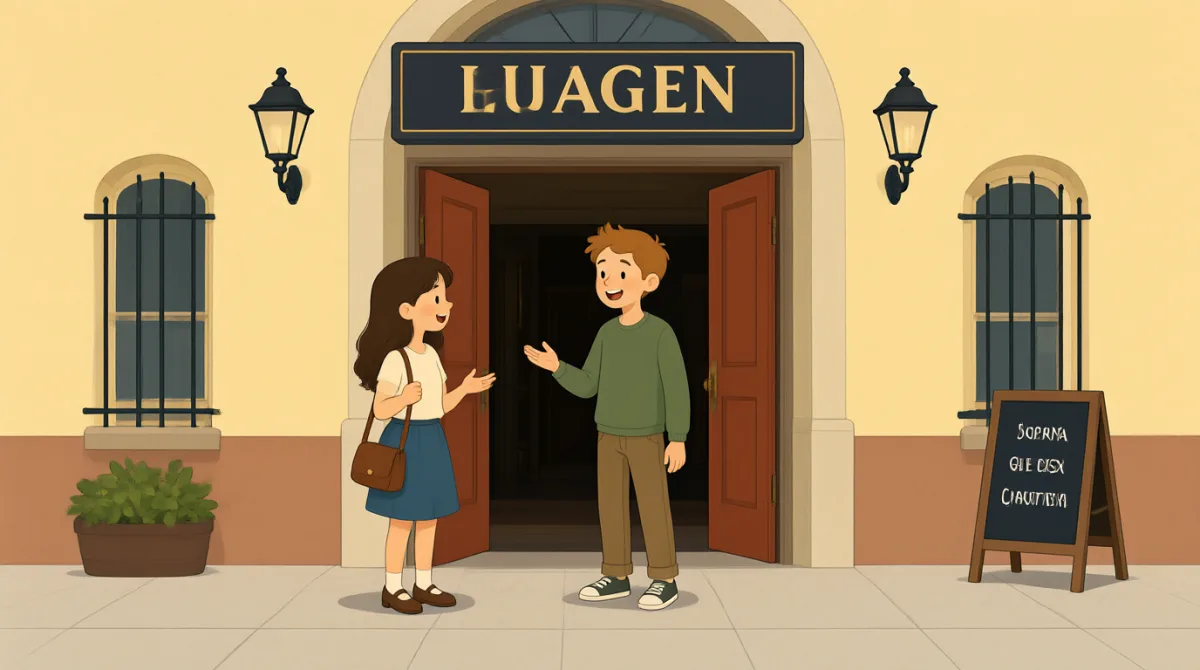

Hi, Jack! I’m glad we got here early. The concert starts in thirty minutes.
Hi, Jack! Gut, dass wir so früh hier sind. Das Konzert fängt in dreißig Minuten an.

Me too. The line is already getting long. Do you have your tickets?
Finde ich auch. Die Schlange wird schon länger. Hast du deine Tickets?
Yes, they’re on my phone. I’m so excited to hear the singer live!
Ja, sie sind auf meinem Handy. Ich freue mich total darauf, die Sängerin live zu hören!
I know! Her new songs are great. I listened to the whole album yesterday.
Ich auch! Ihre neuen Songs sind großartig. Ich habe mir gestern das ganze Album angehört.
Which song do you hope she sings tonight? I really like “Stay Close.”
Welchen Song soll sie heute Abend deiner Meinung nach singen? Ich mag „Stay Close“ besonders gern.
That one’s my favorite, too. Let’s go in when the doors open.
Der ist auch mein Lieblingssong. Lass uns reingehen, wenn die Türen aufgehen.
Good idea. I’ll get my ticket ready. Do you know where our seats are?
Gute Idee. Ich mache mein Ticket schon mal bereit. Weißt du, wo unsere Plätze sind?
Yes, they’re on the floor level, near the middle. We should have a good view.
Ja, im Innenraum, ungefähr in der Mitte. Von dort sollten wir eine gute Sicht haben.
Wortschatz8
- got here earlyso früh hier angekommen
Arrived at this place before the expected time. Use it to say when you arrived somewhere.
Das bedeutet, dass du vor der erwarteten Zeit an diesem Ort angekommen bist. Verwende den Ausdruck, wenn du sagen möchtest, wann du irgendwo angekommen bist.
- the line is already getting longdie Schlange wird schon länger
More people are joining the line, so it is growing. Use this phrase to describe a line that is becoming longer.
Immer mehr Leute stellen sich an, sodass die Schlange wächst. Mit diesem Ausdruck beschreibst du, dass eine Schlange länger wird.
- on my phoneauf meinem Handy
Stored or available on my phone. You can use this phrase for tickets, photos, or other things you keep on your phone.
Etwas ist auf meinem Handy gespeichert oder dort verfügbar. Du kannst den Ausdruck für Tickets, Fotos und andere Dinge verwenden, die du auf deinem Handy hast.
- livelive
Happening in person, not in a recording. Here, the speaker is excited to hear the singer perform in person.
Etwas findet persönlich statt und wird nicht abgespielt. Hier freut sich die Person darauf, die Sängerin live auftreten zu hören.
- the whole albumdas ganze Album
All the songs on an album. Use “the whole” to say you listened to or watched something completely.
Alle Songs eines Albums. Mit “the whole” sagst du, dass du dir etwas vollständig angehört oder angesehen hast.
- go inreingehen
Enter a place. You can use it when talking about entering a venue, building, or room.
Einen Ort betreten. Du kannst den Ausdruck verwenden, wenn du davon sprichst, einen Veranstaltungsort, ein Gebäude oder einen Raum zu betreten.
- get my ticket readymein Ticket bereitlegen
Prepare my ticket so I can show it or use it. This phrase is useful before entering an event.
Mein Ticket so vorbereiten, dass ich es vorzeigen oder benutzen kann. Der Ausdruck ist praktisch, bevor du eine Veranstaltung betrittst.
- floor levelim Innenraum
The level of a venue where the floor is, rather than an upper level. Here, it tells where the seats are.
Der Bereich einer Veranstaltungsstätte auf Bodenniveau und nicht auf einer höher gelegenen Ebene. Hier verrät der Ausdruck, wo sich die Plätze befinden.
Wichtige Sätze8
- 1
I’m glad we got here early.
Gut, dass wir so früh hier sind.
Use this to say you are happy you arrived before a busy time. You can replace “here” with another place, such as “I’m glad we got to the station early.”
Damit sagst du, dass du froh bist, vor dem großen Andrang angekommen zu sein. Du kannst “here” durch einen anderen Ort ersetzen, zum Beispiel: “I’m glad we got to the station early.”
- 2
Do you have your tickets?
Hast du deine Tickets?
This is a simple way to check whether someone has what they need to enter an event. Replace “tickets” with another item, such as “your keys” or “your phone.”
So kannst du einfach nachfragen, ob jemand alles dabeihat, was er braucht, um eine Veranstaltung zu besuchen. Ersetze “tickets” durch einen anderen Gegenstand, zum Beispiel “your keys” oder “your phone.”
- 3
I’m so excited to hear the singer live!
Ich freue mich total darauf, die Sängerin live zu hören!
Use this to show strong excitement about an upcoming event. You can change the activity, as in “I’m so excited to see the band live!”
Verwende diesen Satz, um große Vorfreude auf eine bevorstehende Veranstaltung auszudrücken. Du kannst die Aktivität ändern, zum Beispiel: “I’m so excited to see the band live!”
- 4
I listened to the whole album yesterday.
Ich habe mir gestern das ganze Album angehört.
This sentence says you listened to every song on an album. You can replace “the whole album” with another thing, such as “the whole podcast.”
Dieser Satz sagt, dass du dir jeden Song eines Albums angehört hast. Du kannst “the whole album” durch etwas anderes ersetzen, zum Beispiel durch “the whole podcast.”
- 5
Which song do you hope she sings tonight?
Welchen Song soll sie heute Abend deiner Meinung nach singen?
Use this question to ask which song someone wants to hear at a performance. Change “song” or “she” to fit the event.
Mit dieser Frage erkundigst du dich, welchen Song jemand bei einem Auftritt hören möchte. Passe “song” oder “she” an die jeweilige Veranstaltung an.
- 6
Let’s go in when the doors open.
Lass uns reingehen, wenn die Türen aufgehen.
Use “Let’s” to suggest doing something together, and “when” to say when you will do it. You can reuse the pattern with another action, such as “Let’s sit down when the show starts.”
Mit “Let’s” schlägst du vor, etwas gemeinsam zu tun, und mit “when” sagst du, wann ihr es tun werdet. Du kannst das Muster mit einer anderen Handlung wiederverwenden, zum Beispiel: “Let’s sit down when the show starts.”
- 7
I’ll get my ticket ready.
Ich mache mein Ticket schon mal bereit.
Use “I’ll” to say what you plan to do. This sentence is useful when you are preparing to enter an event.
Mit “I’ll” sagst du, was du vorhast. Dieser Satz passt gut, wenn du dich darauf vorbereitest, eine Veranstaltung zu betreten.
- 8
We should have a good view.
Von dort sollten wir eine gute Sicht haben.
Use this to say you expect to see something well. You can change “view” to another noun, such as “We should have a good seat.”
Damit sagst du, dass du erwartest, etwas gut sehen zu können. Du kannst “view” durch ein anderes Substantiv ersetzen, zum Beispiel: “We should have a good seat.”