Meeting Outside the Venue
Quedando afuera del recinto
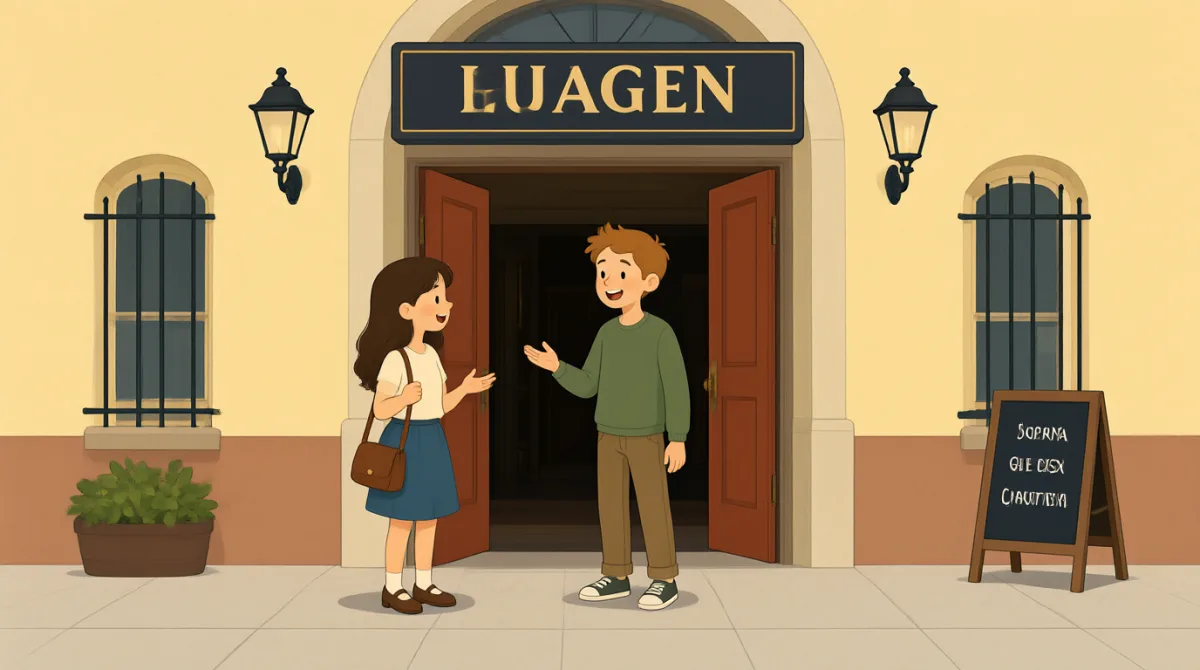
Emma and Jack meet outside the concert venue. They talk about the singer and get ready to go in.
Emma y Jack se encuentran afuera del recinto del concierto. Hablan sobre la cantante y se preparan para entrar.
Diálogo8

Hi, Jack! I’m glad we got here early. The concert starts in thirty minutes.
¡Hola, Jack! Me alegra que hayamos llegado temprano. El concierto empieza en treinta minutos.

Me too. The line is already getting long. Do you have your tickets?
A mí también. La fila ya se está haciendo larga. ¿Tienes las entradas?
Yes, they’re on my phone. I’m so excited to hear the singer live!
Sí, las tengo en el celular. ¡Tengo muchísimas ganas de escuchar a la cantante en vivo!
I know! Her new songs are great. I listened to the whole album yesterday.
¡Ya lo creo! Sus canciones nuevas son geniales. Ayer escuché el álbum entero.
Which song do you hope she sings tonight? I really like “Stay Close.”
¿Qué canción esperas que cante esta noche? A mí me gusta mucho “Stay Close”.
That one’s my favorite, too. Let’s go in when the doors open.
Esa también es mi favorita. Entremos cuando abran las puertas.
Good idea. I’ll get my ticket ready. Do you know where our seats are?
Buena idea. Voy a tener lista mi entrada. ¿Sabes dónde están nuestros asientos?
Yes, they’re on the floor level, near the middle. We should have a good view.
Sí, están en la planta baja, cerca del centro. Deberíamos tener una buena vista.
Vocabulario8
- got here earlyllegamos temprano
Arrived at this place before the expected time. Use it to say when you arrived somewhere.
Significa que llegamos a este lugar antes de la hora prevista. Usa esta expresión para decir cuándo llegaste a algún sitio.
- the line is already getting longla fila ya se está haciendo larga
More people are joining the line, so it is growing. Use this phrase to describe a line that is becoming longer.
Se está sumando más gente a la fila, así que cada vez es más larga. Usa esta expresión para describir una fila que está creciendo.
- on my phoneen mi celular
Stored or available on my phone. You can use this phrase for tickets, photos, or other things you keep on your phone.
Guardado o disponible en mi celular. Puedes usar esta expresión para hablar de entradas, fotos u otras cosas que tengas en el celular.
- liveen vivo
Happening in person, not in a recording. Here, the speaker is excited to hear the singer perform in person.
Algo que sucede en persona, no en una grabación. En este caso, a quien habla le entusiasma escuchar a la cantante actuar en persona.
- the whole albumel álbum entero
All the songs on an album. Use “the whole” to say you listened to or watched something completely.
Todas las canciones de un álbum. Usa “the whole” para decir que escuchaste o viste algo completo.
- go inentrar
Enter a place. You can use it when talking about entering a venue, building, or room.
Pasar al interior de un lugar. Puedes usar esta expresión para hablar de entrar a un recinto, edificio o habitación.
- get my ticket readytener lista mi entrada
Prepare my ticket so I can show it or use it. This phrase is useful before entering an event.
Preparar mi entrada para poder mostrarla o usarla. Esta expresión es útil antes de entrar a un evento.
- floor levella planta baja
The level of a venue where the floor is, rather than an upper level. Here, it tells where the seats are.
El nivel del recinto donde está el piso principal, en lugar de un nivel superior. Aquí indica dónde están los asientos.
Frases clave8
- 1
I’m glad we got here early.
Me alegra que hayamos llegado temprano.
Use this to say you are happy you arrived before a busy time. You can replace “here” with another place, such as “I’m glad we got to the station early.”
Usa esta frase para decir que te alegra haber llegado antes de que haya mucha gente. Puedes cambiar “here” por otro lugar, por ejemplo: “I’m glad we got to the station early.”
- 2
Do you have your tickets?
¿Tienes las entradas?
This is a simple way to check whether someone has what they need to enter an event. Replace “tickets” with another item, such as “your keys” or “your phone.”
Esta es una forma sencilla de comprobar si alguien tiene lo que necesita para entrar a un evento. Puedes reemplazar “tickets” por otra cosa, como “your keys” o “your phone”.
- 3
I’m so excited to hear the singer live!
¡Tengo muchísimas ganas de escuchar a la cantante en vivo!
Use this to show strong excitement about an upcoming event. You can change the activity, as in “I’m so excited to see the band live!”
Usa esta frase para expresar mucha emoción por un evento próximo. Puedes cambiar la actividad, como en “I’m so excited to see the band live!”
- 4
I listened to the whole album yesterday.
Ayer escuché el álbum entero.
This sentence says you listened to every song on an album. You can replace “the whole album” with another thing, such as “the whole podcast.”
Esta oración dice que escuchaste todas las canciones de un álbum. Puedes reemplazar “the whole album” por otra cosa, como “the whole podcast”.
- 5
Which song do you hope she sings tonight?
¿Qué canción esperas que cante esta noche?
Use this question to ask which song someone wants to hear at a performance. Change “song” or “she” to fit the event.
Usa esta pregunta para preguntarle a alguien qué canción quiere escuchar en una actuación. Cambia “song” o “she” según el evento.
- 6
Let’s go in when the doors open.
Entremos cuando abran las puertas.
Use “Let’s” to suggest doing something together, and “when” to say when you will do it. You can reuse the pattern with another action, such as “Let’s sit down when the show starts.”
Usa “Let’s” para proponer hacer algo juntos y “when” para indicar cuándo lo harán. Puedes reutilizar el patrón con otra acción, por ejemplo: “Let’s sit down when the show starts.”
- 7
I’ll get my ticket ready.
Voy a tener lista mi entrada.
Use “I’ll” to say what you plan to do. This sentence is useful when you are preparing to enter an event.
Usa “I’ll” para decir lo que planeas hacer. Esta oración es útil cuando te preparas para entrar a un evento.
- 8
We should have a good view.
Deberíamos tener una buena vista.
Use this to say you expect to see something well. You can change “view” to another noun, such as “We should have a good seat.”
Usa esta frase para decir que esperas ver algo bien. Puedes cambiar “view” por otro sustantivo, como en “We should have a good seat.”