Finding Our Seats
Encontramos nuestros asientos
The friends enter the stadium and look for their seats. They ask an usher for help and find the correct section.
Los amigos entran al estadio y buscan sus asientos. Le piden ayuda a un acomodador y encuentran la sección correcta.
Diálogo8
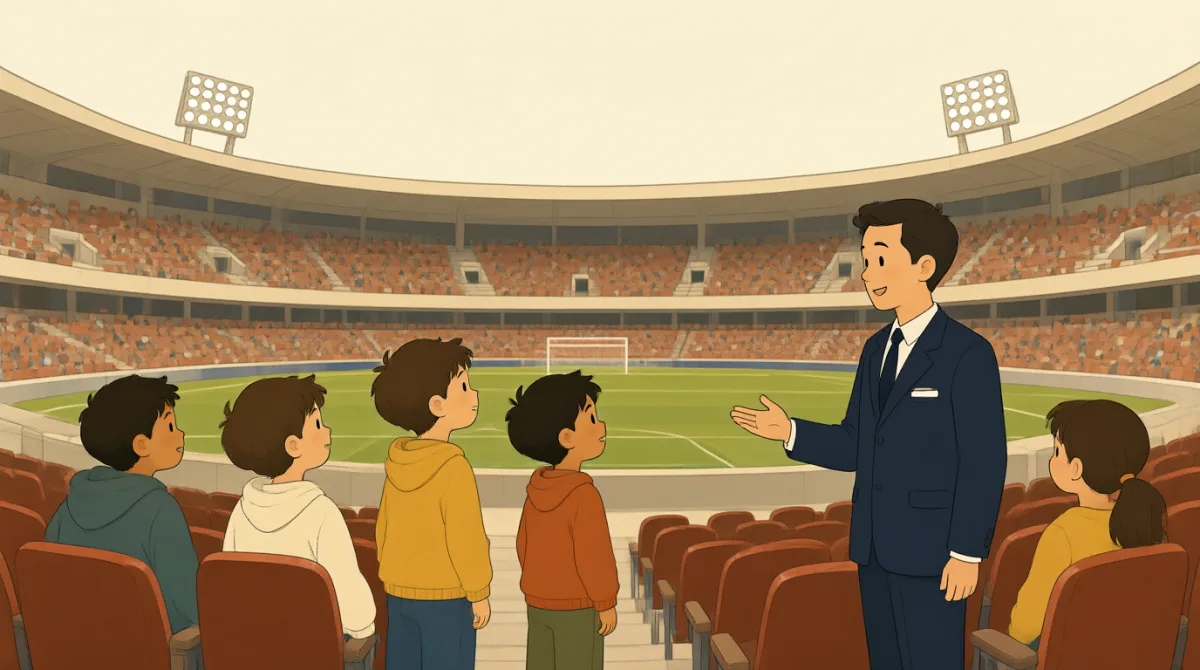

Our tickets say Section 112. Do you know where we should go?
Nuestros boletos dicen sección 112. ¿Sabes a dónde tenemos que ir?

I see a sign for Section 110. Maybe our seats are close.
Veo un letrero que dice sección 110. Quizá nuestros asientos estén cerca.

Let’s ask the usher. Excuse me, which way is Section 112?
Preguntémosle al acomodador. Disculpe, ¿por dónde se va a la sección 112?
The usher says we should go up these stairs and turn left.
El acomodador dice que tenemos que subir estas escaleras y girar a la izquierda.
Great! I found our row. We’re in row eight, right?
¡Genial! Ya encontré nuestra fila. Estamos en la fila ocho, ¿verdad?
Yes, row eight. Our seats are 12, 13, and 14.
Sí, fila ocho. Nuestros asientos son el 12, el 13 y el 14.
I’m in seat 12. Leo, you’re next to me, and Grace is beside you.
Yo estoy en el asiento 12. Leo, tú estás a mi lado, y Grace está junto a ti.
We found them! Let’s sit down before the game starts.
¡Los encontramos! Sentémonos antes de que empiece el partido.
Vocabulario7
- ticketsboletos
Tickets show where you can sit at an event. Here, they show the friends’ section and seat numbers.
Los boletos indican dónde puedes sentarte en un evento. En este caso, muestran la sección y los números de asiento de los amigos.
- Section 112sección 112
A section is one part of a stadium with many rows of seats. You can use the section number to find your seats.
Una sección es una parte del estadio que tiene muchas filas de asientos. Puedes usar el número de sección para encontrar tus asientos.
- usheracomodador
An usher helps people find their seats at a stadium or theater. You can ask an usher for directions.
Un acomodador ayuda a la gente a encontrar sus asientos en un estadio o teatro. Puedes pedirle indicaciones.
- turn leftgirar a la izquierda
This means to change direction to the left. You can use it when giving or following directions.
Significa cambiar de dirección hacia la izquierda. Puedes usarlo para dar o seguir indicaciones.
- row eightfila ocho
A row is a line of seats. The friends use the row number to find the right seats.
Una fila es una línea de asientos. Los amigos usan el número de fila para encontrar los asientos correctos.
- next to mea mi lado
This means beside me, with no seat or person between us. You can use it to describe where someone is sitting.
Significa junto a mí, sin ningún asiento ni persona entre nosotros. Puedes usar esta expresión para describir dónde está sentado alguien.
- sit downsentarse
This means to take a seat. You can use it when asking someone to sit or saying what you will do.
Significa tomar asiento. Puedes usarlo para pedirle a alguien que se siente o para decir lo que vas a hacer.
Frases clave7
- 1
Do you know where we should go?
¿Sabes a dónde tenemos que ir?
Use this to ask someone for directions or advice. You can change the place, for example, “Do you know where we should wait?”
Usa esta pregunta para pedirle indicaciones o un consejo a alguien. Puedes cambiar el lugar; por ejemplo: “Do you know where we should wait?” (¿Sabes dónde deberíamos esperar?).
- 2
Excuse me, which way is Section 112?
Disculpe, ¿por dónde se va a la sección 112?
This is a polite way to ask for directions. Replace “Section 112” with the place you are looking for.
Esta es una forma educada de pedir indicaciones. Cambia “Section 112” por el lugar que estás buscando.
- 3
The usher says we should go up these stairs and turn left.
El acomodador dice que tenemos que subir estas escaleras y girar a la izquierda.
This sentence reports directions from another person. You can reuse “go up these stairs and turn left” to give simple directions.
Esta oración transmite las indicaciones de otra persona. Puedes reutilizar “go up these stairs and turn left” para dar indicaciones sencillas.
- 4
I found our row.
Ya encontré nuestra fila.
Use this to say that you located the correct line of seats. You can change “our row” to another place, such as “our gate.”
Usa esta frase para decir que encontraste la fila de asientos correcta. Puedes cambiar “our row” por otro lugar, como “our gate”.
- 5
We’re in row eight, right?
Estamos en la fila ocho, ¿verdad?
Use this to check that information is correct. The word “right?” makes it a quick confirmation question.
Usa esta frase para confirmar que la información es correcta. La palabra “right?” convierte la frase en una pregunta breve de confirmación.
- 6
Our seats are 12, 13, and 14.
Nuestros asientos son el 12, el 13 y el 14.
This is a simple way to give seat numbers. You can use the same pattern to tell someone which seats belong to your group.
Esta es una forma sencilla de decir los números de los asientos. Puedes usar la misma estructura para decirle a alguien cuáles son los asientos de tu grupo.
- 7
Let’s sit down before the game starts.
Sentémonos antes de que empiece el partido.
Use “Let’s” to suggest doing something together. You can replace “sit down” with another activity, such as “get some food.”
Usa “Let’s” para proponer hacer algo juntos. Puedes cambiar “sit down” por otra actividad, como “get some food”.