No Smiling, Please
Nada de sonreír, por favor
Jack gives Emma simple instructions about how to sit and look at the camera. Emma tries to keep a neutral expression.
Jack le da a Emma instrucciones sencillas sobre cómo sentarse y mirar a la cámara. Emma intenta mantener una expresión neutra.
Diálogo8
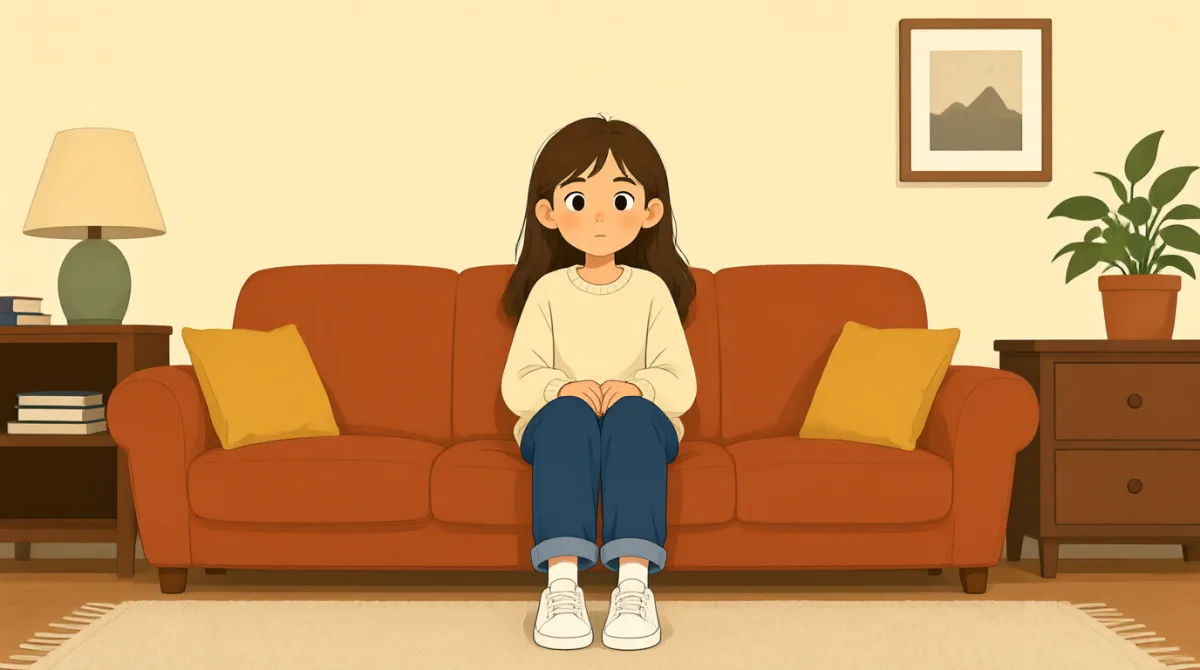

Sit up straight, Emma, and put both feet flat on the floor.
Siéntate derecha, Emma, y apoya bien los dos pies en el suelo.

Like this? Should I move closer to the camera?
¿Así? ¿Me acerco más a la cámara?
That’s good. Look straight at the camera, please.
Así está bien. Mira directamente a la cámara, por favor.
Okay. Should I smile a little?
Vale. ¿Sonrío un poco?
No smiling, please. Keep your face relaxed and your mouth closed.
No sonrías, por favor. Relaja la cara y mantén la boca cerrada.
All right. I’ll try to look calm.
De acuerdo. Intentaré parecer tranquila.
Great. Keep your head still and look right at the lens.
Muy bien. Mantén la cabeza quieta y mira directamente al objetivo.
Got it. I’m ready when you are.
Entendido. Estoy lista cuando tú lo estés.
Vocabulario8
- sit up straightsentarse derecho
Sit with your back straight. It helps you look neat in the photo.
Siéntate con la espalda recta. Así saldrás bien en la foto.
- put both feet flat on the floorapoyar bien los dos pies en el suelo
Place both feet on the floor, not on your toes. This is a simple instruction about how to sit.
Pon los dos pies en el suelo, no de puntillas. Es una instrucción sencilla sobre cómo sentarse.
- move closeracercarse
Come nearer to something. You can use this phrase when asking someone to change their position.
Ponerse más cerca de algo. Puedes usar esta expresión para pedirle a alguien que cambie de posición.
- look straight at the cameramirar directamente a la cámara
Face the camera and look directly at it. This is useful when taking a photo.
Colócate frente a la cámara y mírala directamente. Es útil cuando te hacen una foto.
- keep your face relaxedrelajar la cara
Try not to tense the muscles in your face. You might hear this instruction when posing for a picture.
Intenta no tensar los músculos de la cara. Puede que oigas esta instrucción cuando posas para una foto.
- mouth closedboca cerrada
Keep your lips together and do not open your mouth. It describes a simple way to pose for a photo.
Mantén los labios juntos y no abras la boca. Describe una forma sencilla de posar para una foto.
- keep your head stillmantener la cabeza quieta
Do not move your head. This instruction helps the photographer take a clear picture.
No muevas la cabeza. Esta instrucción ayuda al fotógrafo a hacer una foto nítida.
- the lensel objetivo
The lens is the part of the camera that you look toward. In this dialogue, Jack asks Emma to look right at it.
El objetivo es la parte de la cámara hacia la que miras. En este diálogo, Jack le pide a Emma que lo mire directamente.
Frases clave8
- 1
Sit up straight, Emma, and put both feet flat on the floor.
Siéntate derecha, Emma, y apoya bien los dos pies en el suelo.
This sentence gives two clear instructions about how to sit. You can reuse the pattern “Sit up straight and put…” to give someone simple directions.
Esta frase da dos instrucciones claras sobre cómo sentarse. Puedes reutilizar la estructura “Sit up straight and put…” para dar indicaciones sencillas a alguien.
- 2
Should I move closer to the camera?
¿Me acerco más a la cámara?
Use this question to check whether you need to change your position. Replace “closer to the camera” with another place or person.
Usa esta pregunta para comprobar si tienes que cambiar de posición. Sustituye “closer to the camera” por otro lugar o persona.
- 3
Look straight at the camera, please.
Mira directamente a la cámara, por favor.
This is a polite way to ask someone to face the camera. You can use “Look straight at…” when giving directions.
Es una forma educada de pedirle a alguien que mire a la cámara. Puedes usar “Look straight at…” cuando das indicaciones.
- 4
Should I smile a little?
¿Sonrío un poco?
This is a simple way to ask whether a small smile is okay. You can replace “smile” with another action to check what to do.
Es una forma sencilla de preguntar si está bien sonreír un poco. Puedes sustituir “smile” por otra acción para preguntar qué hacer.
- 5
No smiling, please.
No sonrías, por favor.
This is a short, polite instruction asking someone not to smile. Use “No [action], please” to give a brief direction.
Es una instrucción breve y educada para pedirle a alguien que no sonría. Usa “No [action], please” para dar una indicación breve.
- 6
Keep your face relaxed and your mouth closed.
Relaja la cara y mantén la boca cerrada.
This sentence gives two instructions for a calm facial expression. You can use “Keep your…” to tell someone how to hold a position or expression.
Esta frase da dos instrucciones para mantener una expresión tranquila. Puedes usar “Keep your…” para decirle a alguien cómo mantener una postura o expresión.
- 7
I’ll try to look calm.
Intentaré parecer tranquila.
Use “I’ll try to…” when you say you will make an effort to do something. You can replace “look calm” with another action or expression.
Usa “I’ll try to…” para decir que te esforzarás por hacer algo. Puedes sustituir “look calm” por otra acción o expresión.
- 8
I’m ready when you are.
Estoy lista cuando tú lo estés.
This is a friendly way to say you are ready to begin whenever the other person is. It works well before taking a photo or starting an activity.
Es una forma amistosa de decir que estás lista para empezar cuando lo esté la otra persona. Queda bien antes de hacer una foto o empezar una actividad.