No Smiling, Please
Bitte nicht lächeln
Jack gives Emma simple instructions about how to sit and look at the camera. Emma tries to keep a neutral expression.
Jack gibt Emma einfache Anweisungen dazu, wie sie sitzen und in die Kamera schauen soll. Emma versucht, einen neutralen Gesichtsausdruck zu bewahren.
Dialog8
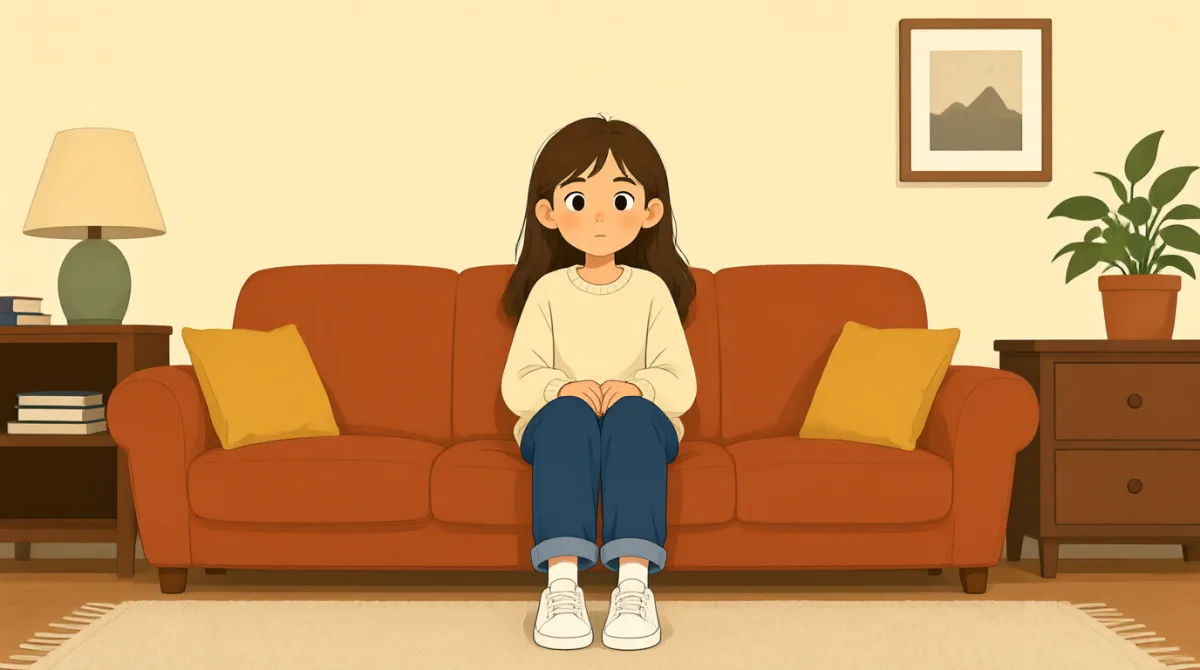

Sit up straight, Emma, and put both feet flat on the floor.
Setz dich aufrecht hin, Emma, und stell beide Füße flach auf den Boden.

Like this? Should I move closer to the camera?
So? Soll ich näher an die Kamera rücken?
That’s good. Look straight at the camera, please.
Das ist gut. Schau bitte gerade in die Kamera.
Okay. Should I smile a little?
Okay. Soll ich ein bisschen lächeln?
No smiling, please. Keep your face relaxed and your mouth closed.
Bitte nicht lächeln. Entspann dein Gesicht und halte den Mund geschlossen.
All right. I’ll try to look calm.
Alles klar. Ich versuche, ruhig zu wirken.
Great. Keep your head still and look right at the lens.
Super. Halte den Kopf still und schau direkt in die Linse.
Got it. I’m ready when you are.
Verstanden. Ich bin bereit, wenn du es bist.
Wortschatz8
- sit up straightaufrecht sitzen
Sit with your back straight. It helps you look neat in the photo.
Sitz mit geradem Rücken. So wirkst du auf dem Foto gepflegt.
- put both feet flat on the floorbeide Füße flach auf den Boden stellen
Place both feet on the floor, not on your toes. This is a simple instruction about how to sit.
Stell beide Füße auf den Boden und nicht nur auf die Zehenspitzen. Das ist eine einfache Anweisung dazu, wie du sitzen sollst.
- move closernäher rücken
Come nearer to something. You can use this phrase when asking someone to change their position.
Komm näher an etwas heran. Diese Wendung kannst du verwenden, wenn du jemanden bittest, seine Position zu verändern.
- look straight at the cameragerade in die Kamera schauen
Face the camera and look directly at it. This is useful when taking a photo.
Wende dich der Kamera zu und schau direkt hinein. Das ist beim Fotografieren nützlich.
- keep your face relaxeddas Gesicht entspannen
Try not to tense the muscles in your face. You might hear this instruction when posing for a picture.
Versuch, die Muskeln in deinem Gesicht nicht anzuspannen. Diese Anweisung hörst du vielleicht, wenn du für ein Foto posierst.
- mouth closedden Mund geschlossen halten
Keep your lips together and do not open your mouth. It describes a simple way to pose for a photo.
Halte die Lippen zusammen und öffne den Mund nicht. Das beschreibt eine einfache Haltung für ein Foto.
- keep your head stillden Kopf still halten
Do not move your head. This instruction helps the photographer take a clear picture.
Beweg den Kopf nicht. So kann der Fotograf ein scharfes Bild aufnehmen.
- the lensdie Linse
The lens is the part of the camera that you look toward. In this dialogue, Jack asks Emma to look right at it.
Die Linse ist der Teil der Kamera, in den du schaust. In diesem Dialog bittet Jack Emma, direkt hineinzuschauen.
Wichtige Sätze8
- 1
Sit up straight, Emma, and put both feet flat on the floor.
Setz dich aufrecht hin, Emma, und stell beide Füße flach auf den Boden.
This sentence gives two clear instructions about how to sit. You can reuse the pattern “Sit up straight and put…” to give someone simple directions.
Dieser Satz enthält zwei klare Anweisungen dazu, wie man sitzen soll. Das Muster “Sit up straight and put…” kannst du wiederverwenden, um jemandem einfache Anweisungen zu geben.
- 2
Should I move closer to the camera?
Soll ich näher an die Kamera rücken?
Use this question to check whether you need to change your position. Replace “closer to the camera” with another place or person.
Mit dieser Frage kannst du überprüfen, ob du deine Position verändern sollst. Ersetze “closer to the camera” durch einen anderen Ort oder eine andere Person.
- 3
Look straight at the camera, please.
Schau bitte gerade in die Kamera.
This is a polite way to ask someone to face the camera. You can use “Look straight at…” when giving directions.
So bittest du jemanden höflich, sich der Kamera zuzuwenden. “Look straight at…” kannst du verwenden, wenn du jemandem eine Anweisung gibst.
- 4
Should I smile a little?
Soll ich ein bisschen lächeln?
This is a simple way to ask whether a small smile is okay. You can replace “smile” with another action to check what to do.
So kannst du einfach fragen, ob ein kleines Lächeln in Ordnung ist. Ersetze “smile” durch eine andere Handlung, um nachzufragen, was du tun sollst.
- 5
No smiling, please.
Bitte nicht lächeln.
This is a short, polite instruction asking someone not to smile. Use “No [action], please” to give a brief direction.
Das ist eine kurze, höfliche Anweisung, nicht zu lächeln. Verwende “No [action], please”, um eine knappe Anweisung zu geben.
- 6
Keep your face relaxed and your mouth closed.
Entspann dein Gesicht und halte den Mund geschlossen.
This sentence gives two instructions for a calm facial expression. You can use “Keep your…” to tell someone how to hold a position or expression.
Dieser Satz enthält zwei Anweisungen für einen ruhigen Gesichtsausdruck. Mit “Keep your…” kannst du jemandem sagen, wie er eine Haltung oder einen Gesichtsausdruck beibehalten soll.
- 7
I’ll try to look calm.
Ich versuche, ruhig zu wirken.
Use “I’ll try to…” when you say you will make an effort to do something. You can replace “look calm” with another action or expression.
Verwende “I’ll try to…”, wenn du sagst, dass du dich um etwas bemühen wirst. Ersetze “look calm” durch eine andere Handlung oder einen anderen Gesichtsausdruck.
- 8
I’m ready when you are.
Ich bin bereit, wenn du es bist.
This is a friendly way to say you are ready to begin whenever the other person is. It works well before taking a photo or starting an activity.
Das ist eine freundliche Art zu sagen, dass du bereit bist, sobald die andere Person es auch ist. Der Satz passt gut, bevor ein Foto gemacht oder eine Aktivität begonnen wird.