Taking Off Glasses
Quitarse las gafas
Jack explains that Emma needs to take off her glasses for the photo. He helps her get ready in front of the camera.
Jack le explica a Emma que tiene que quitarse las gafas para la foto. La ayuda a prepararse frente a la cámara.
Diálogo8
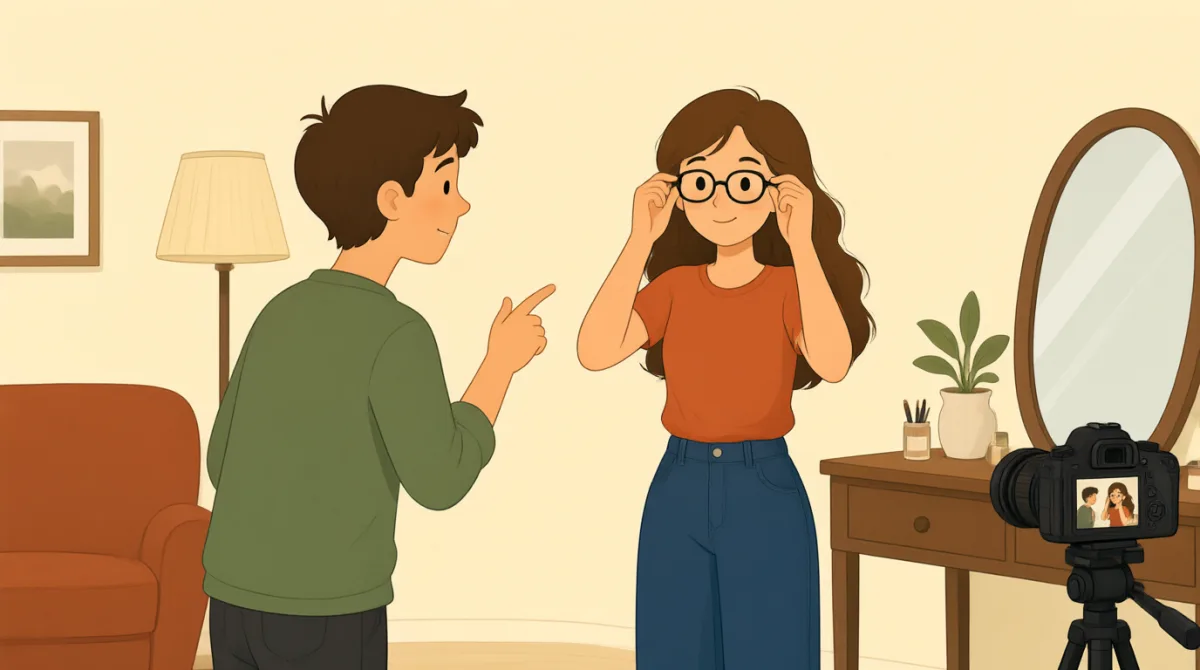

All right, Emma. Please take off your glasses before we take the photo.
Muy bien, Emma. Quítate las gafas antes de que hagamos la foto, por favor.

Oh, sure. Should I put them on the table?
Ah, claro. ¿Las pongo sobre la mesa?
Yes, please. Then stand on the mark in front of the camera.
Sí, por favor. Luego ponte sobre la marca frente a la cámara.
Like this? I hope I’m standing in the right place.
¿Así? Espero estar en el lugar correcto.
That’s right. Move a little closer to the camera, please.
Así está bien. Acércate un poquito a la cámara, por favor.
Okay. Should I look straight at the camera now?
Vale. ¿Ahora miro directamente a la cámara?
Yes. Keep your head straight, and I’ll get you ready.
Sí. Mantén la cabeza recta y te ayudaré a prepararte.
All right. Let me know when you’re ready to take it.
De acuerdo. Avísame cuando estés listo para hacer la foto.
Vocabulario8
- take off your glassesquitarse las gafas
This means to remove your glasses. Use “take off” when you remove something you are wearing.
Significa quitarte las gafas. Usa “take off” cuando te quitas algo que llevas puesto.
- put them on the tableponerlas sobre la mesa
This means to place the glasses on the table. You can use “put [something] on [a place]” to say where you leave an object.
Significa colocar las gafas sobre la mesa. Puedes usar “put [something] on [a place]” para indicar dónde dejas un objeto.
- stand on the markponerse sobre la marca
This means to stand on the spot marked on the floor. It is useful when someone tells you where to stand.
Significa colocarse sobre la marca del suelo. Es útil cuando alguien te indica dónde ponerte.
- in front of the camerafrente a la cámara
This means in the place facing the camera. You can use “in front of” to describe where someone or something is.
Significa estar en el lugar que queda frente a la cámara. Puedes usar “in front of” para describir dónde está alguien o algo.
- a little closerun poquito más cerca
This means slightly nearer. Use it to ask someone to move nearer without going too far.
Significa un poco más cerca. Úsalo para pedirle a alguien que se acerque sin que avance demasiado.
- look straight at the cameramirar directamente a la cámara
This means to face the camera and look directly at it. It is a useful instruction for taking photos.
Significa ponerse frente a la cámara y mirarla directamente. Es una indicación útil para hacer fotos.
- keep your head straightmantener la cabeza recta
This means to hold your head upright and not tilt it. It is a simple instruction for posing for a photo.
Significa mantener la cabeza erguida y sin inclinarla. Es una instrucción sencilla para posar en una foto.
- Let me know when you’re ready to take it.Avísame cuando estés listo para hacer la foto.
This means to tell me when you are ready to take the photo. You can use “Let me know when…” to ask someone to tell you when something happens.
Significa que me avises cuando estés listo para hacer la foto. Puedes usar “Let me know when…” para pedirle a alguien que te avise cuando ocurra algo.
Frases clave8
- 1
Please take off your glasses before we take the photo.
Quítate las gafas antes de que hagamos la foto, por favor.
Use this polite sentence to ask someone to remove their glasses before a photo. You can replace “your glasses” with another item of clothing or accessory.
Usa esta frase cortés para pedirle a alguien que se quite las gafas antes de una foto. Puedes sustituir “your glasses” por otra prenda o accesorio.
- 2
Should I put them on the table?
¿Las pongo sobre la mesa?
Use “Should I…?” to ask what you ought to do. “Them” refers to the glasses, and you can replace it with another object.
Usa “Should I…?” para preguntar qué deberías hacer. “Them” se refiere a las gafas y puedes sustituirlo por otro objeto.
- 3
Then stand on the mark in front of the camera.
Luego ponte sobre la marca frente a la cámara.
This gives someone a clear direction about where to stand. You can change the place or object to give other simple instructions.
Esta frase indica claramente a alguien dónde ponerse. Puedes cambiar el lugar o el objeto para dar otras instrucciones sencillas.
- 4
I hope I’m standing in the right place.
Espero estar en el lugar correcto.
Use this sentence when you are unsure whether you are in the correct spot. You can replace “standing” with another action, such as “waiting” or “sitting.”
Usa esta frase cuando no estés seguro de encontrarte en el lugar correcto. Puedes sustituir “standing” por otra acción, como “waiting” o “sitting”.
- 5
Move a little closer to the camera, please.
Acércate un poquito a la cámara, por favor.
This is a polite way to ask someone to come nearer. Replace “the camera” with the person or place they should move closer to.
Es una forma cortés de pedirle a alguien que se acerque. Sustituye “the camera” por la persona o el lugar al que debería acercarse.
- 6
Should I look straight at the camera now?
¿Ahora miro directamente a la cámara?
Use this question to check what you should do next. You can replace “look straight at the camera” with another action.
Usa esta pregunta para comprobar qué tienes que hacer después. Puedes sustituir “look straight at the camera” por otra acción.
- 7
Keep your head straight, and I’ll get you ready.
Mantén la cabeza recta y te ayudaré a prepararte.
This combines an instruction with an offer to help. You can use “Keep your…” to give someone a simple direction.
Esta frase combina una instrucción con el ofrecimiento de ayudar. Puedes usar “Keep your…” para darle a alguien una indicación sencilla.
- 8
Let me know when you’re ready to take it.
Avísame cuando estés listo para hacer la foto.
Use this to ask someone to tell you when they are ready. Here, “it” means the photo; in other situations, it can refer to another activity or item.
Usa esta frase para pedirle a alguien que te avise cuando esté listo. Aquí, “it” significa la foto; en otras situaciones, puede referirse a otra actividad o cosa.