Building It at Home
Montándolo en casa
After the sofa arrives, Emma and Mia unpack it and follow the instructions to put it together. They finish the job and enjoy their new living room.
Cuando llega el sofá, Emma y Mia lo desembalan y siguen las instrucciones para montarlo. Terminan el trabajo y disfrutan de su nueva sala de estar.
Diálogo8
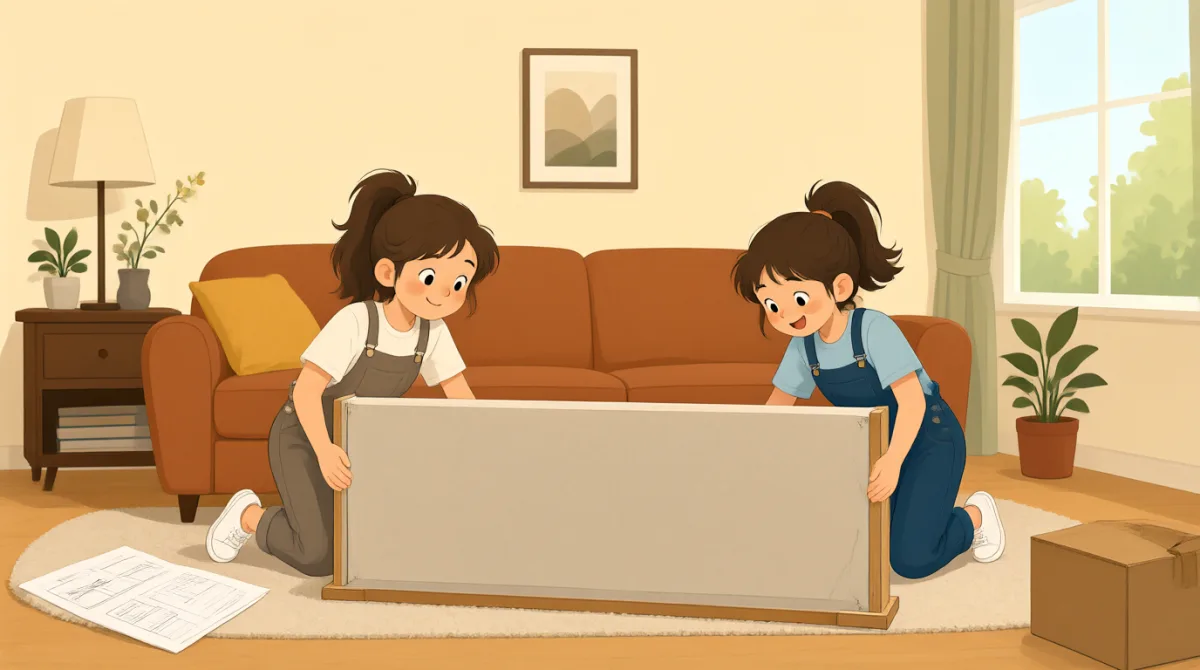

The sofa is here! Let’s open the boxes and check the instructions.
¡Ya llegó el sofá! Abramos las cajas y revisemos las instrucciones.

Sure. I’ll take out the parts while you find the tools.
Claro. Yo saco las piezas mientras tú buscas las herramientas.
I found the screws and the little wrench. What should we do first?
Encontré los tornillos y la llavecita. ¿Qué hacemos primero?
The instructions say to attach the legs to the bottom of the sofa.
Las instrucciones dicen que hay que sujetar las patas a la parte de abajo del sofá.
Can you hold this side? I’ll put the screws in.
¿Puedes sujetar este lado? Yo pongo los tornillos.
Of course. Turn the wrench slowly so the screws go in straight.
Claro. Gira la llave despacio para que los tornillos entren derechos.
All four legs are on. Let’s turn the sofa over carefully.
Ya están puestas las cuatro patas. Démosle la vuelta al sofá con cuidado.
It looks great! Now we can sit down and enjoy your new living room.
¡Quedó genial! Ahora podemos sentarnos y disfrutar de tu nueva sala de estar.
Vocabulario7
- open the boxesabrir las cajas
To remove the things inside a box. Use this phrase when you unpack something you bought.
Sacar las cosas que hay dentro de una caja. Usa esta expresión cuando desembalas algo que compraste.
- take outsacar
To remove something from a container or box. You can say, “I’ll take out the parts.”
Retirar algo de un recipiente o una caja. Puedes decir: “I’ll take out the parts” (Yo saco las piezas).
- toolsherramientas
Things you use to do a job, such as a wrench or a screwdriver. Use this word when talking about fixing or building something.
Cosas que usas para hacer un trabajo, como una llave o un destornillador. Usa esta palabra cuando hables de reparar o montar algo.
- screwstornillos
Small metal fasteners that hold pieces together. They are often used to build furniture.
Piezas metálicas pequeñas que mantienen unidas distintas partes. Se suelen usar para montar muebles.
- attach the legssujetar las patas
To connect the legs to another part of the furniture. You can use “attach” when explaining how to put something together.
Unir las patas a otra parte del mueble. Puedes usar “attach” cuando expliques cómo montar algo.
- hold this sidesujetar este lado
To keep one side in place while someone works on it. Use this phrase when you need help handling a large or heavy object.
Mantener un lado en su sitio mientras alguien trabaja en él. Usa esta expresión cuando necesites ayuda para manejar un objeto grande o pesado.
- sit downsentarse
To move into a sitting position. Use this common phrase when inviting someone to take a seat.
Ponerse en posición sentada. Esta expresión común se usa para invitar a alguien a tomar asiento.
Frases clave8
- 1
Let’s open the boxes and check the instructions.
Abramos las cajas y revisemos las instrucciones.
This sentence suggests two tasks using “Let’s.” Use the same pattern to suggest doing something together, such as “Let’s unpack the dishes.”
Esta oración propone hacer dos cosas usando “Let’s”. Usa el mismo patrón para sugerir que hagan algo juntos, como “Let’s unpack the dishes” (Desembalemos los platos).
- 2
I’ll take out the parts while you find the tools.
Yo saco las piezas mientras tú buscas las herramientas.
This sentence divides two jobs using “while.” Use “I’ll … while you …” to explain what two people can do at the same time.
Esta oración reparte dos tareas usando “while”. Usa “I’ll … while you …” para explicar qué pueden hacer dos personas al mismo tiempo.
- 3
What should we do first?
¿Qué hacemos primero?
This is a useful way to ask about the first step in a task. Use it when you need instructions or are unsure where to begin.
Esta es una forma útil de preguntar cuál es el primer paso de una tarea. Úsala cuando necesites instrucciones o no sepas por dónde empezar.
- 4
The instructions say to attach the legs to the bottom of the sofa.
Las instrucciones dicen que hay que sujetar las patas a la parte de abajo del sofá.
This explains what the instructions tell you to do. Use “The instructions say to …” when describing a step in a guide.
Esta oración explica lo que las instrucciones te indican que hagas. Usa “The instructions say to …” para describir un paso de una guía.
- 5
Can you hold this side?
¿Puedes sujetar este lado?
This is a simple, polite way to ask someone for help. You can replace “this side” with another thing they can hold or support.
Esta es una forma sencilla y amable de pedir ayuda. Puedes sustituir “this side” por otra cosa que la persona pueda sujetar o sostener.
- 6
Turn the wrench slowly so the screws go in straight.
Gira la llave despacio para que los tornillos entren derechos.
This sentence gives an instruction and explains its purpose with “so.” Use this pattern to say how to do something and what result you want.
Esta oración da una instrucción y explica su propósito con “so”. Usa este patrón para decir cómo hacer algo y qué resultado quieres conseguir.
- 7
Let’s turn the sofa over carefully.
Démosle la vuelta al sofá con cuidado.
This suggests moving the sofa together and reminds everyone to be careful. Use “Let’s … carefully” for other shared tasks that need care.
Esta frase propone mover el sofá entre todos y recuerda que hay que tener cuidado. Usa “Let’s … carefully” para otras tareas que hagan en equipo y requieran cuidado.
- 8
Now we can sit down and enjoy your new living room.
Ahora podemos sentarnos y disfrutar de tu nueva sala de estar.
This sentence shows that the job is finished and it is time to relax. Use “Now we can …” to talk about what you are able to do next.
Esta oración indica que el trabajo ya terminó y que es hora de relajarse. Usa “Now we can …” para hablar de lo que pueden hacer a continuación.