Checking Out and Leaving a Review
Auschecken und eine Bewertung hinterlassen
On her last morning, Emma asks Jack about checkout and confirms where to leave the key. She thanks him for his help and says she'll leave a review mentioning the comfortable stay and quick repair.
An ihrem letzten Morgen fragt Emma Jack nach der Check-out-Zeit und vergewissert sich, wo sie den Schlüssel hinterlassen soll. Sie bedankt sich für seine Hilfe und sagt, dass sie in ihrer Bewertung den angenehmen Aufenthalt und die schnelle Reparatur erwähnen wird.
Dialog10
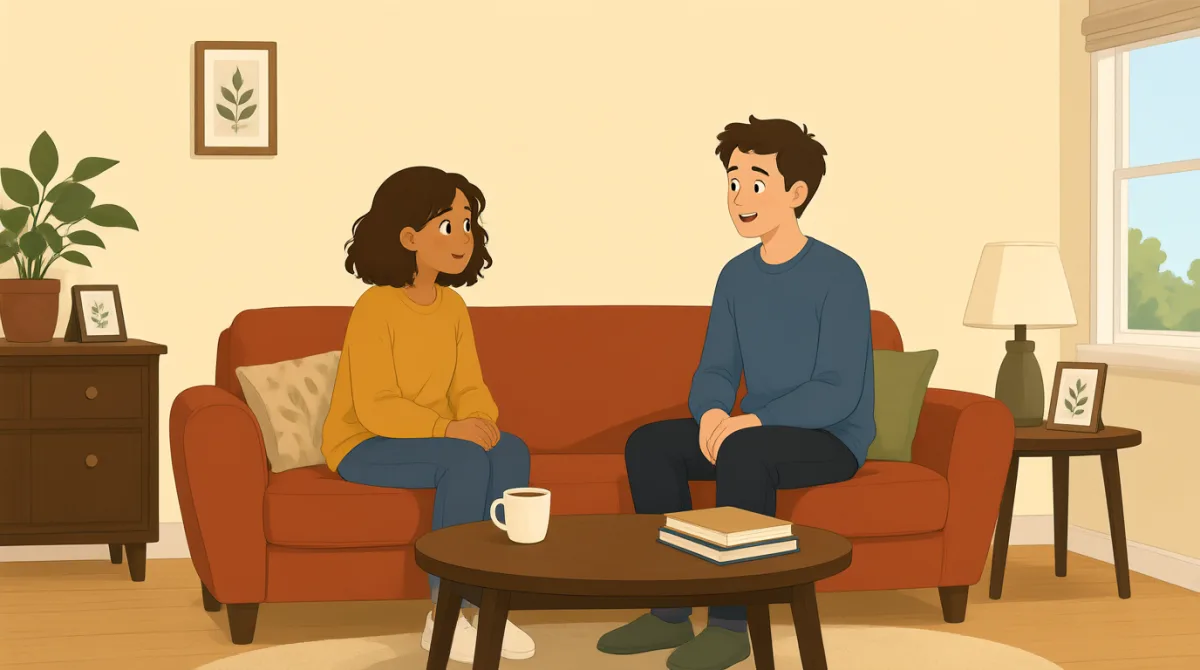

Morning, Jack. I’m getting ready to check out. What time should I be out of the rental?
Morgen, Jack. Ich mache mich gerade zum Auschecken fertig. Bis wann muss ich aus der Ferienunterkunft raus sein?

Good morning! Checkout is by eleven. Just make sure the front door is locked when you leave.
Guten Morgen! Der Check-out ist bis elf. Denk nur daran, die Haustür abzuschließen, wenn du gehst.
Sounds good. Should I leave the key in the lockbox, or hand it to you?
Alles klar. Soll ich den Schlüssel in der Schlüsselbox lassen oder ihn dir geben?
Please put it back in the lockbox and scramble the code afterward. That way, it stays secure.
Leg ihn bitte wieder in die Schlüsselbox und verstell danach den Code. So ist der Schlüssel sicher.
Got it. Do you want me to take out the trash or strip the bed before I go?
Verstanden. Soll ich noch den Müll rausbringen oder das Bett abziehen, bevor ich gehe?
No need to strip the bed. Just leave the trash in the kitchen bin, and I’ll take care of it.
Du musst das Bett nicht abziehen. Lass den Müll einfach im Küchenmülleimer, darum kümmere ich mich.
Thanks for making everything easy. I had a really comfortable stay, and the hot water repair was quick.
Danke, dass du alles so einfach gemacht hast. Ich hatte einen wirklich angenehmen Aufenthalt, und das Problem mit dem Warmwasser wurde schnell behoben.
I’m glad we got that sorted out. Thanks for letting me know about it right away.
Schön, dass wir das in den Griff bekommen haben. Danke, dass du mir gleich Bescheid gesagt hast.
I’ll leave you a review and mention the comfortable place and how quickly you fixed the problem.
Ich werde eine Bewertung für dich schreiben und den angenehmen Aufenthalt sowie erwähnen, wie schnell du das Problem behoben hast.
I appreciate that, Emma. Have a safe trip home, and you’re welcome back anytime.
Das weiß ich zu schätzen, Emma. Gute Heimreise, und du bist jederzeit wieder willkommen.
Wortschatz8
- check outauschecken
To leave a hotel or rental at the end of your stay. Here, Emma is asking about the time she needs to leave.
Ein Hotel oder eine Ferienunterkunft am Ende des Aufenthalts verlassen. Hier fragt Emma, wann sie gehen muss.
- lockboxSchlüsselbox
A secure box that holds a key and can be opened with a code. Guests can return the key to it after their stay.
Eine verschließbare Box, in der ein Schlüssel aufbewahrt wird und die sich mit einem Code öffnen lässt. Gäste können den Schlüssel nach ihrem Aufenthalt dort zurücklegen.
- scramble the codeden Code verstellen
To change the numbers on a lockbox so the code is no longer visible. This helps keep the key secure.
Die Zahlen an einer Schlüsselbox so verändern, dass der Code nicht mehr zu sehen ist. So bleibt der Schlüssel sicher.
- strip the beddas Bett abziehen
To remove the sheets and other bedding. Jack says Emma does not need to do this before leaving.
Bettlaken und andere Bettwäsche abnehmen. Jack sagt, dass Emma das vor ihrer Abreise nicht machen muss.
- take care of itsich darum kümmern
To handle or deal with something. Jack says he will take care of the trash.
Etwas erledigen oder sich um etwas kümmern. Jack sagt, dass er den Müll übernimmt.
- sorted outin den Griff bekommen
Fixed or dealt with successfully. Jack uses this phrase to talk about the hot water problem.
Ein Problem erfolgreich beheben oder sich darum kümmern. Jack verwendet diese Wendung für das Warmwasserproblem.
- right awaysofort
Immediately or very soon. Emma told Jack about the problem as soon as she noticed it.
Unverzüglich oder sehr bald. Emma hat Jack von dem Problem erzählt, sobald sie es bemerkt hat.
- safe trip homeGute Heimreise
A friendly way to wish someone a safe journey. Jack says this as Emma is leaving.
Ein freundlicher Wunsch für eine sichere Reise. Jack sagt das, als Emma abreist.
Wichtige Sätze8
- 1
What time should I be out of the rental?
Bis wann muss ich aus der Ferienunterkunft raus sein?
Use this to ask when you need to leave a rental or other place. You can replace “the rental” with “the hotel room” or another place.
Mit „What time should I be out of the rental?“ fragst du, wann du eine Ferienunterkunft oder einen anderen Ort verlassen musst. Du kannst „the rental“ durch „the hotel room“ oder einen anderen Ort ersetzen.
- 2
Should I leave the key in the lockbox, or hand it to you?
Soll ich den Schlüssel in der Schlüsselbox lassen oder ihn dir geben?
This is a polite way to ask how to return something. Replace “the key” with another item you need to hand back.
Mit „Should I leave the key in the lockbox, or hand it to you?“ fragst du höflich, wie du etwas zurückgeben sollst. Ersetze „the key“ durch einen anderen Gegenstand, den du zurückgeben musst.
- 3
No need to strip the bed.
Du musst das Bett nicht abziehen.
This short phrase tells someone that a task is unnecessary. You can use “No need to” before other actions, such as “No need to wait.”
Mit „No need to strip the bed.“ sagst du kurz, dass jemand eine bestimmte Aufgabe nicht erledigen muss. Du kannst „No need to“ auch vor andere Tätigkeiten setzen, zum Beispiel „No need to wait.“
- 4
Just leave the trash in the kitchen bin, and I’ll take care of it.
Lass den Müll einfach im Küchenmülleimer, darum kümmere ich mich.
Use this to give a simple instruction and reassure someone that you will handle the task. You can change “the trash” and “the kitchen bin” to fit the situation.
Mit „Just leave the trash in the kitchen bin, and I’ll take care of it.“ gibst du eine einfache Anweisung und versicherst der anderen Person, dass du dich darum kümmerst. Du kannst „the trash“ und „the kitchen bin“ passend zur Situation ersetzen.
- 5
I had a really comfortable stay, and the hot water repair was quick.
Ich hatte einen wirklich angenehmen Aufenthalt, und das Problem mit dem Warmwasser wurde schnell behoben.
This is useful for sharing positive feedback about a rental or service. Replace the details with what you liked and what was handled well.
„I had a really comfortable stay, and the hot water repair was quick.“ eignet sich, um positives Feedback zu einer Unterkunft oder einem Service zu geben. Ersetze die Einzelheiten durch das, was dir gefallen hat und was gut erledigt wurde.
- 6
I’m glad we got that sorted out.
Schön, dass wir das in den Griff bekommen haben.
Use this when a problem has been fixed or successfully handled. “That” can refer to a specific issue mentioned earlier.
„I’m glad we got that sorted out.“ kannst du sagen, wenn ein Problem behoben oder erfolgreich geklärt wurde. „That“ kann sich auf ein bestimmtes Problem beziehen, das zuvor erwähnt wurde.
- 7
I’ll leave you a review and mention the comfortable place and how quickly you fixed the problem.
Ich werde eine Bewertung für dich schreiben und den angenehmen Aufenthalt sowie erwähnen, wie schnell du das Problem behoben hast.
This is a clear way to tell someone what you plan to include in a review. You can mention other positive details instead.
Mit „I’ll leave you a review and mention the comfortable place and how quickly you fixed the problem.“ kannst du klar sagen, was du in einer Bewertung erwähnen möchtest. Du kannst stattdessen auch andere positive Einzelheiten nennen.
- 8
Have a safe trip home, and you’re welcome back anytime.
Gute Heimreise, und du bist jederzeit wieder willkommen.
This is a warm way to say goodbye to a guest. Use “Have a safe trip” for someone who is traveling.
„Have a safe trip home, and you’re welcome back anytime.“ ist eine herzliche Art, sich von einem Gast zu verabschieden. „Have a safe trip“ kannst du zu jemandem sagen, der eine Reise antritt.