Trying On Shoes
Schuhe anprobieren
Mia helps her child try on a pair of shoes. Grace checks that they fit well and feel comfortable.
Mia hilft ihrem Kind, ein Paar Schuhe anzuprobieren. Grace prüft, ob sie gut sitzen und bequem sind.
Dialog8
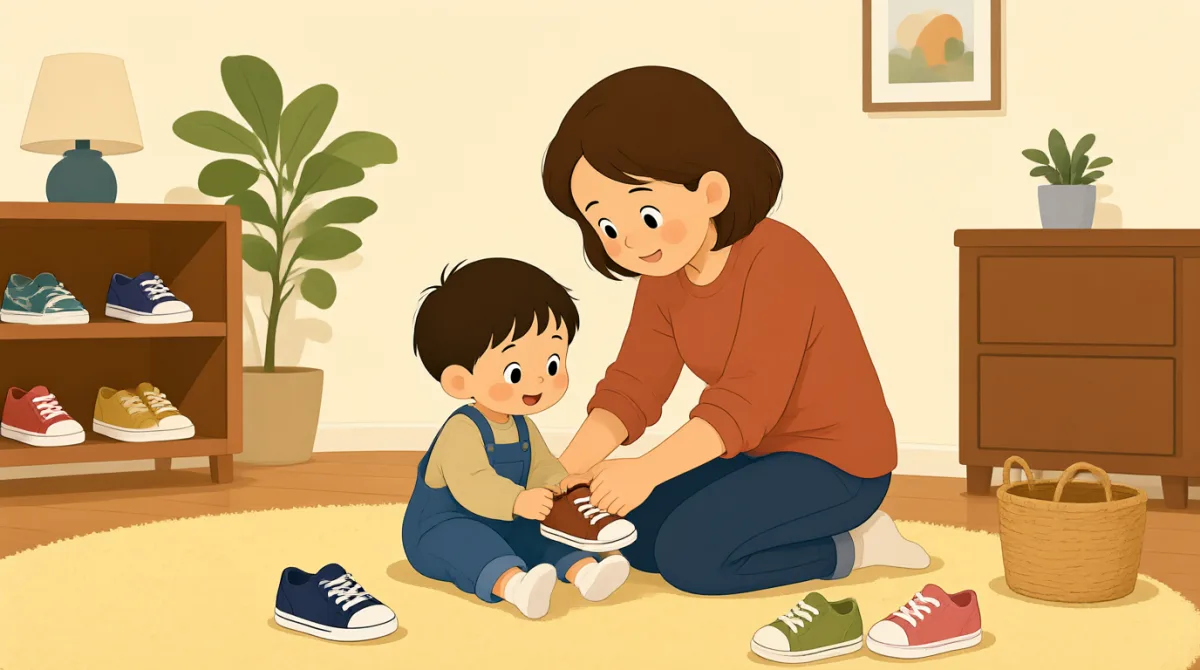

Could my child try on these shoes? They look just right.
Könnte mein Kind diese Schuhe anprobieren? Sie sehen genau richtig aus.

Of course. Have them sit here, and I’ll bring a few sizes.
Natürlich. Lass dein Kind hier sitzen, ich hole ein paar Größen.
Thanks. This is the size they usually wear.
Danke. Diese Größe trägt mein Kind normalerweise.
Let’s try them on. Are the toes touching the front?
Probieren wir sie an. Berühren die Zehen vorne den Schuh?
No, there’s a little room. They say the shoes feel comfortable.
Nein, es ist noch ein bisschen Platz. Mein Kind sagt, die Schuhe sind bequem.
Good. Can they walk around in them for a moment?
Gut. Kann dein Kind damit kurz herumgehen?
Sure. They’re walking now, and the shoes stay on well.
Klar. Es läuft gerade herum, und die Schuhe bleiben gut an den Füßen.
Great! They fit well and don’t seem too tight.
Super! Sie passen gut und scheinen nicht zu eng zu sein.
Wortschatz8
- try onanprobieren
To put on clothes or shoes to see if they fit. You can say, “Can I try on these shoes?”
Kleidung oder Schuhe anziehen, um zu sehen, ob sie passen. Du kannst sagen: „Can I try on these shoes?“ (Kann ich diese Schuhe anprobieren?)
- a few sizesein paar Größen
More than one size. A shop assistant may bring a few sizes so you can find the best fit.
Mehr als eine Größe. Eine Verkäuferin oder ein Verkäufer kann ein paar Größen holen, damit du die beste Passform findest.
- usually wearnormalerweise tragen
The size someone wears most of the time. You can use this phrase when telling a shop assistant your usual size.
Die Größe, die jemand die meiste Zeit trägt. Mit dieser Wendung kannst du einer Verkäuferin oder einem Verkäufer sagen, welche Größe du normalerweise trägst.
- toesZehen
The parts at the ends of your feet. When trying on shoes, check that your toes have enough room.
Die Teile vorne an deinen Füßen. Wenn du Schuhe anprobierst, solltest du prüfen, ob deine Zehen genug Platz haben.
- a little roomein bisschen Platz
A small amount of extra space. Use this phrase to say the shoes are not too small.
Ein kleiner zusätzlicher Freiraum. Mit dieser Wendung kannst du sagen, dass die Schuhe nicht zu klein sind.
- walk aroundherumgehen
To walk in an area for a short time. You can walk around in new shoes to see how they feel.
Für kurze Zeit in einem Bereich umhergehen. In neuen Schuhen kannst du herumgehen, um zu sehen, wie sie sich anfühlen.
- stay onanbleiben
To remain in place without coming off. Shoes should stay on when you walk.
An Ort und Stelle bleiben und nicht abgehen. Schuhe sollten beim Gehen an den Füßen bleiben.
- too tightzu eng
So close or small that it feels uncomfortable. You can use this phrase to describe shoes that do not fit well.
So eng oder klein, dass es unbequem ist. Mit dieser Wendung kannst du Schuhe beschreiben, die nicht gut passen.
Wichtige Sätze7
- 1
Could my child try on these shoes?
Könnte mein Kind diese Schuhe anprobieren?
Use this polite question to ask if someone can try on shoes or clothes. Replace “my child” with the person’s name or “I” to fit your situation.
Mit dieser höflichen Frage erkundigst du dich, ob jemand Schuhe oder Kleidung anprobieren kann. Ersetze „my child“ durch den Namen der Person oder durch „I“, je nachdem, was passt.
- 2
Have them sit here, and I’ll bring a few sizes.
Lass dein Kind hier sitzen, ich hole ein paar Größen.
This gives someone a simple instruction and explains what you will do next. “I’ll bring…” is useful when offering to get something.
Damit gibst du jemandem eine einfache Anweisung und sagst, was du als Nächstes tun wirst. „I’ll bring…“ ist nützlich, wenn du anbietest, etwas zu holen.
- 3
This is the size they usually wear.
Diese Größe trägt mein Kind normalerweise.
Use this sentence to tell a shop assistant someone’s usual size. You can replace “they” with “I,” “he,” or “she.”
Mit diesem Satz sagst du einer Verkäuferin oder einem Verkäufer, welche Größe jemand normalerweise trägt. Du kannst „they“ durch „I“, „he“ oder „she“ ersetzen.
- 4
Are the toes touching the front?
Berühren die Zehen vorne den Schuh?
This question checks whether shoes are too small. You can ask it when helping someone try on shoes.
Mit dieser Frage prüfst du, ob die Schuhe zu klein sind. Du kannst sie stellen, wenn du jemandem beim Anprobieren hilfst.
- 5
They say the shoes feel comfortable.
Mein Kind sagt, die Schuhe sind bequem.
Use this sentence to report how someone feels about a pair of shoes. You can replace “comfortable” with another feeling, such as “tight.”
Mit diesem Satz gibst du wieder, wie jemand ein Paar Schuhe findet. Du kannst „comfortable“ durch ein anderes Gefühl ersetzen, zum Beispiel durch „tight“.
- 6
Can they walk around in them for a moment?
Kann dein Kind damit kurz herumgehen?
This is a polite way to ask someone to test shoes by walking. “For a moment” means for a short time.
Das ist eine höfliche Art, jemanden zu bitten, die Schuhe beim Gehen auszuprobieren. „For a moment“ bedeutet für kurze Zeit.
- 7
They fit well and don’t seem too tight.
Sie passen gut und scheinen nicht zu eng zu sein.
Use this sentence to describe shoes that fit comfortably. You can replace “They” with another item, such as “These shoes.”
Mit diesem Satz beschreibst du Schuhe, die bequem passen. Du kannst „They“ durch einen anderen Gegenstand ersetzen, zum Beispiel durch „These shoes“.