Taking Off Glasses
Die Brille abnehmen
Jack explains that Emma needs to take off her glasses for the photo. He helps her get ready in front of the camera.
Jack erklärt Emma, dass sie für das Foto ihre Brille abnehmen muss. Er hilft ihr, sich vor der Kamera vorzubereiten.
Dialog8
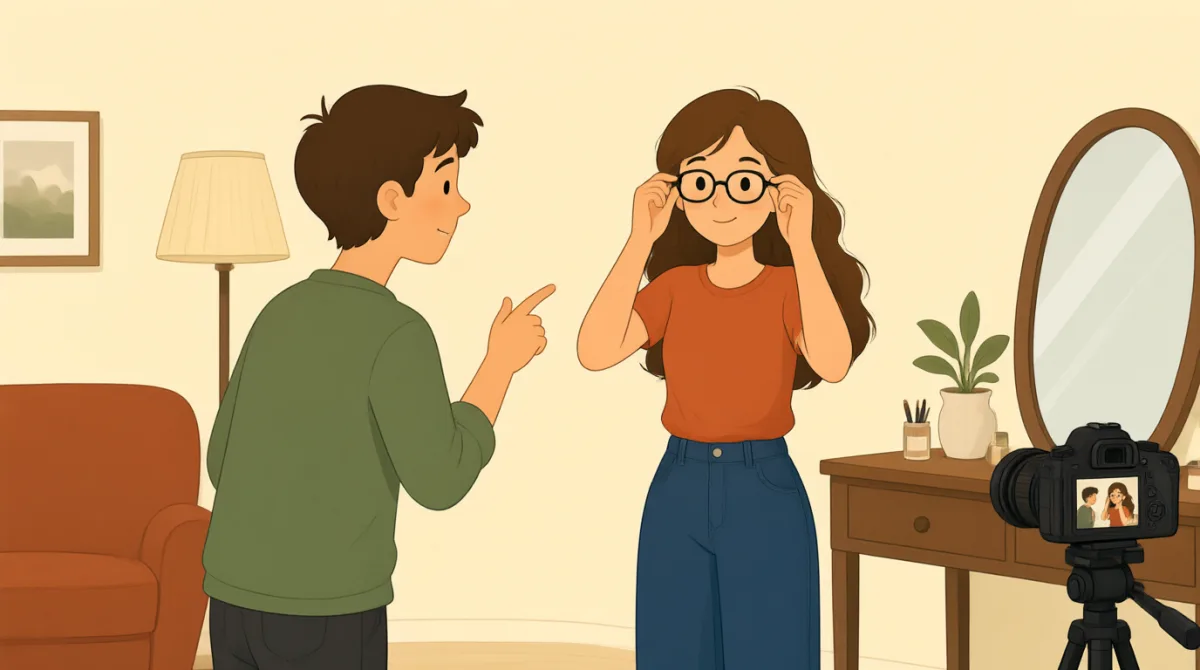

All right, Emma. Please take off your glasses before we take the photo.
Also gut, Emma. Bitte nimm deine Brille ab, bevor wir das Foto machen.

Oh, sure. Should I put them on the table?
Oh, klar. Soll ich sie auf den Tisch legen?
Yes, please. Then stand on the mark in front of the camera.
Ja, bitte. Stell dich dann auf die Markierung vor der Kamera.
Like this? I hope I’m standing in the right place.
So? Ich hoffe, ich stehe an der richtigen Stelle.
That’s right. Move a little closer to the camera, please.
Genau. Geh bitte ein Stück näher an die Kamera.
Okay. Should I look straight at the camera now?
Okay. Soll ich jetzt direkt in die Kamera schauen?
Yes. Keep your head straight, and I’ll get you ready.
Ja. Halte den Kopf gerade, dann mache ich dich fertig.
All right. Let me know when you’re ready to take it.
Alles klar. Sag mir Bescheid, wenn du bereit bist, das Foto zu machen.
Wortschatz8
- take off your glassesdie Brille abnehmen
This means to remove your glasses. Use “take off” when you remove something you are wearing.
Das bedeutet, die Brille abzusetzen. „take off“ verwendest du, wenn du etwas ausziehst oder abnimmst, das du gerade trägst.
- put them on the tablesie auf den Tisch legen
This means to place the glasses on the table. You can use “put [something] on [a place]” to say where you leave an object.
Das bedeutet, die Brille auf den Tisch zu legen. Mit „put [something] on [a place]“ kannst du sagen, wo du einen Gegenstand ablegst.
- stand on the marksich auf die Markierung stellen
This means to stand on the spot marked on the floor. It is useful when someone tells you where to stand.
Das bedeutet, sich auf die Stelle zu stellen, die auf dem Boden markiert ist. Die Wendung ist hilfreich, wenn dir jemand sagt, wo du stehen sollst.
- in front of the cameravor der Kamera
This means in the place facing the camera. You can use “in front of” to describe where someone or something is.
Das bedeutet, an der Stelle zu sein, von der aus man in Richtung Kamera schaut. Mit „in front of“ kannst du beschreiben, wo sich jemand oder etwas befindet.
- a little closerein Stück näher
This means slightly nearer. Use it to ask someone to move nearer without going too far.
Das bedeutet, etwas näher. Damit kannst du jemanden bitten, näher zu kommen, ohne dass die Person zu weit geht.
- look straight at the cameradirekt in die Kamera schauen
This means to face the camera and look directly at it. It is a useful instruction for taking photos.
Das bedeutet, sich zur Kamera auszurichten und direkt hineinzuschauen. Das ist eine nützliche Anweisung beim Fotografieren.
- keep your head straightden Kopf gerade halten
This means to hold your head upright and not tilt it. It is a simple instruction for posing for a photo.
Das bedeutet, den Kopf aufrecht zu halten und nicht zur Seite zu neigen. Das ist eine einfache Anweisung für eine Fotopose.
- Let me know when you’re ready to take it.Let me know when you’re ready to take it.
This means to tell me when you are ready to take the photo. You can use “Let me know when…” to ask someone to tell you when something happens.
Das bedeutet: Sag mir, wenn du bereit bist, das Foto zu machen. Mit „Let me know when…“ kannst du jemanden bitten, dir Bescheid zu sagen, wenn etwas passiert.
Wichtige Sätze8
- 1
Please take off your glasses before we take the photo.
Bitte nimm deine Brille ab, bevor wir das Foto machen.
Use this polite sentence to ask someone to remove their glasses before a photo. You can replace “your glasses” with another item of clothing or accessory.
Mit diesem höflichen Satz bittest du jemanden, vor einem Foto die Brille abzunehmen. Du kannst „your glasses“ durch ein anderes Kleidungsstück oder Accessoire ersetzen.
- 2
Should I put them on the table?
Soll ich sie auf den Tisch legen?
Use “Should I…?” to ask what you ought to do. “Them” refers to the glasses, and you can replace it with another object.
Mit „Should I…?“ fragst du, was du tun sollst. „Them“ bezieht sich auf die Brille. Du kannst es durch einen anderen Gegenstand ersetzen.
- 3
Then stand on the mark in front of the camera.
Stell dich dann auf die Markierung vor der Kamera.
This gives someone a clear direction about where to stand. You can change the place or object to give other simple instructions.
Damit sagst du jemandem klar, wo die Person stehen soll. Du kannst den Ort oder Gegenstand ändern, um andere einfache Anweisungen zu geben.
- 4
I hope I’m standing in the right place.
Ich hoffe, ich stehe an der richtigen Stelle.
Use this sentence when you are unsure whether you are in the correct spot. You can replace “standing” with another action, such as “waiting” or “sitting.”
Diesen Satz verwendest du, wenn du nicht sicher bist, ob du an der richtigen Stelle bist. Du kannst „standing“ durch eine andere Tätigkeit ersetzen, zum Beispiel „waiting“ oder „sitting“.
- 5
Move a little closer to the camera, please.
Geh bitte ein Stück näher an die Kamera.
This is a polite way to ask someone to come nearer. Replace “the camera” with the person or place they should move closer to.
So bittest du jemanden höflich, näher zu kommen. Ersetze „the camera“ durch die Person oder den Ort, dem die Person näher kommen soll.
- 6
Should I look straight at the camera now?
Soll ich jetzt direkt in die Kamera schauen?
Use this question to check what you should do next. You can replace “look straight at the camera” with another action.
Mit dieser Frage kannst du nachfragen, was du als Nächstes tun sollst. Du kannst „look straight at the camera“ durch eine andere Tätigkeit ersetzen.
- 7
Keep your head straight, and I’ll get you ready.
Halte den Kopf gerade, dann mache ich dich fertig.
This combines an instruction with an offer to help. You can use “Keep your…” to give someone a simple direction.
Dieser Satz verbindet eine Anweisung mit dem Angebot zu helfen. Mit „Keep your…“ kannst du jemandem eine einfache Anweisung geben.
- 8
Let me know when you’re ready to take it.
Sag mir Bescheid, wenn du bereit bist, das Foto zu machen.
Use this to ask someone to tell you when they are ready. Here, “it” means the photo; in other situations, it can refer to another activity or item.
Mit diesem Satz bittest du jemanden, dir zu sagen, wenn die Person bereit ist. Hier bedeutet „it“ das Foto; in anderen Situationen kann es sich auf eine andere Tätigkeit oder einen anderen Gegenstand beziehen.