Playing a Game
Ein Spiel spielen
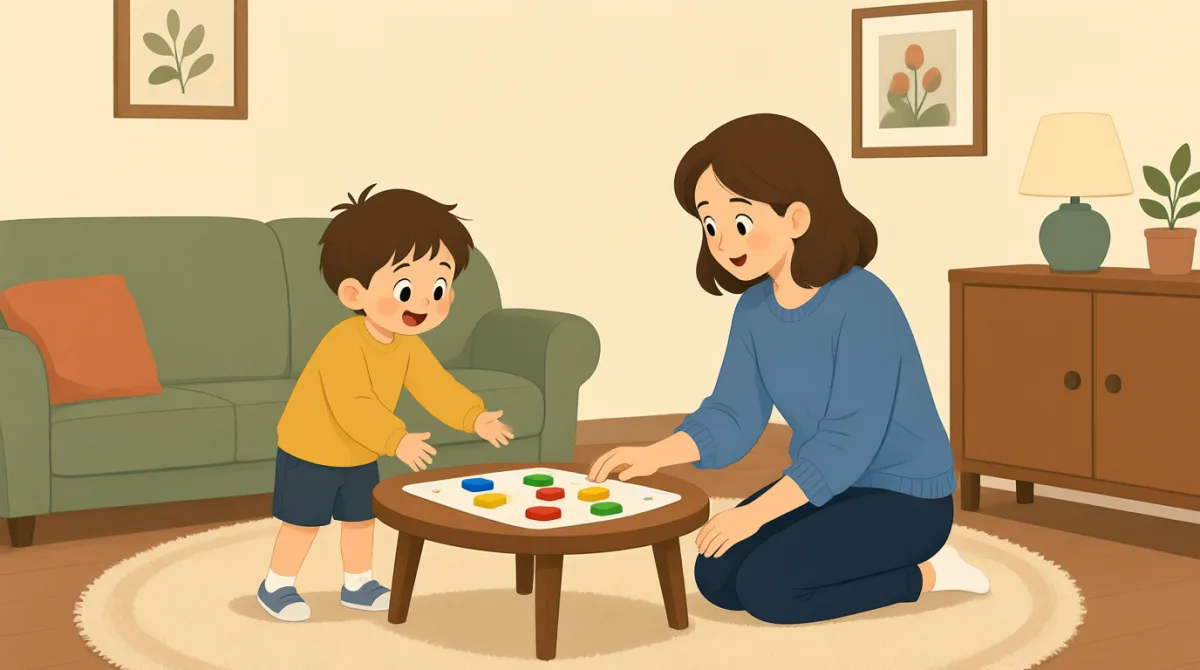
After dinner, Emma and the child play a simple game at home. The child gets excited, and Emma gently reminds them to take turns.
Nach dem Abendessen spielen Emma und das Kind zu Hause ein einfaches Spiel. Das Kind wird ganz aufgeregt, und Emma erinnert es sanft daran, sich abzuwechseln.
Dialog8

What should we play after dinner? I found a picture game.
Was sollen wir nach dem Abendessen spielen? Ich habe ein Bilder-Spiel gefunden.

That sounds fun. Let’s take turns picking a card.
Das klingt lustig. Lass uns abwechselnd eine Karte ziehen.
Great! I’ll go first. Oh, I got a picture of a dog.
Super! Ich fange an. Oh, ich habe ein Bild von einem Hund gezogen.
I know that one! It says, “Find something red.”
Das kenne ich! Da steht: „Finde etwas Rotes.“
You found the red ball! Now it’s my turn to pick a card.
Du hast den roten Ball gefunden! Jetzt bin ich dran, eine Karte zu ziehen.
Wait, I want another turn! This game is so exciting.
Warte, ich will noch mal dran sein! Das Spiel ist so spannend.
I’m glad you like it. Let’s take turns, so we both get to play.
Schön, dass es dir gefällt. Lass uns abwechseln, damit wir beide spielen können.
Okay, your turn. Then I can pick the next card.
Okay, du bist dran. Danach kann ich die nächste Karte ziehen.
Wortschatz8
- take turnssich abwechseln
To take turns means to do something one at a time. Use it when people share an activity.
“To take turns” bedeutet, etwas abwechselnd zu tun. Du kannst den Ausdruck verwenden, wenn mehrere Personen bei einer Aktivität an der Reihe sind.
- pick a cardeine Karte ziehen
To pick a card means to choose one from a group. You can use this phrase in card games.
“To pick a card” bedeutet, eine Karte aus mehreren auszuwählen. Den Ausdruck kannst du bei Kartenspielen verwenden.
- go firstals Erste:r anfangen
To go first means to do something before the other person. Use it to say who starts a game or activity.
“To go first” bedeutet, etwas vor der anderen Person zu tun. Verwende den Ausdruck, wenn du sagen möchtest, wer ein Spiel oder eine Aktivität beginnt.
- I got a picture of a dog.Ich habe ein Bild von einem Hund gezogen.
This tells someone what picture you found on a card. You can use “I got a picture of…” to describe a game card.
Damit sagst du jemandem, welches Bild du auf einer Karte gefunden hast. Mit “I got a picture of…” kannst du beschreiben, was auf einer Spielkarte zu sehen ist.
- I know that one!Das kenne ich!
This means you recognize or understand something. Say it when you know the answer or have seen something before.
“I know that one!” bedeutet, dass du etwas erkennst oder verstehst. Sag das, wenn du die Antwort weißt oder etwas schon einmal gesehen hast.
- another turnnoch mal dran sein
Another turn means one more chance to do something in a game. You can ask for another turn when you want to play again.
“Another turn” bedeutet, dass du bei einem Spiel noch eine Gelegenheit bekommst, etwas zu tun. Du kannst darum bitten, noch mal dranzukommen, wenn du weiterspielen möchtest.
- I’m glad you like it.Schön, dass es dir gefällt.
Use this to show that you feel happy someone enjoys something. It works well when sharing a game, food, or activity.
Mit “I’m glad you like it.” zeigst du, dass du dich freust, weil jemandem etwas gefällt. Das passt gut, wenn ihr ein Spiel, Essen oder eine andere Aktivität miteinander teilt.
- your turndu bist dran
This tells someone it is their time to play or do something. You can use it to pass an activity to another person.
Damit sagst du jemandem, dass die Person jetzt spielen oder etwas tun kann. Mit “your turn” gibst du einer anderen Person den Vortritt.
Wichtige Sätze8
- 1
What should we play after dinner?
Was sollen wir nach dem Abendessen spielen?
This is a friendly way to ask what activity someone wants to do. You can replace “play” with another activity, such as “watch” or “do.”
Mit “What should we play after dinner?” fragst du auf freundliche Weise, was die andere Person gern machen möchte. Du kannst “play” durch eine andere Aktivität ersetzen, zum Beispiel “watch” oder “do”.
- 2
Let’s take turns picking a card.
Lass uns abwechselnd eine Karte ziehen.
This suggests sharing a game fairly. You can use “Let’s take turns…” for other activities, such as choosing a song or using a toy.
Mit “Let’s take turns picking a card.” schlägst du vor, das Spiel fair miteinander zu teilen. “Let’s take turns…” kannst du auch bei anderen Aktivitäten verwenden, etwa wenn ihr abwechselnd ein Lied auswählt oder mit einem Spielzeug spielt.
- 3
I’ll go first.
Ich fange an.
This is a simple way to say you want to start. Use “I’ll” plus an action to say what you will do first.
“I’ll go first.” ist eine einfache Möglichkeit zu sagen, dass du anfangen möchtest. Mit “I’ll” plus einer Handlung sagst du, was du zuerst tun wirst.
- 4
You found the red ball!
Du hast den roten Ball gefunden!
This praises someone for finding the right thing. You can replace “the red ball” with the item they found.
Mit “You found the red ball!” lobst du jemanden dafür, das Richtige gefunden zu haben. Du kannst “the red ball” durch den Gegenstand ersetzen, den die Person gefunden hat.
- 5
Now it’s my turn to pick a card.
Jetzt bin ich dran, eine Karte zu ziehen.
This tells someone that you are ready to take your turn. Use “It’s my turn to…” before an action in a game or shared activity.
Mit “Now it’s my turn to pick a card.” sagst du, dass du bereit bist, an die Reihe zu kommen. Verwende “It’s my turn to…” vor einer Handlung bei einem Spiel oder einer Aktivität, die ihr gemeinsam macht.
- 6
I’m glad you like it.
Schön, dass es dir gefällt.
This is a warm response when someone enjoys something you chose. You can use it for games, meals, or other activities.
“I’m glad you like it.” ist eine herzliche Antwort, wenn jemandem etwas gefällt, das du ausgesucht hast. Du kannst den Satz bei Spielen, Mahlzeiten oder anderen Aktivitäten verwenden.
- 7
Let’s take turns, so we both get to play.
Lass uns abwechseln, damit wir beide spielen können.
This gently reminds someone to share the game. “So we both get to…” explains how taking turns helps everyone.
Mit “Let’s take turns, so we both get to play.” erinnerst du jemanden sanft daran, das Spiel mit dir zu teilen. “So we both get to…” erklärt, wie das Abwechseln allen die Möglichkeit gibt, mitzumachen.
- 8
Okay, your turn.
Okay, du bist dran.
This is a short, natural way to let someone know they can play next. Use it when passing a turn in a game.
“Okay, your turn.” ist eine kurze, natürliche Art, jemandem zu sagen, dass die Person als Nächstes spielen kann. Verwende den Satz, wenn du bei einem Spiel den Zug weitergibst.