Going Through Security Check
透過安檢
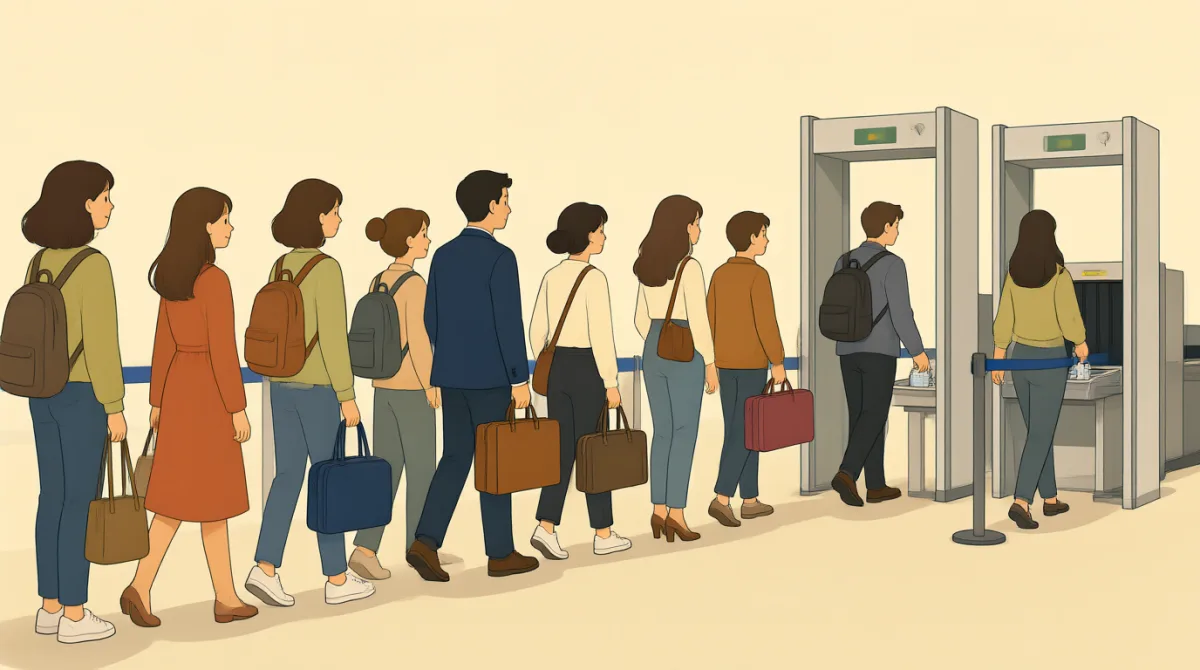
Passengers line up for the security check, placing carry-on items, electronics, and liquids in trays for X-ray screening and walking through metal detectors or body scanners.
旅客排隊等候安檢,將隨身物品、電子產品和液體放入托盤進行X光安檢,並走過金屬探測器或人體掃描器。
對話8

Next passenger, please. Do you have any liquids or electronics in your carry-on?
下一位旅客請過來。您的隨身行李裡有液體或電子產品嗎?

Yes, I have a laptop and a small bottle of hand sanitizer. Should I take them out?
是的,我有一個膝上型電腦和一小瓶洗手液。需要把它們拿出來嗎?
Yes, please take out your laptop and place it in a separate tray. The hand sanitizer needs to go into a clear, resealable bag along with any other liquids, and it has to be 100ml or less.
是的,請取出您的膝上型電腦,單獨放在一個托盤裡。洗手液和其他液體一樣,需要放入一個透明的、可重複密封的袋子裡,並且必須是100毫升或更少。
Okay, got it. What about my shoes? Do I need to take them off?
好的,明白了。那我的鞋子呢?需要脫掉嗎?
For this lane, yes, please remove your shoes and place them in a tray as well. Empty your pockets into a tray too.
對於這條安檢通道,是的,請脫掉您的鞋子也放在一個托盤裡。口袋裡的東西也請清空放在托盤裡。
Alright, shoes off, pockets emptied. Anything else?
好的,鞋子脫了,口袋清空了。還有別的嗎?
No, that should be everything. Once you've placed all your items in the trays, you can proceed through the body scanner.
不,應該就這些了。把所有物品都放在托盤裡後,您就可以透過人體掃描器了。
Thanks for your help!
謝謝您的幫助!
詞彙8
- carry-on隨身行李
A carry-on is a small bag or luggage you take with you onto the airplane, not checked into the cargo hold. Use it when talking about airport bags.
“carry-on”指可以帶上飛機的小包或行李,不需要託運。談到機場行李時可以用這個詞。
- liquids液體
Liquids are things like water, lotion, or sanitizer that are in liquid form. At security, remember the 100ml rule for carry-ons.
“liquids”指水、乳液或免洗洗手液這類液態物品。在機場安檢時,記得隨身攜帶的液體不得超過100毫升。
- electronics電子產品
Electronics are devices like phones, laptops, or chargers that use electricity. You often need to remove them at airport security for screening.
“electronics”指手機、膝上型電腦或充電器這類使用電力的裝置。在機場安檢時,通常需要把它們取出來單獨檢查。
- laptop膝上型電腦
A laptop is a portable computer you can carry around. It's common to take it out separately during security checks.
“laptop”指可以隨身攜帶的行動式電腦。過安檢時,通常需要把它單獨取出來。
- hand sanitizer免洗洗手液
Hand sanitizer is a liquid gel used to clean your hands without water. In small amounts, it's allowed in carry-ons but must follow liquid rules.
“hand sanitizer”是一種不用水就能清潔雙手的液體或凝膠。少量可以帶上飛機,但必須遵守液體攜帶規定。
- tray托盤
A tray is a flat container used at security to hold your items for X-ray scanning. Place belongings like shoes or electronics in it.
“tray”指安檢時用來放置物品、供X光掃描的平盤。鞋子或電子產品等物品都可以放進去。
- resealable bag可重複密封袋
A resealable bag is a plastic bag with a zipper that can be closed and opened multiple times. Use a clear one for liquids at airport security.
“resealable bag”指帶拉鍊、可以反覆開啟和封上的塑膠袋。在機場安檢時,液體要放進透明的這種袋子裡。
- body scanner人體掃描器
A body scanner is a machine at security that checks for hidden items on your body using waves, not metal. You walk through it after trays are scanned.
“body scanner”是安檢時用來檢查身上是否藏有物品的裝置,它透過電磁波而不是金屬探測來進行掃描。托盤透過掃描後,旅客需要走過這臺裝置。
關鍵句7
- 1
Do you have any liquids or electronics in your carry-on?
您的隨身行李裡有液體或電子產品嗎?
This is a polite question from security to check for restricted items. It's useful for asking about contents in bags. Notice the use of 'any' for questions about existence.
這是安檢人員禮貌地詢問是否有違禁物品。詢問包裡有沒有某些東西時很實用。注意,問某樣東西是否存在時會用“any”。
- 2
Should I take them out?
我需要把它們拿出來嗎?
This asks for permission or confirmation on an action. 'Should I' is a common way to seek advice or instructions, helpful in situations needing guidance like at airports.
這句話是在詢問是否應該做某件事,或確認具體要求。“Should I”常用來徵求建議或詢問指示,在機場這類需要明確指引的場合很有用。
- 3
Yes, please take out your laptop and place it in a separate tray.
是的,請取出您的膝上型電腦,單獨放在一個托盤裡。
This gives instructions politely with 'please.' It's useful for following security rules. The imperative 'take out' and 'place' shows command forms in polite requests.
這句話用“please”禮貌地提出指示,適合用於說明安檢要求。“take out”和“place”是祈使句,用來禮貌地告訴對方要做什麼。
- 4
What about my shoes? Do I need to take them off?
那我的鞋子呢?我需要脫掉嗎?
This inquires about additional requirements. 'What about' introduces a new topic, and 'Do I need to' asks if something is necessary, common in procedural conversations.
這句話是在詢問還有沒有其他要求。“What about”用來引出一個新話題;“Do I need to”則是詢問某件事是否有必要,在詢問流程要求時很常見。
- 5
For this lane, yes, please remove your shoes and place them in a tray as well.
這條安檢通道需要,請脫掉鞋子,也放在一個托盤裡。
This specifies conditions ('for this lane') and gives steps. 'As well' means 'also,' useful for adding items. Imperatives like 'remove' and 'place' guide actions clearly.
這句話說明了適用的情況(“for this lane”),並給出具體步驟。“As well”表示“也”,可以用來補充要放入托盤的物品。“remove”和“place”這樣的祈使句能清楚地說明該怎麼做。
- 6
Empty your pockets into a tray too.
也請把口袋裡的東西都拿出來,放進托盤裡。
This is a direct instruction to remove items from pockets. 'Empty into' means to put contents out into something. 'Too' adds this to previous actions, practical for quick compliance.
這句話直接指示對方把口袋裡的物品取出來。“Empty into”表示把裡面的東西倒出或取出,放進某個容器裡。“Too”表示“也”,用來補充前面提到的步驟,方便對方快速照做。
- 7
No, that should be everything. Once you've placed all your items in the trays, you can proceed through the body scanner.
不用,應該就這些了。等您把所有物品都放進托盤後,就可以透過人體掃描器了。
This confirms completion and gives next steps. 'Should be' expresses expectation, and 'once you've' uses a time clause for sequence. Useful for wrapping up procedures.
這句話先確認安檢準備工作應該已經完成,再告知下一步。“Should be”表示預計如此;“once you've”引出一個時間條件,說明先完成一件事,再進行下一步。它很適合用來結束一段流程說明。