Setting Up the Tent
Çadırı Kurmak
Emma and Jack unpack their tent and try to put it up. They work together and follow the instructions.
Emma ve Jack çadırlarını çantadan çıkarıp kurmaya çalışıyor. Birlikte çalışıp talimatları izliyorlar.
Diyalog9
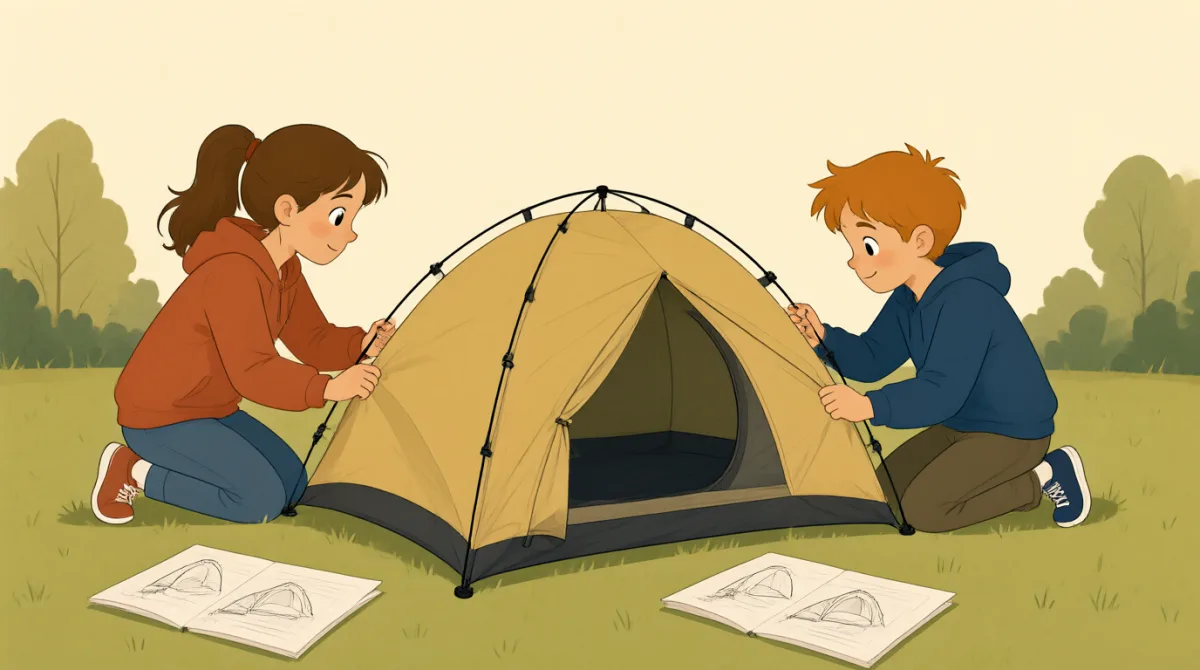

The tent is out of the bag. Which pieces should we use first?
Çadır çantadan çıktı. Önce hangi parçaları kullanmalıyız?

Let's check the instructions. First, we need to lay the tent flat.
Talimatlara bakalım. Önce çadırı yere düz bir şekilde sermemiz gerekiyor.
Okay, I’ll spread it out here. Is this the front door?
Tamam, buraya yayayım. Burası ön kapı mı?
Yes. Now connect these poles and push them through the loops.
Evet. Şimdi şu çubukları birbirine bağla ve halkalardan geçir.
This pole is a little stuck. Can you help me with it?
Bu çubuk biraz sıkıştı. Bana yardım eder misin?
Sure. Hold this end while I push the pole through.
Tabii. Ben çubuğu iterken şu ucundan tut.
Great, it’s standing up! Where do these small pegs go?
Harika, ayağa kalktı! Şu küçük kazıklar nereye takılıyor?
Put them through the loops at each corner, then push them into the ground.
Her köşedeki halkalardan geçir, sonra yere çak.
All done! The tent feels strong. Let’s put our bags inside.
İşimiz bitti! Çadır sağlam duruyor. Çantalarımızı içeri koyalım.
Kelime Bilgisi8
- lay the tent flatçadırı yere düz bir şekilde sermek
Put the tent on the ground so it is flat. You can use this phrase when you prepare something before setting it up.
Çadırı düz olacak şekilde yere koymak demek. Bir şeyi kurmadan önce hazırlarken bu ifadeyi kullanabilirsin.
- spread it outyaymak
Open the tent and make it cover a larger area. You can also spread out a blanket or a map.
Çadırı açıp daha geniş bir alana yaymak demek. Battaniyeyi ya da haritayı yaymak için de bu ifadeyi kullanabilirsin.
- connect these polesşu çubukları birbirine bağlamak
Join these tent poles together. Use “connect” when you attach two or more things.
Çadır çubuklarını birbirine eklemek demek. İki ya da daha fazla şeyi birleştirmekten söz ederken “connect” kullanılır.
- push them through the loopshalkalardan geçirmek
Move the poles through the small fabric loops. “Push something through” describes moving it from one side to the other.
Çubukları kumaştaki küçük halkaların içinden geçirmek demek. “Push something through”, bir şeyi bir taraftan diğer tarafa iterek geçirmek anlamına gelir.
- a little stuckbiraz sıkışmış
Not moving easily, but only slightly. You can say this when something is difficult to pull or move.
Kolay hareket etmiyor ama yalnızca biraz takılmış demek. Çekmesi ya da hareket ettirmesi zor olan şeyler için söyleyebilirsin.
- pegskazıklar
Small pointed pieces that hold the tent in place in the ground. They help keep the tent steady.
Çadırı yerde sabitleyen, ucu sivri küçük parçalar demek. Çadırın sabit durmasına yardımcı olurlar.
- at each cornerher köşede
At every corner of the tent. Use “each” to talk about every one in a group.
Çadırın bütün köşelerinde demek. “Each”, bir gruptaki her bir şeyden söz etmek için kullanılır.
- push them into the groundyere çakmak
Press the pegs down into the soil. You can use this phrase when putting something firmly into the ground.
Kazıkları toprağa bastırarak sokmak demek. Bir şeyi yere sağlamca yerleştirirken bu ifadeyi kullanabilirsin.
Önemli Cümleler8
- 1
Let's check the instructions.
Talimatlara bakalım.
This is a useful way to suggest looking at directions before starting a task. You can also say, “Let’s check the instructions for the game.”
Bir işe başlamadan önce yönergelere göz atmayı önermek için kullanışlı bir ifade. “Let’s check the instructions for the game.” (Oyunun talimatlarına bakalım.) da diyebilirsin.
- 2
First, we need to lay the tent flat.
Önce çadırı yere düz bir şekilde sermemiz gerekiyor.
This sentence explains the first step in a task. Reuse “First, we need to…” to describe what to do at the beginning.
Bu cümle, bir işin ilk adımını anlatır. Bir işe başlarken yapılması gerekenleri açıklamak için “First, we need to…” kalıbını kullanabilirsin.
- 3
Okay, I’ll spread it out here.
Tamam, buraya yayayım.
This sentence offers to do a simple task and says where you will do it. Use “I’ll spread it out” for things like a blanket or a map.
Bu cümle, basit bir işi yapmayı teklif eder ve nerede yapacağını söyler. Battaniye ya da harita gibi şeyler için “I’ll spread it out” diyebilirsin.
- 4
Can you help me with it?
Bana yardım eder misin?
This is a polite way to ask someone for help. You can use it when a task or object is difficult to manage.
Birinden yardım istemenin nazik bir yolu. Bir işi yapmak ya da bir şeyi idare etmek zor olduğunda kullanabilirsin.
- 5
Hold this end while I push the pole through.
Ben çubuğu iterken şu ucundan tut.
This gives someone a clear task to do at the same time as yours. Use “while” to connect two actions happening together.
Bu cümle, kendi işinle aynı anda karşıdaki kişinin yapacağı şeyi açıkça söyler. Aynı anda gerçekleşen iki eylemi bağlamak için “while” kullanılır.
- 6
Put them through the loops at each corner, then push them into the ground.
Her köşedeki halkalardan geçir, sonra yere çak.
This sentence gives simple instructions in the correct order. Use “then” to introduce the next step.
Bu cümle, basit talimatları doğru sırayla verir. Bir sonraki adımı anlatmak için “then” kullanılır.
- 7
The tent feels strong.
Çadır sağlam duruyor.
This describes how something seems when you touch or use it. You can also say, “The table feels strong.”
Bu cümle, bir şeye dokunduğunda ya da onu kullandığında nasıl göründüğünü anlatır. “The table feels strong.” (Masa sağlam duruyor.) da diyebilirsin.
- 8
Let’s put our bags inside.
Çantalarımızı içeri koyalım.
This is a friendly suggestion to move things into a place. Reuse “Let’s put our…” when suggesting a shared action.
Bir şeyleri bir yere taşımayı öneren samimi bir ifade. Birlikte yapılacak bir şeyi önerirken “Let’s put our…” kalıbını kullanabilirsin.